Your child reads الشَّمْس out loud and says ash-shams. You look at the word, and you can clearly see a letter sitting there that they did not say. Did they make a mistake, or is that supposed to happen?
That is the sun and moon letter rule, and this is the one Quran rule where the page and the sound disagree on purpose. It catches every parent who is following along without reading Arabic, because there is nothing visibly wrong to point at. This guide is written for that moment: what the rule is, how to hear it in one second, and where your child will meet it first.
What are sun and moon letters?
Arabic has one word for “the”. It is الـ, written in front of a noun, and in English we usually write it as al-. What happens to that al- depends entirely on the letter that comes next.
The 28 Arabic letters split into two equal halves of 14. After a sun letter, the “l” in al- goes silent and the next letter doubles instead, so الشَّمْس is said ash-shams and not al-shams. After a moon letter, the “l” is pronounced exactly as it looks, so الْقَمَر is said al-qamar. The lam is written either way. It is only the sound that changes.
In the Quran the two halves have proper names. The first is lam shamsiyyah, the solar lam, and the second is lam qamariyyah, the lunar lam. If your child is working through a Noorani Qaida, they will meet both of these long before they meet most of the other rules. Those other rules, and the order they usually arrive in, are in our guide to the Tajweed rules. The same rule is why a child says Ar-Rahmaan and As-Salaam, and it shapes eighteen of the 99 names of Allah.
Why can you not see this rule in the writing?
Here is the part that trips families up, and most explanations of this rule skip straight past it.
The lam does not disappear from the page. Look at الشَّمْس again. The ل is still printed, in full, exactly where it always was. Nothing has been removed and nothing has been crossed out. A reader who can see the letters but cannot yet hear the language will look at that word and conclude, reasonably, that a letter was skipped.
It was not skipped. It was merged. The lam has been folded into the letter after it, and the mark that records the merge is a small w-shape sitting above that next letter: ـّ, called a shadda. That tiny mark is the entire visible trace of the rule, and it is easy to miss on a phone screen or in a small print mushaf.
So the practical situation for a parent is this. Your child says one thing, the page shows another, and the only evidence that they were right is a mark about two millimetres wide. That is why this rule is worth ten minutes of your evening rather than being left to the teacher.
What are the 14 sun letters?
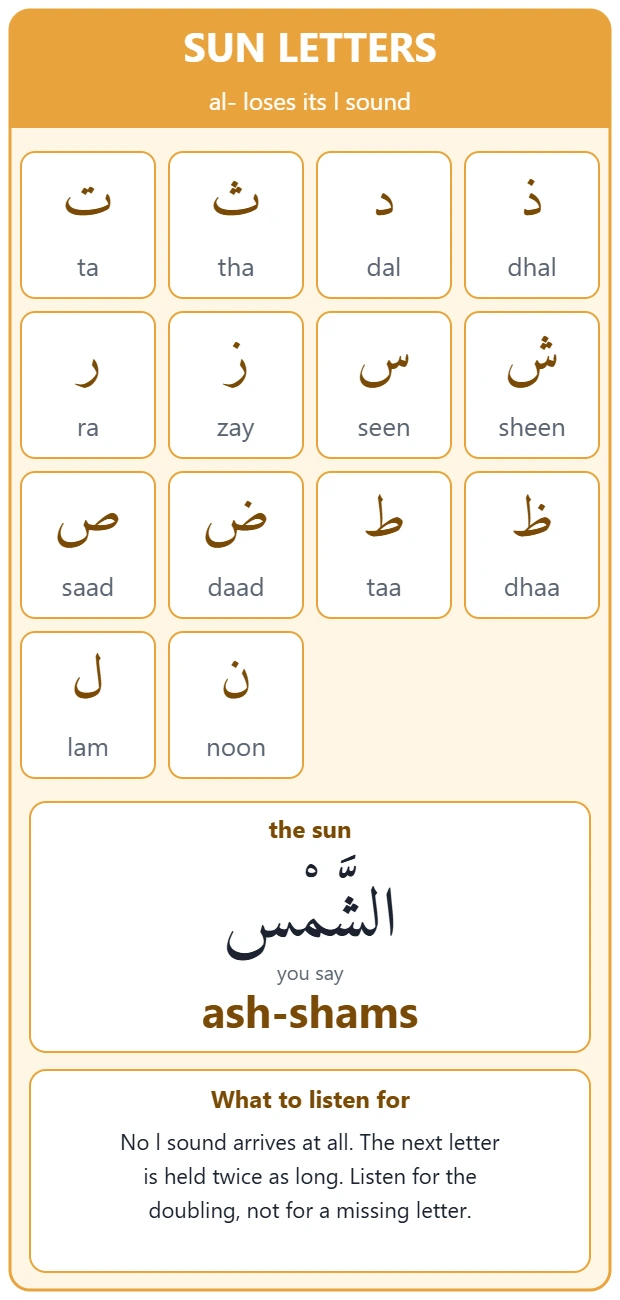
After these, the lam goes quiet and the letter that follows doubles. Read the last column out loud and you will hear it.
| Letter | Name | Written with “the” | What you say |
|---|---|---|---|
| ت | ta | التِّين | at-teen |
| ث | tha | الثَّاقِب | ath-thaaqib |
| د | dal | الدِّين | ad-deen |
| ذ | dhal | الذِّكْر | adh-dhikr |
| ر | ra | الرَّحْمٰن | ar-Rahmaan |
| ز | zay | الزَّيْتُون | az-zaytoon |
| س | seen | السَّمَاء | as-samaa |
| ش | sheen | الشَّمْس | ash-shams |
| ص | saad | الصَّلَاة | as-salaah |
| ض | daad | الضُّحَى | ad-duhaa |
| ط | taa | الطَّارِق | at-taariq |
| ظ | dhaa | الظَّالِمِين | az-zaalimeen |
| ل | lam | اللَّيْل | al-layl |
| ن | noon | النَّاس | an-naas |
Lam is the row that looks like a mistake and is not. Lam is itself a sun letter, so in اللَّيْل the first lam merges into the second one. You end up saying a long, held l. It sounds like al-layl, which is why people assume the rule did not apply. It did. The doubling is the proof.
What are the 14 moon letters?
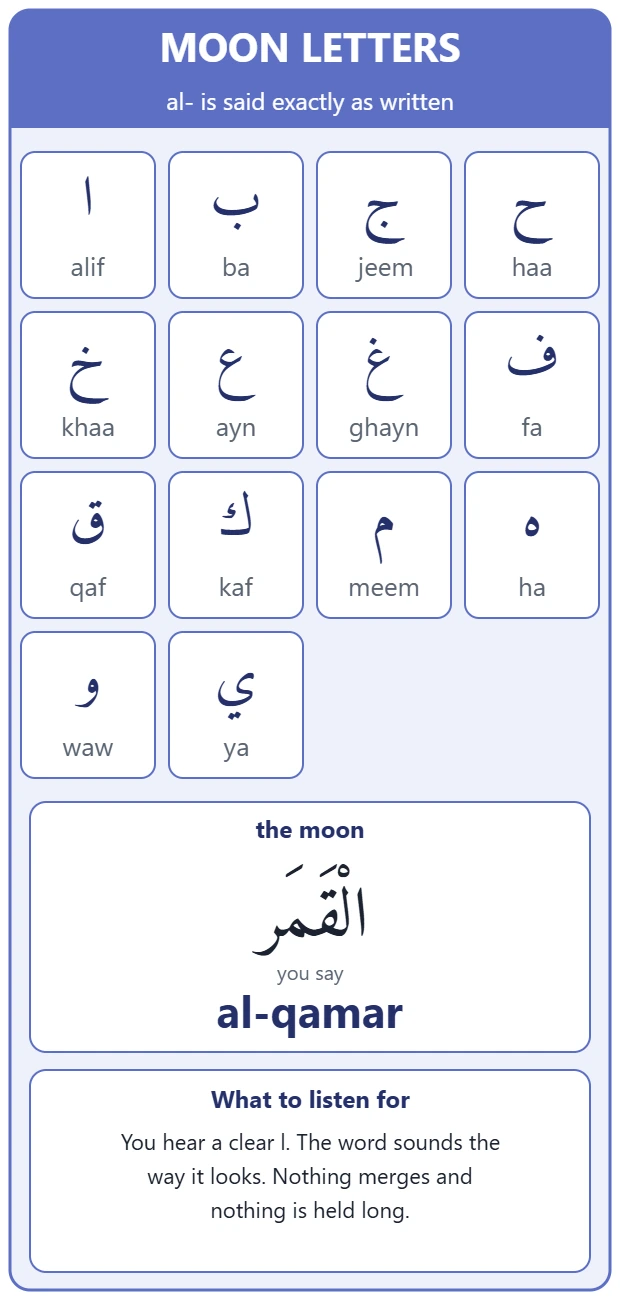
After these, nothing happens. The lam is said plainly, and the word sounds the way it looks.
| Letter | Name | Written with “the” | What you say |
|---|---|---|---|
| ا | alif | الْأَرْض | al-ard |
| ب | ba | الْبَيْت | al-bayt |
| ج | jeem | الْجَنَّة | al-jannah |
| ح | haa | الْحَمْد | al-hamd |
| خ | khaa | الْخَيْر | al-khayr |
| ع | ayn | الْعَالَمِين | al-aalameen |
| غ | ghayn | الْغَيْب | al-ghayb |
| ف | fa | الْفِيل | al-feel |
| ق | qaf | الْقَمَر | al-qamar |
| ك | kaf | الْكِتَاب | al-kitaab |
| م | meem | الْمُلْك | al-mulk |
| ه | ha | الْهُدَى | al-hudaa |
| و | waw | الْوَاحِد | al-waahid |
| ي | ya | الْيَوْم | al-yawm |
How can you check your child if you do not read Arabic?
You do not need to read the word. You need to hear one thing, and it takes about a second.
- Listen for the letter “l”. Every one of these words begins with the same two written letters. So the only question is whether an “l” sound arrives or not.
- If you hear it, the next letter is a moon letter. al-qamar, al-kitaab, al-hamd. Clean and separate.
- If you do not hear it, listen for a doubled sound instead. ash-shams, ar-Rahmaan, an-naas. The sound sits on the next letter slightly longer than feels natural in English.
- The mistake to catch is the flat middle. A child who has not learned the rule says al-shams: the “l” is there, and the “sh” is short. That is the one to correct.
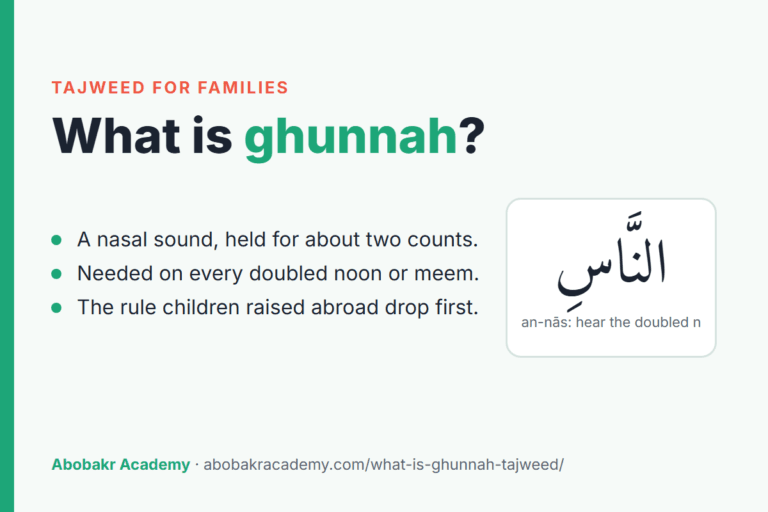
There is a second thing to listen for once the first is solid, and it is the doubling itself. A held consonant is a real length, not a decoration. Our guide to ghunnah and the two-count hold covers how long “held” actually means, because the same instinct applies here.
Where does this happen in Surah Al-Fatihah?
You do not have to go looking for examples. The surah your child recites in every unit of every prayer contains both rules, alternating, from the first line. Here is the whole of Surah Al-Fatihah filtered down to the words carrying “the”.
| Word | You say | Letter after “al-“ | Which rule |
|---|---|---|---|
| الْحَمْدُ | al-hamdu | ح | moon, lam is clear |
| الْعَالَمِينَ | al-aalameen | ع | moon, lam is clear |
| الرَّحْمَٰنِ | ar-Rahmaan | ر | sun, lam is silent |
| الرَّحِيمِ | ar-Raheem | ر | sun, lam is silent |
| الدِّينِ | ad-deen | د | sun, lam is silent |
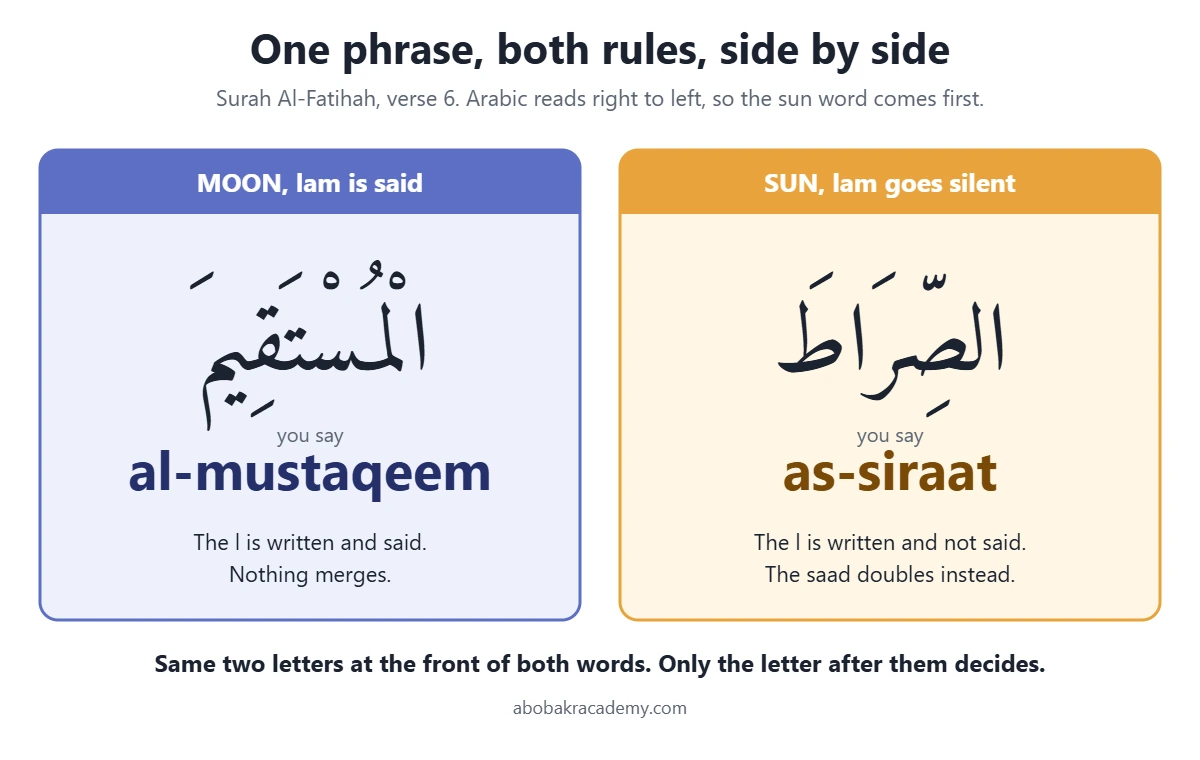
| الصِّرَاطَ | as-siraat | ص | sun, lam is silent |
| الْمُسْتَقِيمَ | al-mustaqeem | م | moon, lam is clear |
| الْمَغْضُوبِ | al-maghdoob | م | moon, lam is clear |
| الضَّالِّينَ | ad-daalleen | ض | sun, lam is silent |
Look at the fourth and fifth rows together. الصِّرَاطَ الْمُسْتَقِيمَ is said as-siraat al-mustaqeem. Two words, side by side, in one phrase, and the rule flips between them. The first drops its “l” and doubles the s. The second keeps its “l” exactly as printed. That single phrase is the cheapest drill in the entire Quran for this rule, and your family already says it seventeen times a day.
If you want to see any word in the Quran broken down letter by letter, the Quranic Arabic Corpus at the University of Leeds shows the grammar of every word for free.
Which of these will your child meet first?
Not all 28 letters carry equal weight for a beginner, and no chart tells you that. It depends on what your child is actually reading, and for almost every child in a Quran class that means the short surahs at the end of the mushaf.
In that stretch, a handful of these words do nearly all the work:
- النَّاس, an-naas, the people. A sun letter, and it appears five times in Surah An-Nas alone. If your child gets this one word right, they have understood the rule.
- الْفَلَق, al-falaq, and الْفِيل, al-feel. Moon letters, plainly pronounced, and a useful contrast to sit beside an-naas.
- الدِّين, ad-deen, in Surah Al-Maun. Sun letter. Children very often read this as al-deen, because it is a word they have heard said that way in English conversation at home.
- الْكَوْثَر, al-kawthar, and الْكَافِرُون, al-kaafiroon. Moon letters, and both are surah names, so they get said out loud constantly.
The practical order is: teach an-naas first because the doubling is loud and obvious, then put al-falaq next to it so the difference has something to push against. Everything else follows from that pair. To hear that doubling five times in six short verses, play Surah An-Nas with audio, one verse at a time.
What is the shadda actually doing here?
The shadda is the mark that carries this rule, so it is worth knowing on its own.
A shadda means “say this letter twice”. Not twice in a row with a gap, but as one sound held for roughly double the length. English does this without noticing in phrases like “bookkeeper” or “unnamed”, where the doubled consonant is genuinely longer than a single one.
When a sun letter follows “the”, the lam is absorbed into it and a shadda appears on that letter to record what happened. So the shadda in الشَّمْس is not decoration and it is not emphasis. It is a receipt for a letter that is written but not spoken.
This matters beyond this one rule, because shaddas appear everywhere in the Quran for other reasons too, and a child who reads them as ordinary letters will be slightly wrong on a very large number of words. Our free tajweed rules chart lays out the marks alongside the rules they belong to.
Why are they called sun and moon letters?
Because of the two example words themselves, and that is genuinely the whole reason.
The Arabic for sun is الشَّمْس, ash-shams, which begins with ش and swallows the lam. The Arabic for moon is الْقَمَر, al-qamar, which begins with ق and keeps it. Early grammarians picked the two most familiar objects in the sky as the labels for the two behaviours, and the names stuck for well over a thousand years.
It is a naming convention, not a meaning. There is nothing bright about ش and nothing nocturnal about ق. If it helps your child to remember it as a story, use it. If it confuses them, drop it and call them the silent-lam letters and the clear-lam letters, which is what they are.
How do you remember which letters are which?
Three approaches, in the order we would actually try them with a child.
Learn the shorter list only. There are 14 in each group, so memorising both is doing the job twice. Learn the sun letters, and treat everything else as a moon letter by default. Most children find the sun list easier because the merging is audible.
Group them by where the tongue goes. Almost every sun letter is made with the tip or blade of the tongue near the front of the mouth: ت ث د ذ ر ز س ش ص ض ط ظ ل ن. The lam is made in the same place, so it has somewhere to merge into. Moon letters are made further back, at the throat, the soft palate or the lips, so the lam has nothing to blend with and stays put. This is not a memory trick. It is the actual reason the rule exists, and children who learn it this way tend to stop needing the list.
Use the word itself as the test. Say the word both ways out loud, al-shams and ash-shams, and let your child pick which one they have heard in prayer. Recognition is faster than recall, and by the time a child has prayed for a year they have heard the correct form thousands of times.
Common questions about sun and moon letters
Is the lam ever removed from the writing?
No. The lam of “the” is always written, in every word, for both groups. If it were removed you would not need this rule, because the page would already tell you what to say. What changes is the sound, and the only written clue is the shadda on the letter that follows.
Is alif a sun letter or a moon letter?
Moon. The lam before it is pronounced clearly, as in الْأَرْض, al-ard. Alif comes up as a question more than any other letter because it is the first letter of the alphabet and because the “al-” itself begins with one, which makes it look like a special case. It is not.
Does this rule apply outside the Quran?
Yes. It is a rule of the Arabic language, not of recitation, so it applies to every Arabic word carrying “the”, in speech, in the newspaper and in a text message. Learning it for the Quran means your child has also learned a piece of everyday Arabic grammar for free.
What happens if my child reads it the wrong way?
The word is still understood, and nobody should be made anxious about it. It is a pronunciation error rather than a meaning error. It is also one of the easiest errors to fix, because the correct version is already in the child’s ear from prayer, so correction is usually a matter of pointing at it once rather than drilling it.
How long does this take a child to learn?
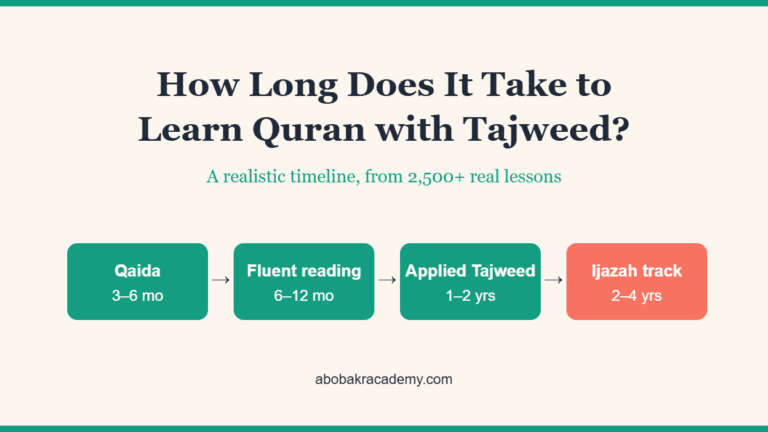
The concept takes one sitting. Reliable recognition while reading at speed takes a few weeks of ordinary practice, and it usually arrives on its own once a child has enough reading volume. It is not a rule that needs its own study programme, which is why we teach it inside regular Quran reading with tajweed rather than as a separate module.
Print the chart, then on to Tajweed
If you want to keep this beside you while your child reads, both letter groups are on one sheet below. Print it and put it next to the mushaf rather than in a folder.
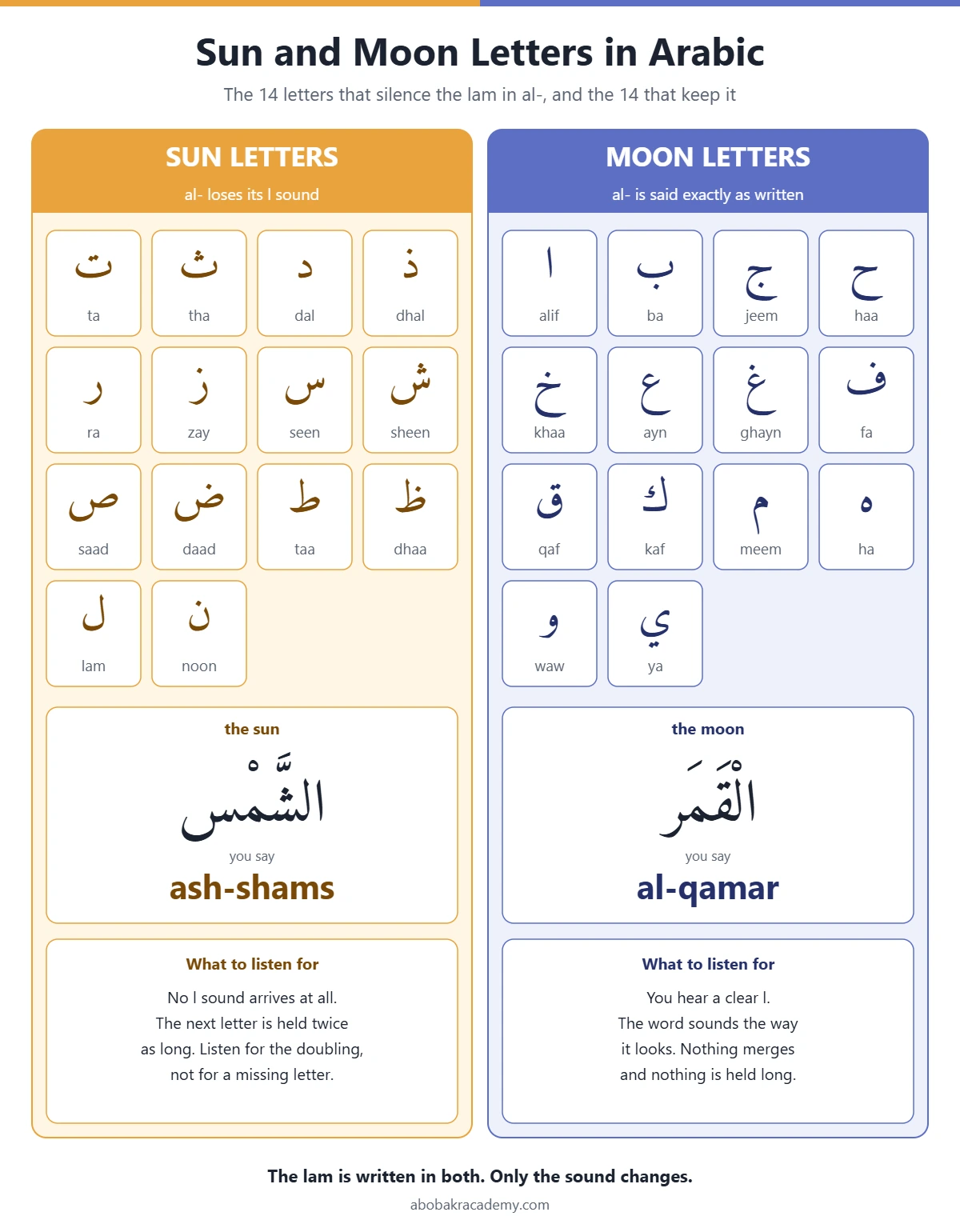
Download the sun and moon letters chart as a PDF. One A4 page, free to print and share, and there is no email form in front of it.
The Prophet, peace be upon him, said: “The one who is proficient in the Quran will be with the noble, righteous scribes, and the one who reads the Quran and stumbles over it, finding it difficult, will have a double reward.” The full narration is recorded in Sahih al-Bukhari. The second half of that is the part worth reading twice, especially in a house where the parents are learning alongside the child.
If your child is at the stage where the letters are known but the rules are not, that is exactly where our online tajweed classes begin, and the teacher works with parents who do not read Arabic every day of the week. You can also start further back with learning the Quran for beginners if the alphabet itself is still settling.