If you’ve already worked out that “read a juz a day” doesn’t mean much when the person doing the reading is a nine-year-old who’s still sounding out letters, or an adult who hasn’t opened a mus-haf since Sunday school, you’re not doing Ramadan wrong. You’ve just noticed something most Ramadan planners don’t account for: they’re written for households where at least one adult already reads Arabic fluently. If yours is not one of them, the plan has to look different.
Why the Usual Ramadan Plans Don’t Fit This House
Search for a Ramadan Quran reading plan and you’ll find the same handful of formats: a juz a day to finish the whole Quran by Eid, a page-a-prayer schedule built around the five daily prayers, or a “pick your pace” chart with three or four speed options. All of them assume the reader can already read. None of them tell you what to do when the reader is learning the letters themselves, or when you, the parent, are the one who’d have to check the reading and can’t.
That gap is why so many well-meant Ramadan plans are dropped by the second week. The child loses momentum because nobody at home can tell whether they’re reading correctly, and the parent stops asking because they don’t know what a right answer sounds like either.
Start With Who Is Reading This Year
A workable plan starts with who is doing what this Ramadan. In most of the families we work with, that’s some mix of three people, and each one needs a different kind of plan.
| Reader | What Ramadan usually does to their reading | What helps |
|---|---|---|
| The child mid-way through learning to read | Parents push a bigger daily target because it’s Ramadan, and the child falls further behind on accuracy | Keep the daily amount the same as any other month; add a short listening habit instead (see below) |
| The parent restarting their own reading | Guilt about “not knowing enough to lead by example” stops them starting at all | A fixed 10 minutes after Maghrib, reading whatever they can manage, with no target to finish anything |
| The homeschooling parent tracking more than one child | One shared chart for children at different stages, so it fits nobody well | One row per child on the same weekly sheet, with different daily amounts written in |
If two or three of these people live in your house, that’s fine. The plan below has a lane for each of them, and none of the lanes requires you to check a recitation by ear in Arabic you don’t read yourself.
A Three-Part Shape That Lasts All Month
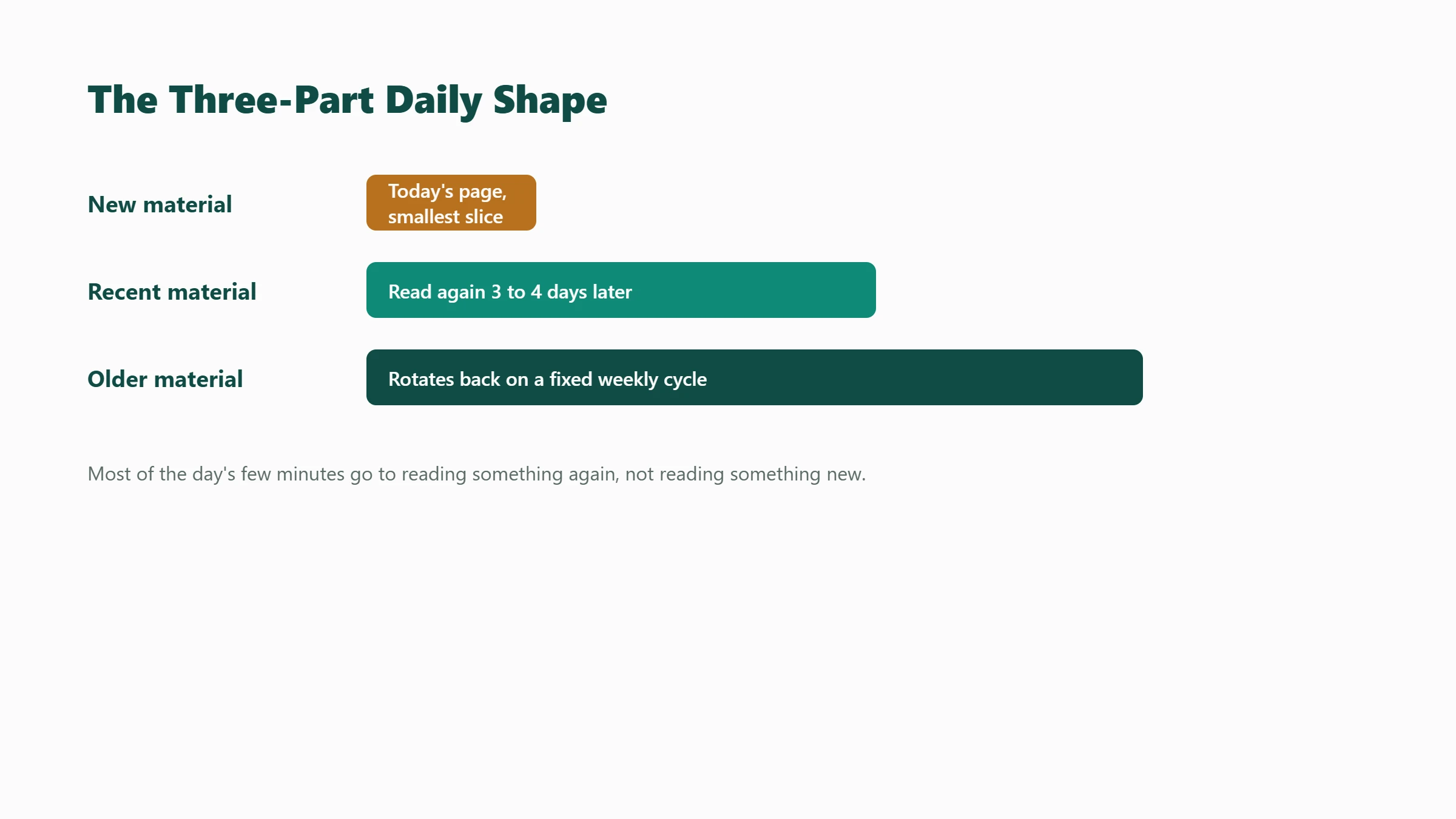
Tutors who run Ramadan intensives lean on the same three-part structure whether the student is six or sixty: new material, recent material, and older material on rotation. Ramadan tends to blow this up, because everyone wants to add new material and nobody wants to spend Ramadan on revision. That’s backwards for a house with a learning reader. New material is the smallest, most fragile part of the day precisely because it hasn’t been tested yet, and a child who takes on too much new reading during Ramadan loses the confidence to keep going once the month ends and the extra attention does too.
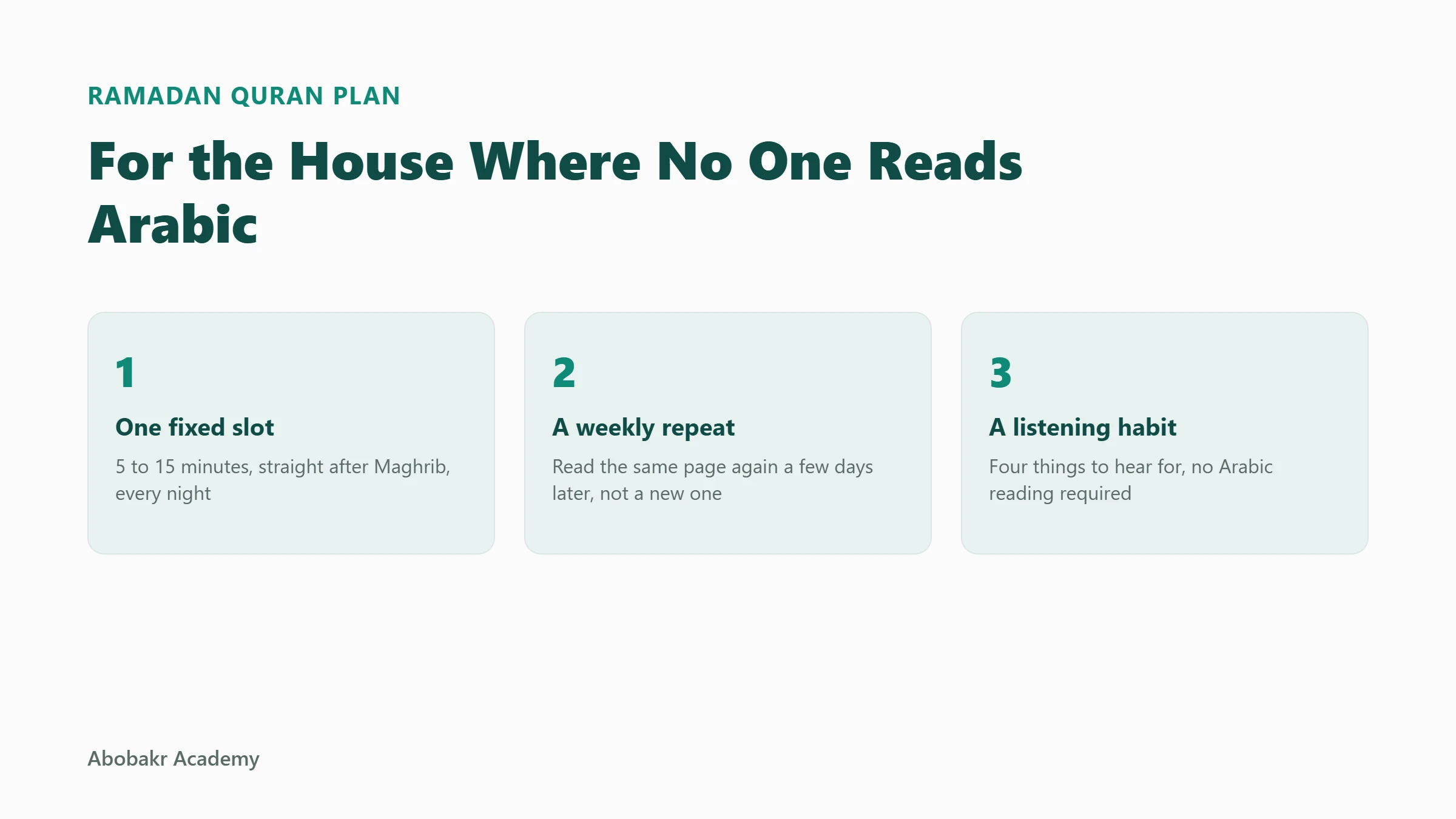
For a family without a fluent Arabic reader at home, the practical version of this looks like three short, separate things rather than one long session:
- A fixed reading slot, five to fifteen minutes, same time every day. Straight after Maghrib works for most families because everyone’s already sitting down.
- A weekly repeat of whatever was read three or four days ago. Not new pages. The same ones, again, out loud.
- One short listening habit, covered in full further down, that gives you something to check even though you can’t read the text yourself.
What an Actual Tuesday Looks Like
Vague plans tend to fade, so here is one evening in a real house.
7:45pm, straight after Maghrib. Your daughter opens her mus-haf to the page she read yesterday, not a new one. She reads it out loud, slowly, while you sit nearby doing something else, half-listening.
7:52pm. She finishes. You ask her to read it once more, this time recording it on your phone. Ninety seconds, done.
8:00pm. You play Saturday’s recording back to back with tonight’s, not to grade it, just to hear whether it sounds steadier. It usually does, and telling her so takes ten seconds and means a lot to her.
Once a week, Friday evening. You send both recordings to her Quran teacher with one line: “Is this improving, and is there anything I should be listening for that I’m missing?” That’s the whole homework loop, and it costs the teacher two minutes to answer.
That’s the entire plan on a normal night. No juz count, no chart to fill in with a marker, nothing that requires you to know whether a letter was pronounced correctly. It survives busy nights because there’s almost nothing to it, which is the point.
Four Things You Can Listen For Without Knowing Arabic
This is the part most Ramadan guides skip, because they’re written by people who can already read the text and check it. You can’t do that, but you can do this: listen for pace, not pronunciation.
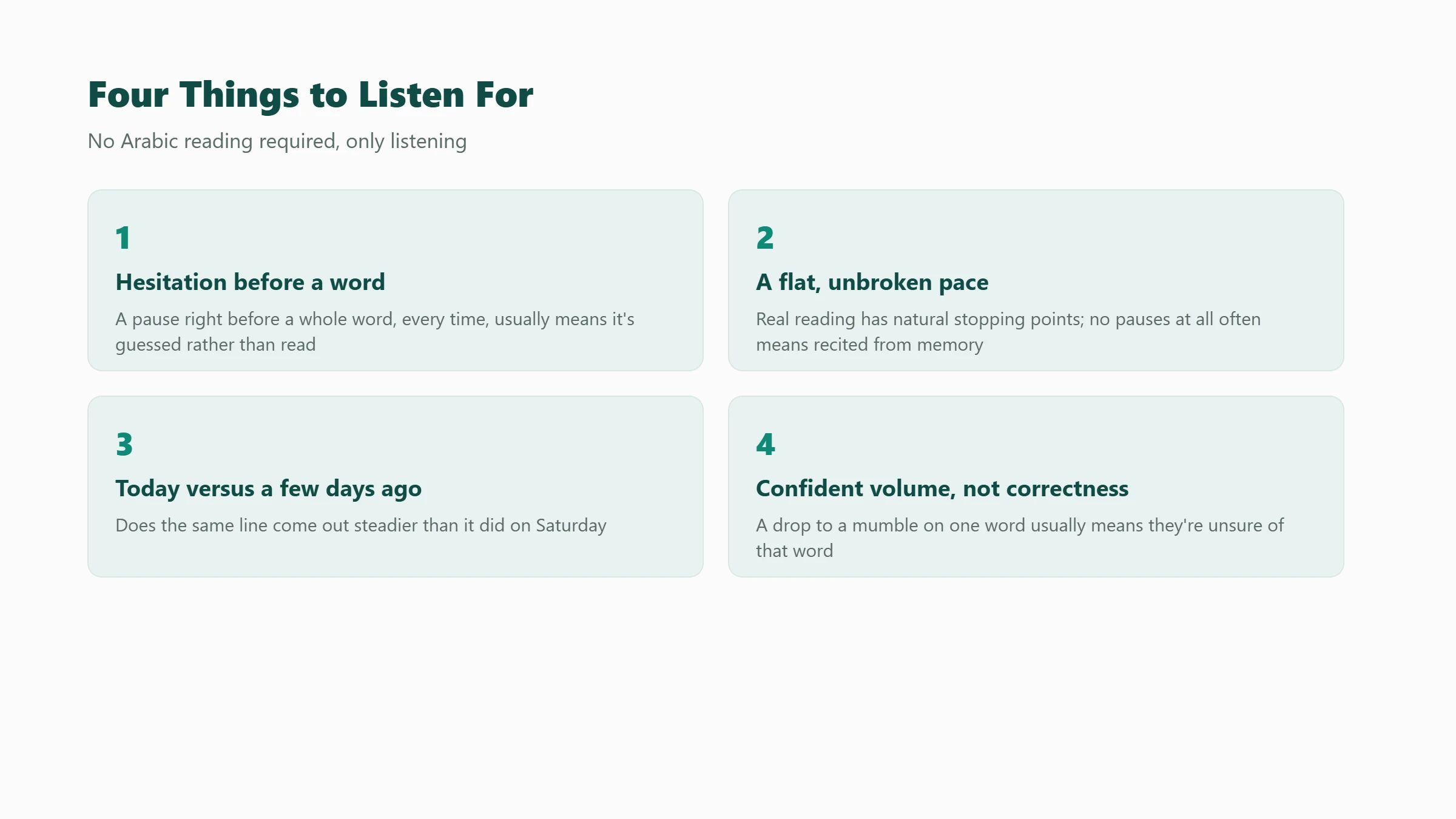
- Hesitation before a word, not during it. A pause mid-word is normal while sounding out a letter. A pause right before a whole word, every time it appears, usually means the word hasn’t been learned yet and is being guessed from memory of the page.
- A flat pace with no pauses at all. Real reading has natural stopping points. A recitation that runs on with no breaks at all is often memorised-and-recited rather than read, which matters if the goal this Ramadan is reading practice specifically.
- Whether today sounds like Saturday. You don’t need to understand the words to notice that a line that took four attempts on Saturday now comes out in one. That’s the actual signal you’re tracking, and it’s audible regardless of what language you speak.
- Volume and confidence, not correctness. A child who drops to a mumble on a specific word is usually unsure of it. Ask them to say that one word again, clearly. You’re not checking if it’s right. You’re checking if they think it’s right.
Send anything that worries you to the teacher rather than guessing. That’s what the Friday message in the walkthrough above is for.
When Ramadan Gets Hard: the Week You Miss
It will happen. A sick child, a late iftar with extended family, three nights in a row where nobody has ten minutes left by the time everyone’s eaten and prayed. Most plans don’t say what to do next, so families either push through with a bigger catch-up session that nobody enjoys, or stop and never start again.
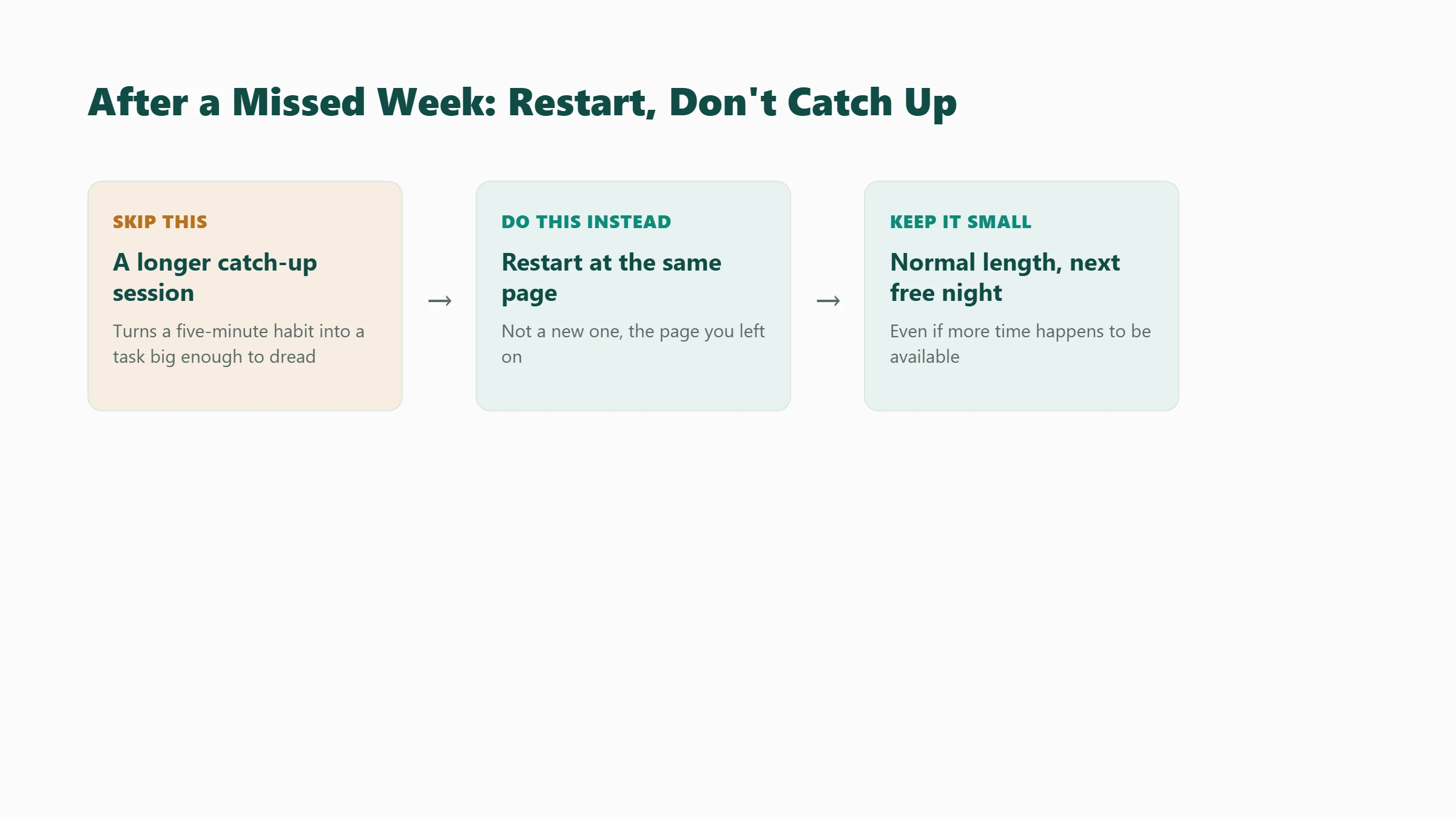
The rule that works is simple: don’t catch up. Restart on the same page you left on, at the normal length, on the next night you have ten minutes. A missed week doesn’t need repaying. Doubling the next session’s length is a reliable way to make that session the last one, because it turns a five-minute habit into a task big enough to dread.
The One-Verse Meaning Habit, Ramadan Version
If nobody at home reads Arabic, meaning is usually the first thing to drop from any plan, because it feels like the part that needs a scholar. It doesn’t. Pick one short verse your child has already memorised or is currently reading, look up what it means in English once, together, and talk about it for two minutes over iftar. That’s the entire habit. Across thirty days it’s thirty verses, which is a real foothold, not a translation project.
The Prophet ﷺ was asked which deeds Allah loves most, and he said “the most regular constant deeds, even though they may be few,” adding, “don’t take upon yourselves except the deeds which are within your ability.” A two-minute habit kept for thirty days does more than a one-hour session kept for three.
The Adult Restarting Their Own Reading This Ramadan
If you’re the parent who hasn’t read consistently since you were a child yourself, Ramadan is often when that guilt gets loudest, usually right when you’re also trying to manage everyone else’s routine. What helps is a smaller commitment you will keep: ten minutes after your own prayer, reading whatever you can manage, with no page target and nobody watching. You don’t need to finish anything this month. You need to still be doing it in week four, and the only way that happens is if week one didn’t feel like an obligation you’d already failed at by day three.
If reading fluently is genuinely out of reach right now, listening counts. Play a recitation while you do something else and follow along in a translation. It isn’t reading, but it isn’t nothing either, and Ramadan is a reasonable month to start either one. Ramadan also arrives about eleven days earlier every year, which is the easiest way to show a child how the Islamic months work. On the first night, teach them to say Ramadan Mubarak and what to answer back; every greeting there has audio.
Why Ease Is the Point, Not a Compromise
Every suggestion above is smaller than what most Ramadan plans ask for. That’s deliberate, and it’s not just a parenting shortcut. The verse that names Ramadan says exactly this about the month itself:
“Allah intends ease for you, not hardship, so that you may complete the prescribed period.”
A plan built around ease is the one likelier to still be running on the 29th night. A plan built around an ambitious khatm target, attempted by a family that isn’t set up for one, usually stops in week two. If this Ramadan is the one where your child reads the same short passage a little more steadily than last month, and you’ve learned to hear the difference, that is as real a win as finishing the Quran. For this house, this year, it is the one within reach.
The Four-Week Rhythm, If You Want It Written Down
Some families do better with something to glance at rather than remembering the shape of the plan. Here’s the same routine laid out by week, adjustable to whichever reader you’re planning for.
| Week | Child still learning to read | Adult restarting |
|---|---|---|
| Week 1 | 5–10 min after Maghrib, same page repeated, one recording | 10 min after Isha, no target, just consistency |
| Week 2 | Same length, add the Friday recording-to-teacher message | Same 10 min, add one verse of meaning at iftar |
| Week 3 | Same length; this is usually where a missed day happens, restart don’t catch up | Same 10 min; if a day is missed, restart on the same passage |
| Week 4 | Compare week 4’s recording to week 1’s, out loud, together | Notice what’s changed in ease of reading, not amount read |
Print this table, or just leave the tab open. Nothing about it depends on reading Arabic to use. If you would rather have it as a sheet on the wall than a table on a screen, the printable thirty night version puts the same shape on one page, with a row for each night and a column to initial on the nights it happened.
Questions Parents Ask About Ramadan Quran Plans
How much should my child read each day in Ramadan if they’re still learning?
The same amount as any other month, not more. Ramadan is a reasonable time to add a short listening or meaning habit alongside the reading, but increasing the reading target itself is what most often causes children to lose accuracy and confidence together.
Is it better to focus on finishing the Quran or on reading practice this Ramadan?
For a family where the reader is still learning, reading practice comes first. A rushed khatm read at a pace nobody can follow teaches very little. A short, steady, correctly-paced habit teaches the actual skill, and finishing becomes realistic in later years once that skill is there.
What if I can’t tell whether my child is reading correctly?
Listen for pace rather than pronunciation: hesitation before whole words, whether today sounds steadier than a few days ago, and confidence versus mumbling. Send anything that concerns you to a qualified teacher rather than guessing at it yourself.
We missed most of the second week. Is the plan ruined?
No. Restart at the same page and the same length you were doing before, on the next night you have the time. Trying to make up the missed days in one longer session is how most routines end.
Should the whole family follow the same reading plan?
Not if they’re at different stages. A shared weekly sheet works, but each person’s row should have their own daily amount written in rather than one target applied to everyone.
Is it enough to just listen to Quran recitation if I can’t read Arabic myself?
It’s a genuine start, not a full substitute for reading. Listening with a translation open builds familiarity and habit. If reading is out of reach this Ramadan, that’s an honest place to begin rather than a reason to do nothing at all.
Where a Teacher Fits Into This
None of the above needs a class to work. It needs ten consistent minutes and a parent willing to listen for pace rather than perfection. Where a teacher earns their place is the part you genuinely can’t do from outside the language: telling you whether a hesitation is normal letter-sounding or a sign a rule hasn’t clicked yet, and keeping the correct tajweed from calcifying into habits that are harder to unlearn later. That’s true whether your child is working through early memorisation or building up reading fluency page by page in an ongoing class built for kids raised outside an Arabic-speaking home.
If the meaning habit above sparks more questions than two minutes at iftar can answer, that’s exactly the gap our piece on what it costs when a child reads beautifully but understands nothing was written for. And if the whole household is working on memorisation rather than reading fluency this Ramadan, the revision structure behind that habit is laid out in full in our guide to how a well-run memorisation program paces sabaq, sabaqi and manzil. Families further back in the alphabet, before reading practice makes sense at all, are usually better served starting with our free Noorani Qaida progress tracker, which uses the same weekly-repeat logic as the plan above.
If you’d like a teacher listening alongside you this Ramadan, someone who can tell you exactly which hesitation to let go and which one needs attention, we run one-to-one online Quran and Tajweed lessons built around families in exactly this situation. Get in touch and we’ll fit a trial lesson around your Ramadan evenings, not the other way round.