

“How long will this take?” Every parent asks us this in the first trial class. Fair question. Nobody wants to commit to something open-ended. So here’s the honest answer, based on 2,500+ lessons we’ve taught: most adults learn Quran with Tajweed well enough to read any page correctly in 12 to 18 months, at two or three lessons a week. Kids usually need longer to read on their own, but their pronunciation often ends up better than their parents’.
That’s the short version. The longer version depends on what “learning Tajweed” means to you, and that phrase means very different things to different people. Let’s break it down properly.
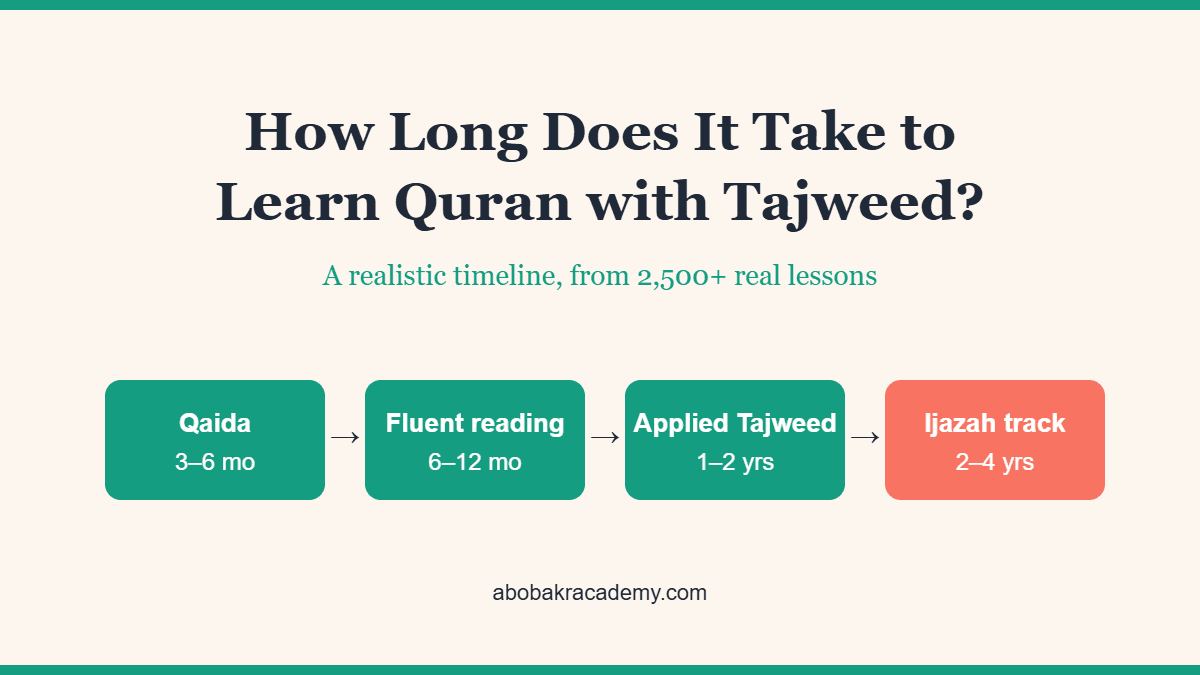
How Long Does It Take to Learn Quran with Tajweed? Stage by Stage
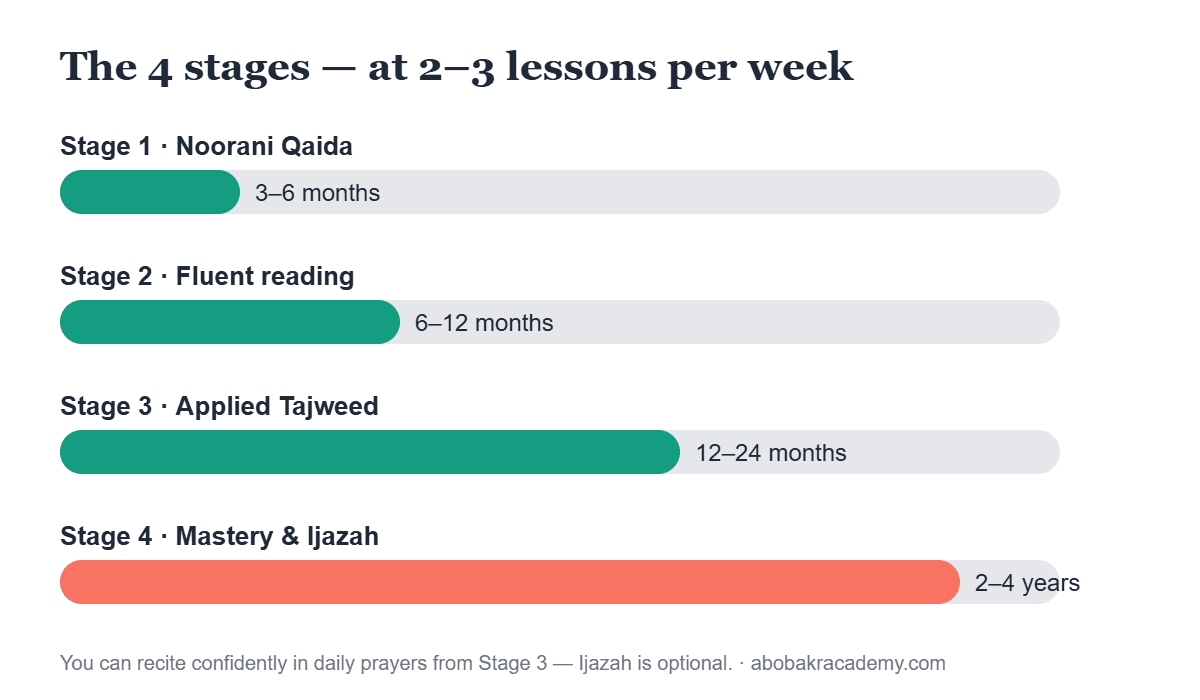
Tajweed isn’t one skill. It’s a ladder, and your timeline depends entirely on which rung you’re standing on today.
| Stage | What you can do | Typical time (2–3 lessons/week) |
|---|---|---|
| 1. Foundation (Noorani Qaida) | Recognize letters, connect them, read simple words from the right articulation points | 3–6 months |
| 2. Fluent reading | Read any page of the Mushaf, slowly, but correctly, without the teacher spelling words out | 6–12 months |
| 3. Applied Tajweed | The main rules. Noon Sakinah, Madd, Qalqalah, happen automatically while you read | 12–24 months |
| 4. Mastery / Ijazah track | Recite a full narration with precision, ready for Ijazah from a qualified Qari | 2–4 years |
Two things surprise almost everyone. First: you don’t need stage 4 to recite beautifully in your prayers. Stage 3 is plenty. Ijazah is a wonderful goal, but it’s a specialist’s path, not the finish line for ordinary believers.
Second: the foundation stage matters more than any other. We’ve re-taught enough students who rushed their Qaida elsewhere to say this with confidence. Articulation mistakes that get repeated for a year become very stubborn. Three careful months at the bottom of the ladder save you a frustrating year near the top.
What Actually Decides Your Speed
Frequency beats duration, every time
Three 30-minute lessons a week will beat one 90-minute lesson, and it isn’t close. Pronunciation is muscle memory. Your tongue and throat need frequent correction, not occasional marathons. Our fastest students all share one boring habit: ten minutes of daily practice on exactly what their tutor corrected last lesson. Not an hour. Ten minutes, every day.
You can’t hear your own mistakes
This is why learning Tajweed from YouTube alone doesn’t work, and we say that as people who recommend listening to great reciters on Quran.com constantly. Listening builds your ear. It just can’t tell you that your ع is coming out as a أ, and every single learner believes their pronunciation is fine until a teacher stops them mid-verse. There’s no way around live correction. There are only detours that cost you months.
Where you’re starting from
Already read Arabic script? You might skip straight to stage 2 and reach applied Tajweed within a year. Starting from the alphabet? Budget the full timeline, and don’t feel bad about it. That’s the normal path, not the slow one. A structured Noorani Qaida program beats diving into the Mushaf and hoping for the best.
Age, but not how you’d expect
Here’s something we see weekly: a seven-year-old and her father start together. Dad races ahead in reading. He understands rule logic instantly. Two years later, the daughter’s recitation sounds native and effortless while Dad is still consciously managing his letters. Kids learn slower and end up better, because their speech muscles are still forming. Neither has the advantage overall; they just need different teaching. Our Quran classes for kids run on repetition games and tiny daily wins; adult lessons lean on rule logic and self-correction.
Lesson Frequency: Three Honest Scenarios
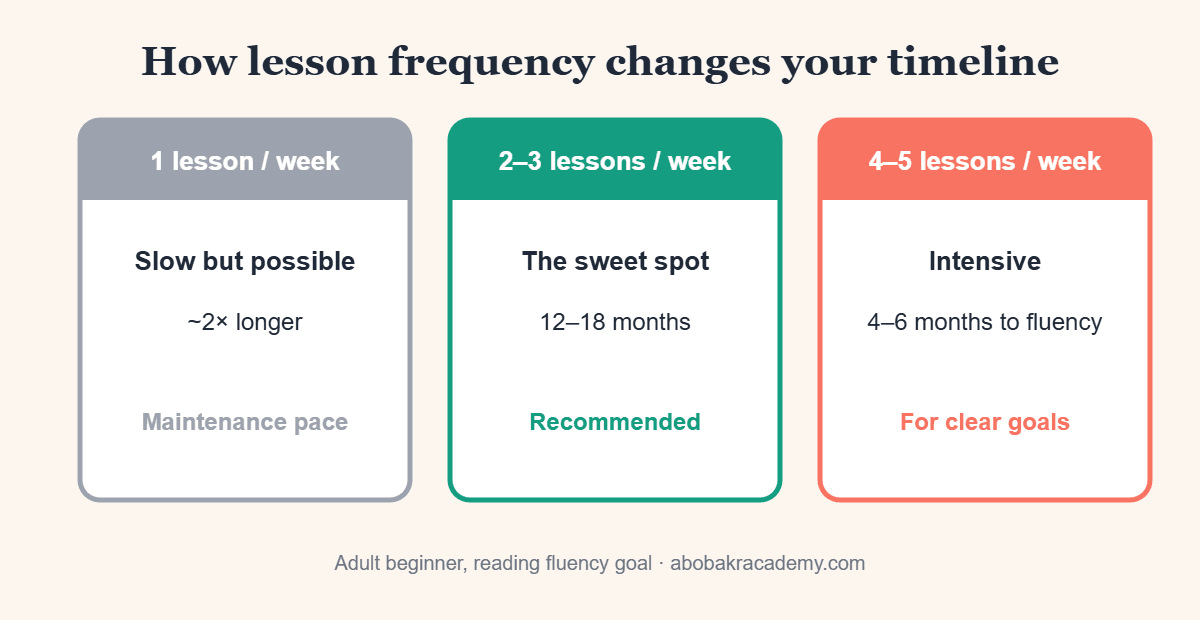
- One lesson a week keeps you moving, barely. Expect roughly double the timelines above. Fine for busy seasons; frustrating as a main plan.
- Two to three lessons a week is where the table above comes from, and where most families who want to learn Quran with Tajweed properly end up landing. Best retention for the money.
- Four or five a week is the intensive lane. Adults can hit fluent reading in 4–6 months. It suits people with a deadline: leading Taraweeh, starting Hifz, or a personal Ramadan goal.
Five Habits That Quietly Add Months
- Skipping the Qaida because it feels childish. It isn’t childish. It’s the foundation, and adults who respect it move faster later.
- Studying rules instead of applying them. Knowing the definition of Ikhfa is trivia. Hearing it corrected in your own recitation is learning. Rules should chase your mistakes, not precede them.
- Practicing errors. An hour of unsupervised daily recitation can cement the very mistakes you’re paying to fix. Practice what was corrected. Nothing else.
- Hopping between teachers. Every new tutor spends weeks rediscovering your error patterns. Consistency compounds like interest.
- Stopping at “good enough” reading, then wondering why long verses feel breathless and uneven years later.
How We Teach Quran with Tajweed at Abobakr Academy
Every student at our online Quran academy starts with a free assessment. Your tutor. A native Arabic speaker, often Al-Azhar trained, places you on the ladder above and tells you, plainly, what your realistic timeline looks like. Lessons are live and one-to-one over Zoom or Google Meet, with correction in the moment and written notes afterward. If certification is your goal, our dedicated Tajweed course runs all the way through the 17 rule families to the Ijazah pathway (for background on the discipline itself, Wikipedia’s Tajwid entry is a decent primer).
Frequently Asked Questions
Can I learn Tajweed in 3 months?
You can build a real foundation in three months, correct articulation points, clean simple words. Full applied Tajweed in that window isn’t realistic for a beginner, and we’d be suspicious of any program promising it. Some steps only stick through repetition.
Is it too late to learn Quran with Tajweed as an adult?
No, and adults are often our fastest students through the first three stages. The sounds English doesn’t have take patient drilling, that’s all. We’ve taken students in their sixties to fluent, correct recitation.
Do I need to speak Arabic first?
No. Tajweed is accurate sound production, not vocabulary. Plenty of our students recite beautifully before they understand a word, though pairing recitation with Arabic study deepens what the recitation means to you.
How long until my child reads the Quran independently?
A child starting around six or seven, with three lessons a week, usually reads slowly but independently in 12–18 months, and reads with confident Tajweed by year two. The biggest accelerator we see isn’t talent. It’s parents keeping the same lesson days and times, week after week.
Ready to Learn Quran with Tajweed? Start With an Assessment
The most accurate timeline isn’t in this article. It’s in your own recitation. Book a free trial class and our tutors will tell you exactly which stage you’re on and what your path looks like, no commitment, and the assessment is yours either way.