Learning the Quran as a beginner means learning to read it in five steps: the Arabic letters, the vowel marks, joined letters and words, the basic rules of recitation (Tajweed), then short surahs from the mushaf. Say everything aloud from the first day, and have someone correct you as you read. With regular practice and correction, most beginners read short surahs slowly within about three months.
Most people stall at the third step, and for a specific reason: the same letter changes shape depending on whether it opens, sits in the middle of, or closes a word. A beginner who has only learned the letters on their own often cannot recognise them once they are joined. The fix is to practise the joined shapes early, alongside the vowel marks, rather than front-loading vocabulary before the reading itself is solid.
The five steps, in order
| Step | What it covers | Taught from |
|---|---|---|
| 1. The letters | The 28 letters and how each one is pronounced, said aloud from the first day. | The first lessons of a Noorani Qaida. |
| 2. The vowel marks | Fatha, kasra and damma, then sukun, shadda and the long vowels, so you read sounds rather than letter names. | The middle lessons of the same Qaida. |
| 3. Joined letters and words | Each letter in its opening, middle and closing shape, until short words read without spelling them out. | The Qaida’s later lessons, which use words from the Quran. |
| 4. Basic Tajweed | Where each letter is made, the lengths of madd, and ghunnah, applied to what you can already read. | The Tajweed rules, one at a time. |
| 5. Short surahs | Al-Fatiha and the short surahs of Juz Amma, read from the mushaf rather than from memory or transliteration. | A clear mushaf in the Madani script. |
Free printables for each step (PDF)
Each of these is a free download, made for the step it sits beside.
- Arabic alphabet chart: every letter in its four joined shapes on one page, for steps 1 and 3 (PDF).
- Noorani Qaida progress tracker: all 16 Qaida lessons, with what to listen for at each, for steps 1 to 3 (PDF).
- Tajweed rules chart: noon and meem sakinah, qalqalah, ghunnah and madd on one page, for step 4 (PDF).
- Short surahs tracker: the short surahs of Juz Amma, to tick off as each one reads cleanly, for step 5 (PDF).
Before you start
Begin with the intention to learn for the sake of Allah, not as an ordinary school subject. Make wudu before you touch the mushaf itself, which most scholars require. Pick a quiet time you can keep every day rather than a long session once a week: 15 to 30 minutes daily does more than two hours on a Sunday.
Go slowly on purpose. The Quran itself tells the reader to recite it in a measured way, and it promises that it has been made easy to remember.
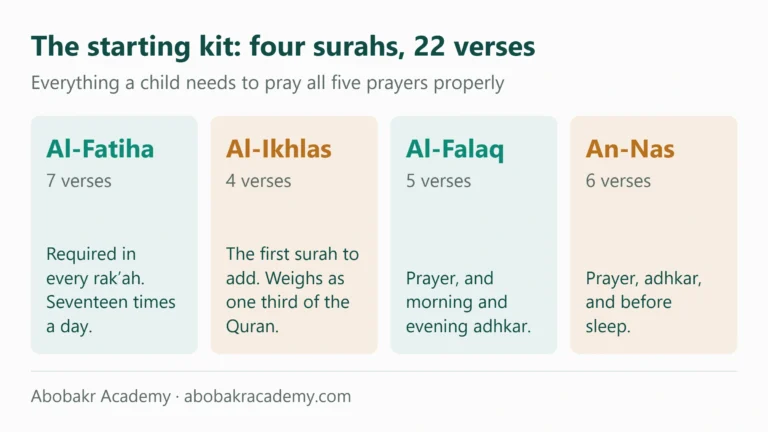
Do not start at the beginning of the Quran. Start with al-Fatiha and the short surahs at the end, which you already hear in prayer, so that what you read connects with what you know.
Reading aloud from the first week
Beginners often spend weeks studying letters silently before attempting to say anything. It feels safer and it slows everything down. The Quran is an oral text, passed on by recitation, and the skill being built is a physical one: your mouth has to learn where each letter is made.
Say every letter out loud from the first session, even when it comes out wrong. Wrong and audible can be corrected. Silent and uncertain cannot.
The sequence that works is short and strict. Single letters until you recognise them instantly. Letters with vowel marks, so you are reading sounds rather than names. Two-letter and three-letter combinations. Then short words, then a full ayah.
Can you learn the Quran by yourself?
You can learn the shapes of the letters by yourself, with a chart and a recording. You cannot reliably learn to pronounce them by yourself, because beginners cannot hear their own errors: the ear that would catch the mistake is the same ear that learned it.
That matters because whatever you repeat in the first months becomes automatic, correct or not. A letter made slightly in the wrong place, a vowel always rushed, a habit of guessing a word from its shape: each takes far longer to remove later than it would have taken to prevent.
So listen to a recognised reciter every day, and have someone hear you read as early as you can. In a lesson, the teacher stops you at the word, not at the end of the line, has you repeat it on its own, then in the verse, then moves on. It feels slow. It is the fastest route there is. If you want to hear the pace a learner copies, the teaching recitation of Sheikh al-Husary is on our page about Quran recitation classes.
How long does it take to learn to read the Quran?
A beginner starting from the alphabet, practising most days and corrected twice a week, is generally reading short surahs slowly by the end of the third month. Not fluently, and not from memory, but reading them. Finishing the Noorani Qaida usually takes an adult three to six months, and reading any page steadily a further six to twelve. Our guide to how long it takes to learn the Quran with Tajweed sets out how the timeline changes with the number of lessons a week.
Adults tend to move through the letters faster than children and then stall at joined reading. Children usually take longer at the start and pass through that stall with less frustration. Neither pattern is a problem, and comparing yourself to the other one is.
The Prophet, peace be upon him, said that the best among you are those who learn the Quran and teach it. Learning is named first, and it has no deadline.
How to tell whether you are progressing
Beginners often cannot tell whether they are improving, which is one of the main reasons they stop. Time spent is a poor signal. These markers are more reliable, roughly in the order they arrive.
- You recognise a letter in all four of its written positions without pausing to work it out.
- You read a vowel mark as a sound rather than naming it first.
- You get through a short line without sounding out every letter.
- You stop reaching for transliteration when a word looks unfamiliar.
- You notice your own mistake before anyone points it out. This one usually arrives last and matters most.
If none of these has shifted after six weeks of regular practice, the problem is almost always how often you are corrected, not effort or ability.
Free learning, transliteration and choosing a mushaf
Can I learn to read the Quran for free?
Yes, up to a point. The Qaida, the charts above and recordings of recognised reciters are all free. What is hard to get free is regular correction. Many masjids run free classes, and our first lesson is free as well. Our list of free ways to learn the Quran online says which of them have a teacher hear you read.
Do I need to learn Arabic to read the Quran?
No. Reading the Quran aloud correctly and understanding its Arabic are separate skills, and most people learn to read first. When you want the meaning as well, a Quranic Arabic course starts from the words the Quran uses most.
Should I use transliteration?
Only for a few days at most. Several Quranic sounds have no English letter, so transliteration teaches an approximation that later has to be unlearned. Reading the Arabic from the start is slower for a week and faster after that.
Which mushaf should a beginner use?
A clear one in the Madani script, the most common print today. A colour-coded Tajweed mushaf helps once you reach step 4, because it marks where each rule applies.
What comes after reading?
Once you read steadily, most people improve their recitation with the full Tajweed rules, start memorising the short surahs, or both.
Classes for beginners and for reverts
Beginners rarely fail for lack of material. They stall because nobody is listening closely enough to catch the small errors while those errors are still small.
If you want that from the start, our Quran classes for beginners run one to one, or in a small group if you ask, and the first lesson is spent finding out what you can already read. If you are new to Islam as well as to the Quran, see our Quran classes for reverts.