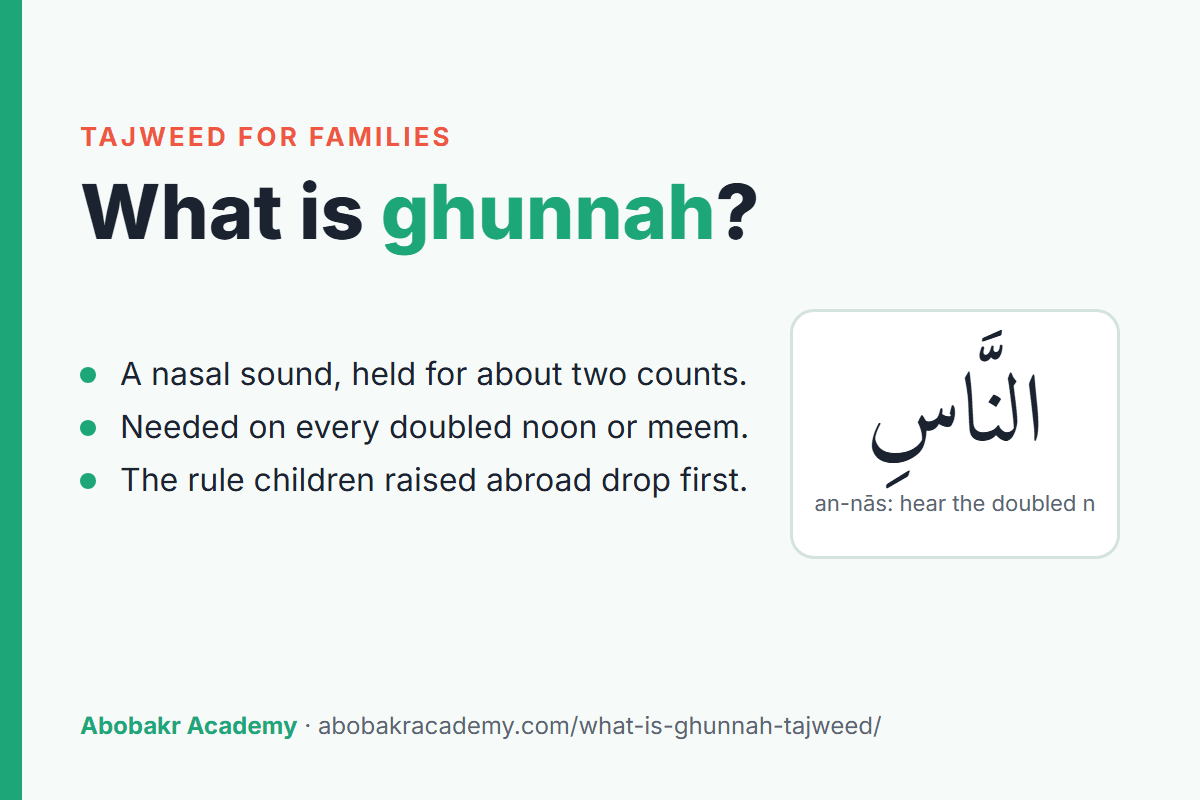
Ghunnah is the nasal sound in Quran recitation: a hum that comes through the nose, not the mouth. It belongs to two letters only, noon (ن) and meem (م), plus tanween, which ends in a noon sound, and it is part of them every time they are read.
Where it is strong, the hum lasts two counts: on a doubled noon or meem (a shaddah), and where one merges into the next letter or is hidden before it (idgham, ikhfa and iqlab). To check it, pinch the nose during the hum. If the sound stops, the ghunnah was there. Below are the five levels, from fullest to lightest, and six verses where you can hear it in a teacher’s slow recitation.
Your child reads the verse and it sounds fine. The letters are right, the pace is steady, nothing makes you stop them. Yet something is missing that a trained ear would catch in the first line. Often it is the ghunnah, the nasal sound certain letters must carry.
What ghunnah is
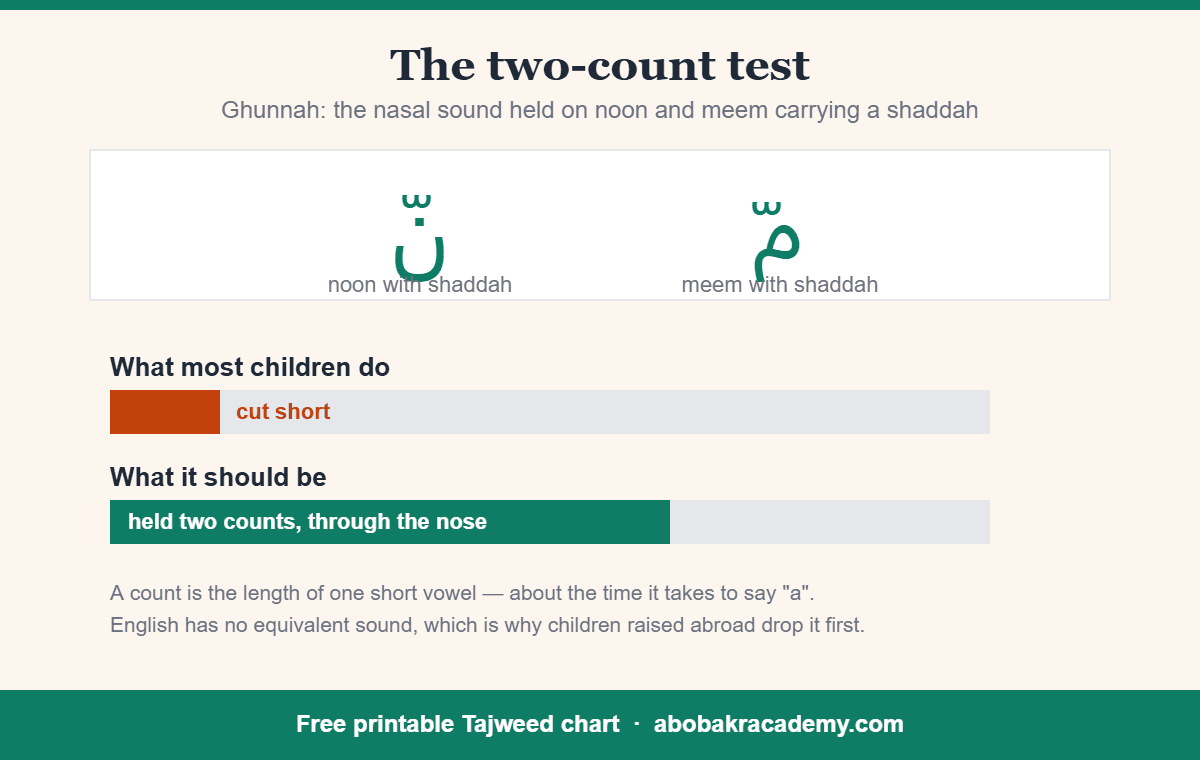
Ghunnah is a nasal sound. It comes through the nose rather than the mouth, and where it is strong it is held for two counts. A count here means the length of one short vowel, about the time it takes to say “a”.
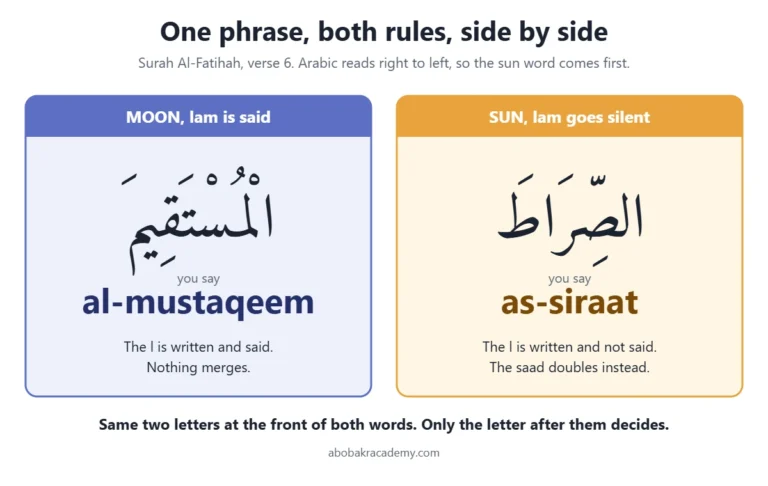
The clearest place it must be held is a noon or a meem with a shaddah: نّ and مّ. That case is the simplest in Tajweed to state and one of the most commonly lost, so it is where this page starts. The other place a shaddah appears constantly is straight after the definite article, where the sun and moon letter rule decides whether the lam is said at all. If you want to see where ghunnah sits among the rest, we have set out the order to learn the Tajweed rules in.
The five levels of ghunnah
Teachers rank ghunnah in five levels by how strongly it is heard. The first three are held for two counts. In the last two the noon or meem still carries a little nasal sound, but it is not held.
| Level | Where | Example | How long |
|---|---|---|---|
| 1 | Noon or meem with a shaddah (mushaddad) | ٱلنَّاسِ، عَمَّ | Two counts, the fullest |
| 2 | Merged into the next letter (idgham with ghunnah) | فَمَن يَعْمَلْ | Two counts |
| 3 | Hidden before the next letter (ikhfa, iqlab, meem before ب) | مِّن جُوعٍ | Two counts |
| 4 | Silent and said clearly (izhar) | مِّنْ خَوْفٍۭ | A trace, not held |
| 5 | With a vowel | مِثْقَالَ | The lightest trace |
Every example comes from the verses below, so you can hear each one.
Hear ghunnah in six verses
A sound is easier to hear than to describe. Every verse below is from Sheikh Mahmoud Khalil al-Husary’s teaching recitation (al-Mu’allim), read slowly for learners to repeat. The words that carry the ghunnah are in orange. You do not need to read Arabic to follow: press play, and listen for the hum where the card tells you.
Noon with shaddah (An-Nas 114:1)
قُلْ أَعُوذُ بِرَبِّ ٱلنَّاسِ
Say, “I seek refuge in the Lord of mankind…”
Listen for: The last word, an-naas. The noon is doubled, so the sound sits in the nose, about two counts, and only then opens into the long aa.
Meem with shaddah (An-Naba 78:1)
عَمَّ يَتَسَآءَلُونَ
About what are they asking one another?
Listen for: The first word, ‘amma. The lips close on the doubled meem and stay closed while the hum lasts its two counts.
Idgham with ghunnah (Az-Zalzalah 99:7)
فَمَن يَعْمَلْ مِثْقَالَ ذَرَّةٍ خَيْرًا يَرَهُۥ
So whoever does an atom’s weight of good will see it…
Listen for: Fa-man ya’mal. The noon of man is not said as a clear n: it merges into the y of the next word, and the nasal sound stays for two counts. The same thing happens again at khairan yarah.
Ikhfa (Quraysh 106:4)
ٱلَّذِىٓ أَطْعَمَهُم مِّن جُوعٍ وَءَامَنَهُم مِّنْ خَوْفٍۭ
Who has fed them, [saving them] from hunger and made them safe, [saving them] from fear.
Listen for: Min joo’. The tongue does not touch for the n; it is hidden, a nasal sound held for two counts on the way to the j. Then listen to the last two words, min khawf: before kh the noon is said clearly and briefly. Hearing the two side by side is the quickest way to learn ikhfa. (Just before, the meem of at’amahum merges into the meem of min, a merged ghunnah of its own.)
Iqlab, then a noon with shaddah (Al-Humazah 104:4)
كَلَّا لَيُنۢبَذَنَّ فِى ٱلْحُطَمَةِ
No! He will surely be thrown into the Crusher.
Listen for: Layunbadhanna. The noon before the b turns into a meem sound with the lips closed and a two-count hum (that is what the small meem above it means), and the word ends on a doubled noon, held again.
Ikhfa shafawi (meem before b) (Al-Fil 105:4)
تَرْمِيهِم بِحِجَارَةٍ مِّن سِجِّيلٍ
Striking them with stones of hard clay…
Listen for: Tarmeehim bi-hijaarah. The meem at the end of the first word meets a b, so the lips close lightly and hum, two counts, then release into the b.
Four words to test it on
You do not need to hunt for examples. These come up constantly:
- إِنَّ (inna), noon with shaddah
- ثُمَّ (thumma), meem with shaddah
- النَّاسِ (an-naas), the word that closes Surah An-Nas
- مِمَّا (mimma), meem with shaddah
Every one of them needs that held nasal sound. If your child rattles through all four without it, the sound is missing every time, and a sound that is always missing is easier to fix than one that comes and goes. The quickest place to hear it held properly is Surah An-Nas, recited slowly verse by verse: the ghunnah on an-nas closes every verse.
Why children raised outside an Arabic-speaking home skip it
English has no equivalent. There is no moment in an English word where you hold a nasal consonant deliberately and count it out. So when a child meets a shaddah on a noon, their mouth does what English trained it to do: it produces the consonant and moves straight on.
It is stubborn because the word still comes out recognisable. Nobody listening casually thinks anything is wrong, because nothing sounds broken. It sounds slightly hurried at most. So the child is not corrected, and they read it the same way the following week, and the week after that.
A year on, it has become a habit, and a habit takes far more work to undo than the rule took to learn.
The two-count test, tonight
You do not need to read Arabic to run this. Ask your child to read a verse containing a shaddah on a noon or meem. Surah An-Nas opens with one. Then listen for a single thing:
Does any sound carry through the nose, or does it stop dead at the letter?
If it stops dead, the ghunnah is missing. If there is a nasal sound but it finishes almost instantly, the rule is present and the length is not, which is a smaller fix.
Keep it low-key. Ask your child to read something they already know well, listen, and say nothing at all the first time. This first time you are only listening.
What the right sound is like
Parents often ask what the correct version sounds like, since they have no reference point. The closest English comparison is the sound at the end of “hmm” when you say it thoughtfully, held briefly rather than clipped. It resonates behind the nose. If you pinch your nostrils gently while making it, the sound stops, which is a useful check: pinch your child’s nose while they read one of the four words above, and if nothing changes, no ghunnah is being produced.
How ghunnah in Tajweed gets fixed
Slowly, with someone listening, in roughly this order:
- Have your child overdo it first, holding the hum for four or five counts, so they get used to feeling it in the nose. Getting the length right can wait.
- Then bring it down to two. Count out loud together at first. Once they have overshot it, most children are surprised how short two counts is.
- Correct ghunnah on its own. Fixing it alongside four other things in one session is too much, and a child corrected on everything at once stops offering to read.
- Expect it to slip. For a while it will be right when you practise and gone in normal reading, and that is normal.

What age this makes sense at
Children can produce the sound long before they can name the rule. A five or six year old can copy a held nasal sound accurately by imitation, and that is the right approach at that age: model it, have them echo it, move on. Naming the rule and counting the length suits roughly seven and above, when a child can hold an abstract instruction while reading at the same time.
If your child is younger and reading already, do not skip the sound and plan to add it later. Imitation now costs nothing and prevents the habit forming.
Where else ghunnah in Tajweed shows up
Noon and meem with shaddah are the clearest cases, but the nasal sound also lives inside several other rules. Ikhfa, Iqlab, and Idgham with ghunnah all carry it, and you can hear each of them above. So a child who has lost ghunnah is getting several rules wrong at once, which is why it is worth catching early.
All of these sit on our free printable Tajweed rules chart, which puts Noon Sakinah, Meem Sakinah, Qalqalah, Ghunnah and the Madd lengths on one page. It is free, there is no signup, and teachers and co-ops are welcome to print it.
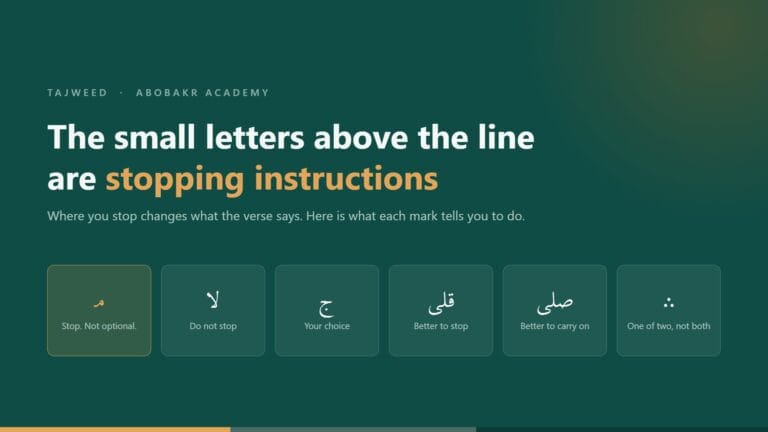
If ghunnah is already steady, the next thing most children have never been shown is what the stopping marks above the line mean. They tell you where you may stop for breath.
Mistakes parents make when correcting
Three come up again and again, all from good intentions:
- Stopping the child at every slip. It turns reading into a test. Let them finish the verse, then go back to one place.
- Holding it too long. Keen correction often produces a four-count drone. Too long is wrong too, though it is easier to fix than no ghunnah at all.
- Expecting one sitting to do it. A child can make the sound within minutes, but it takes weeks of easy repetition before it comes without thinking. Treating the first success as the end is why it so often slips back.

What a parent cannot fix alone
If you do not read Arabic yourself, you can reliably hear whether a nasal sound is present. What you cannot judge is whether its length and quality are right, or whether the letter underneath it is being articulated from the correct place in the mouth.
Nobody hears their own recitation accurately either, which applies just as much to adults learning alongside their children. Correction has to come from someone listening in real time, whether that is a teacher at the masjid, a relative who reads well, or a tutor.
How long to hold it, and is it too late?
What letters have ghunnah?
Only two: noon (ن) and meem (م). Tanween counts with noon, because it ends in a noon sound. No other Arabic letter carries a ghunnah.
What does ghunnah mean in English?
Nasal sound, or nasalisation. The Arabic word غُنَّة names the hum that comes out through the nose when a noon or meem is read.
How many types of ghunnah are there?
Five levels, from fullest to lightest: a noon or meem with a shaddah, one merged into the next letter, one hidden before the next letter, one silent and said clearly, and one with a vowel. The first three are held for two counts. The table above gives an example of each.
How long should ghunnah be held?
Two counts, where a count is the length of a short vowel. Not longer. Over-holding it is its own error, though far less common among beginners than skipping it.
Is ghunnah obligatory?
Yes, wherever it is held: a doubled noon or meem, idgham with ghunnah, ikhfa and iqlab. Leaving it out there is a mistake in the letter itself.
My child has read this way for years. Is it too late?
No. Undoing an established habit takes longer than teaching it fresh, and the correction needs catching consistently for a few weeks before the new pattern holds. Children who have read incorrectly for years do fix it. It just takes more than one lesson.
Can I teach this if I do not read Arabic?
You can spot when it is missing, which already helps. Teaching the correct sound is a different task and needs someone who can model it accurately.
Does ghunnah apply when stopping at the end of a verse?
Yes. If the final word carries a shaddah on a noon or meem, the nasal sound is still held before you stop.
Where should we start if reading itself is still shaky?
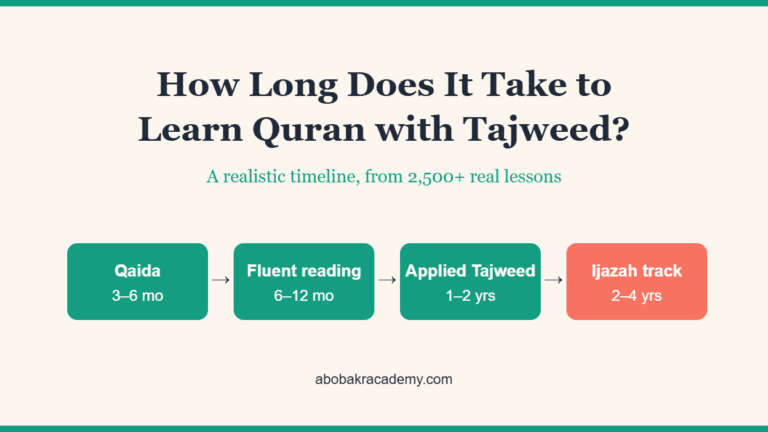
Fluent reading comes before rule work. If your child is still sounding out letters one at a time, start with Quran reading and let Tajweed follow once the words flow.
Start with one rule
If you check one Tajweed rule this week, make it this one. Run the test tonight, and if the sound is missing, make it the only thing you listen for until Friday.
If you would like someone qualified doing the listening, our online Tajweed lessons are one to one, with teachers who work specifically with children learning Arabic sounds for the first time. The first class is free. Tell us your child’s age and roughly where they are, and we will match a teacher.