
Free Printable Tajweed Rules Chart, All the Core Rules on One Page
Most children who have been reading Quran for a year or two can sound out the words perfectly well. What slips is everything around the words. The noon that should have been hidden, the meem held for two counts instead of one, the qaf at the end of a verse that lands flat instead of bouncing. None of that shows up when a child reads aloud quickly, which is exactly why it goes uncorrected for months.
This chart puts the core Tajweed rules on a single page you can print and keep next to the Mushaf. It is free, there is no email signup, and you are welcome to print as many copies as you need for your family, your class, or your weekend school. If you want the two halves of the alphabet on a sheet of their own, the sun and moon letters chart covers all 28 with a printable PDF.
Download the chart
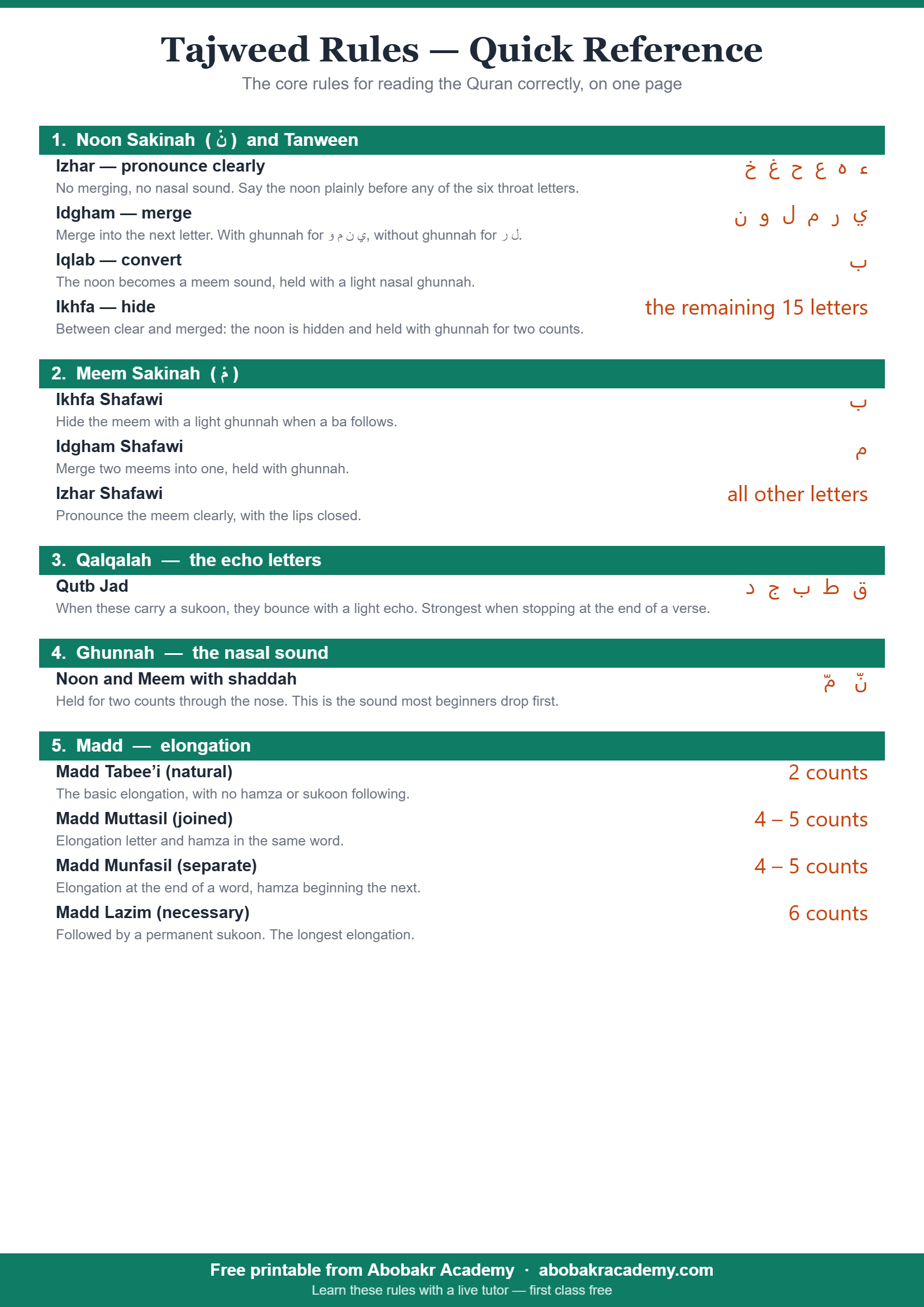
- Tajweed rules chart, print-ready A4 PDF (the fullest version: every rule family, the letters that trigger it, and the mistake each one usually hides)
- Tajweed rules chart, colour version (best on screen, or colour printing)
- Tajweed rules chart, black and white (cleaner on a home printer, no colour ink)
What the chart covers
Five families of rules, which between them account for most of what a beginner gets wrong:
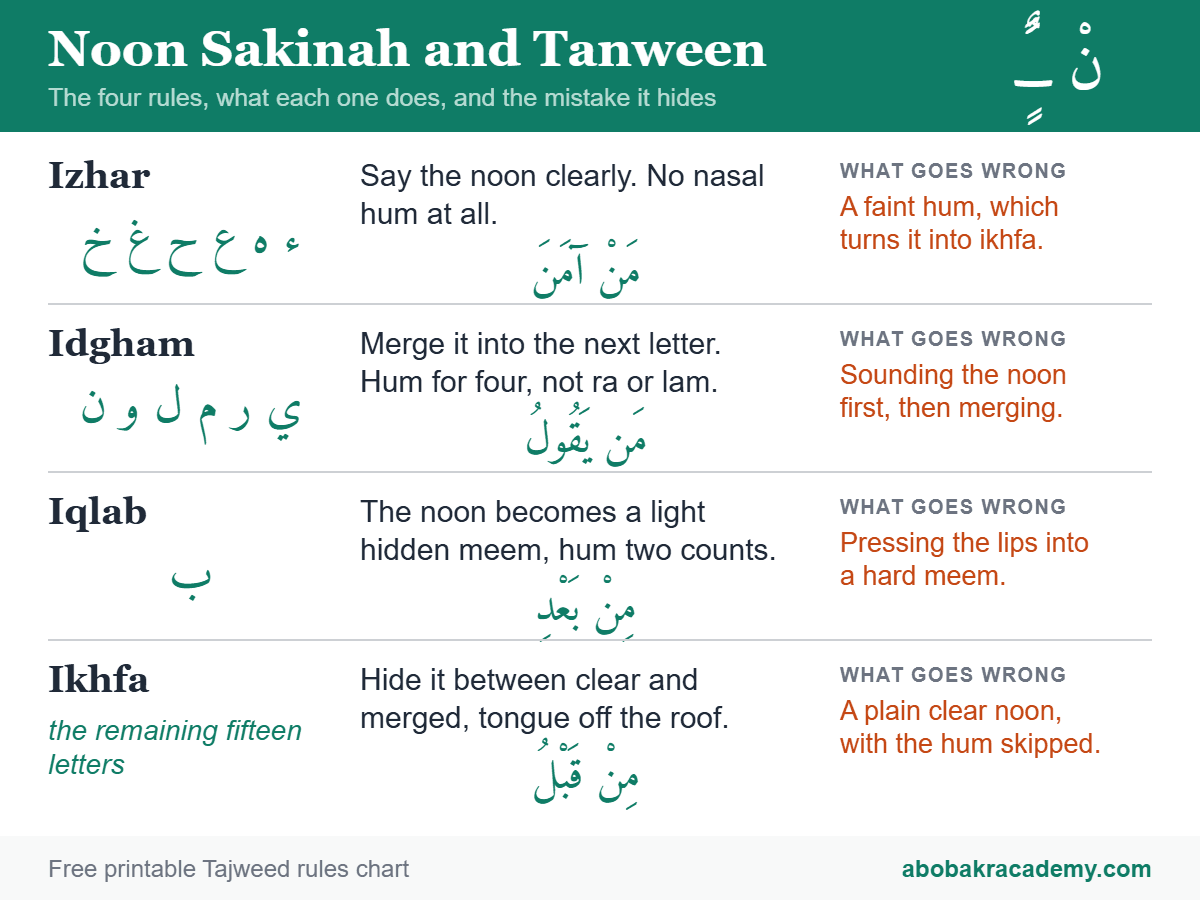
- Noon Sakinah and Tanween, the four rules of Izhar, Idgham, Iqlab and Ikhfa, with the letters that trigger each one.
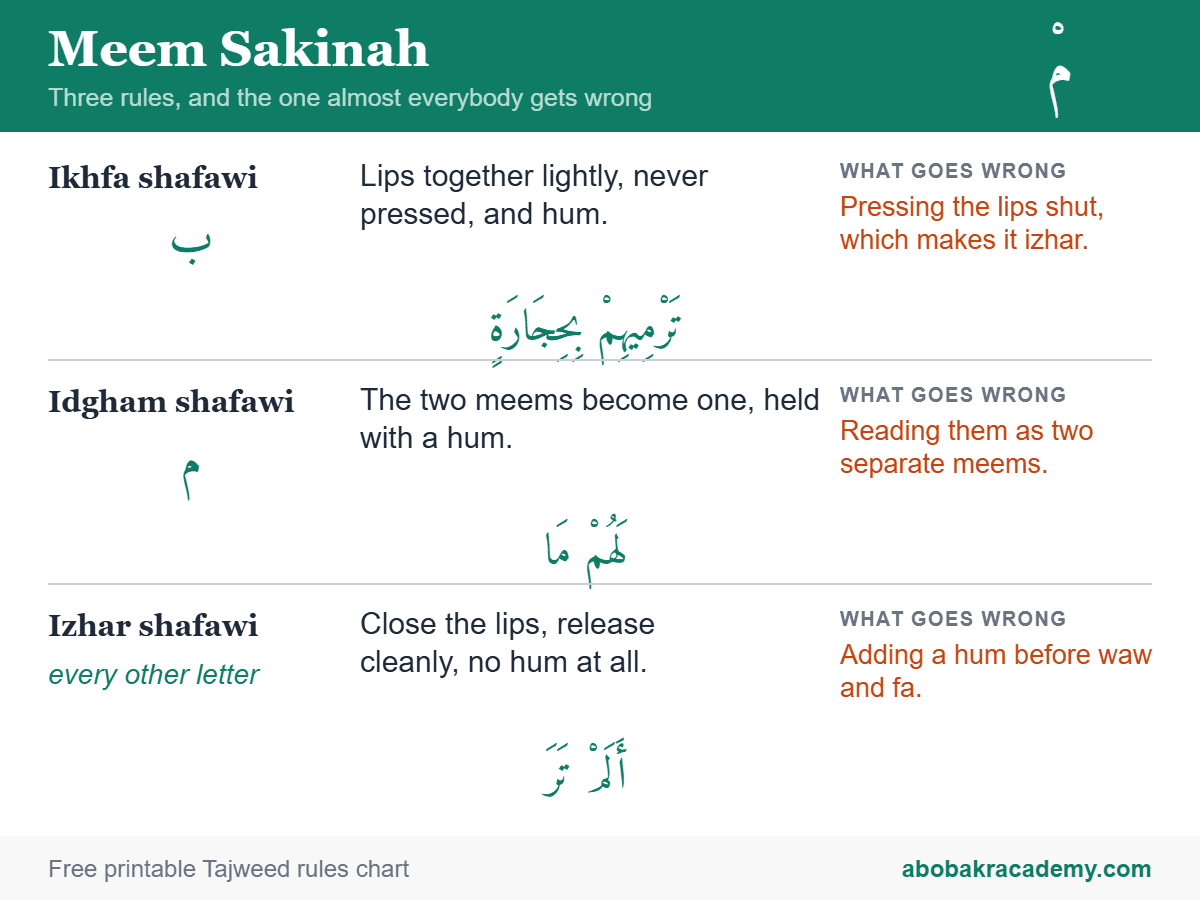
- Meem Sakinah, the three rules, including the one most commonly missed, Ikhfa Shafawi before a ba.
- Qalqalah, the five echoing letters, grouped by the usual mnemonic Qutb Jad.
- Ghunnah. The nasal sound on noon and meem carrying a shaddah.
- Madd, the four common elongations and how many counts each one is held.
One sheet per rule family
The chart at the top of this page is the whole thing on one side of A4. These four are the same rules split by family. They are easier to pin beside a desk, and easier to send to one child who is working on madd this month and not on anything else. Tap any of them to open the full size version.


Every rule, the letters that trigger it, and the mistake it hides
The sheet above is the version to print. This is the same thing as text, so you can search it, read it on a phone and copy a line into a lesson plan. The fourth column is the one to read twice. It is the mistake each rule usually hides, and it is the half that most charts leave out. For the reasoning behind a row rather than the instruction, the full explainer is in our guide to the Tajweed rules, and reading Quran with Tajweed covers holding them together at reading speed.
| Rule | What triggers it | What you do | The fault it usually hides |
|---|---|---|---|
| Izhar | Noon sakinah or tanween before ء ه ع ح غ خ | Say the noon clearly, with no nasal hum at all. مَنْ آمَنَ, man aamana. | A faint hum creeping in, which turns it into ikhfa. |
| Idgham | Before ي ر م ل و ن | Merge the noon into the letter after it. With ghunnah for ي ن م و, without for ر and ل. مَن يَقُولُ, may yaqool. | Sounding the noon first and then merging, so both are heard. |
| Iqlab | Before ب | Turn the noon into a light hidden meem and hold the hum about two counts. مِنْ بَعْدِ, mim ba’di. | Closing the lips firmly and saying a hard meem. |
| Ikhfa | Before the remaining fifteen letters | Hide the noon between clear and merged, tongue away from the roof of the mouth, hum about two counts. مِنْ قَبْلُ, min qablu. | Reading a plain clear noon and skipping the hum. |
| Ikhfa shafawi | Meem sakinah before ب | Bring the lips together lightly without pressing, and hum. تَرْمِيهِمْ بِحِجَارَةٍ, tarmeehim bihijaarah. | Pressing the lips shut, which makes it izhar instead. |
| Idgham shafawi | Meem sakinah before م | Merge the two meems into one and hum. لَهُمْ مَا, lahum maa. | Reading them as two separate meems. |
| Izhar shafawi | Meem sakinah before any other letter | Close the lips, release cleanly, no hum. أَلَمْ تَرَ, alam tara. | Adding a hum before و and ف, where the lips are already busy. |
| Qalqalah | ق ط ب ج د carrying sukoon | Give the letter a light bounce as you release it. قُلْ, qul. | Adding a vowel after the bounce, so qul becomes quli. |
| Ghunnah | Noon or meem carrying a shaddah | Hold the nasal sound about two counts. إِنَّ, inna. | Passing straight over it. This is the one most commonly dropped. |
| Madd tabee’i | A madd letter with no hamzah or sukoon after it | Two counts, the natural length. قَالَ, qaala. | Stretching it to four out of habit. |
| Madd muttasil | Madd letter and hamzah inside the same word | Four to five counts, and it is obligatory. جَاءَ, jaa-a. | Giving it the same length as a natural madd. |
| Madd munfasil | Madd ends one word, hamzah begins the next | Two, four or five counts, but keep it the same throughout. إِنَّا أَعْطَيْنَاكَ, innaa a’taynaak. | Changing the length part way through a recitation. |
| Madd lazim | Madd letter followed by an original sukoon or a shaddah | Six counts, every time. الضَّالِّينَ, ad-daalleen. | Cutting it short, which is the commonest fault in al-Fatihah. |
Every example in the table is a real verse rather than a made up word. If you would rather hear one than read it, al-Fatihah 7 on Quran.com ends on the six count madd lazim in the last row, and it is the one almost everyone shortens.
The rule almost every beginner drops first
If you only watch for one thing when your child reads, make it ghunnah. It is the nasal sound held for roughly two counts on a noon or meem with a shaddah, and because English has no equivalent, children raised outside an Arabic-speaking home tend to skip it entirely without noticing. The word still sounds recognisable, so nobody corrects it, and a year later it has become a habit that takes real effort to undo.
It is easy to check. Ask your child to read a verse containing a shaddah on a noon or meem and listen for whether the sound carries through the nose at all. If it stops dead at the letter, that is the gap.
How to use it with a child
Do not hand a seven-year-old a page of rules and expect it to help. What works better is picking one row per week. Put the chart somewhere visible, choose a single rule, and listen for that one rule only during the week. Ignore the rest, even if you hear other mistakes, a child corrected on five things at once stops volunteering to read at all.
Older children can use it differently: as a checklist to self-assess after reading, which builds the habit of listening to their own recitation rather than waiting to be corrected.
What a chart cannot do
A word of warning before you download it: Tajweed is a listening skill. A chart can tell you that Ikhfa exists and which fifteen letters trigger it; it cannot tell you whether the sound your child is making is right. You cannot hear yourself accurately while you recite. Everyone believes their pronunciation is fine until someone stops them mid-verse.
So use the chart as a reference and a reminder, not as a teacher. The corrections have to come from someone listening in real time, whether that is a parent who reads well, a teacher at the masjid, or a tutor.
Ghunnah is the clearest case. The chart can tell you it lasts about two counts, and no chart can tell you whether the two counts your child just held were nasal or simply slow. That one is testable by ear in a single evening, which is the nearest a parent gets to checking it without Arabic.
Our other free printables
Three more, also free and also without a signup:
- The Arabic alphabet chart, letter forms and the six letters that never join to the left, useful before a child starts reading words.
- The monthly Quran progress check, on the same page, a one-sheet record of what your child can read and recite, so progress is visible month to month rather than guessed at.
- The short surahs tracker, for the stage after reading is fluent, with the nineteen shortest surahs in the order worth learning them and a column for the check that shows a surah has really gone in.
Using it in a class or co-op
Teachers and homeschool groups are welcome to print and distribute this freely. There is no licence to worry about and no attribution required, though a link back is always appreciated if you host it somewhere. If it would be more useful in a different format or size for your setting, tell us and we will make it.
Who the chart suits, and which tradition it follows
Is this suitable for an adult beginner?
Yes. Adults often find the chart more immediately useful than children do, because the rules are presented as logic rather than repetition, and that suits how most adults learn. Pair it with recitation you listen to regularly and it works well.
Do I need to know Arabic to use it?
No. The rules are written in English, with the Arabic letters shown so you can recognise them on the page. Many parents using it cannot read Arabic themselves and use it to follow along with what their child is being taught.
Which Tajweed tradition does this follow?
It follows the rules as commonly taught in the narration of Hafs from Asim, which is what the overwhelming majority of printed Mushafs and online classes use. The instruction the whole discipline rests on is one verse, Surah al-Muzzammil 73:4, to recite the Quran tartilan, measured and unhurried, and the hadith literature treats the sound of it as part of the obligation rather than decoration: Sunan Abi Dawud 1468.
Can we get these rules taught properly?
That is what our online Tajweed lessons are for, a qualified teacher listening and correcting as your child reads, which is the part a chart cannot replace. There is also a broader Quran programme if reading fluency needs work first.
Print it, and start with one rule
Download whichever version suits your printer, put it where your child reads, and pick a single row to focus on this week. If you would like someone qualified listening while they read, our first class is free, tell us your child’s age and roughly where they are, and we will match a teacher.