

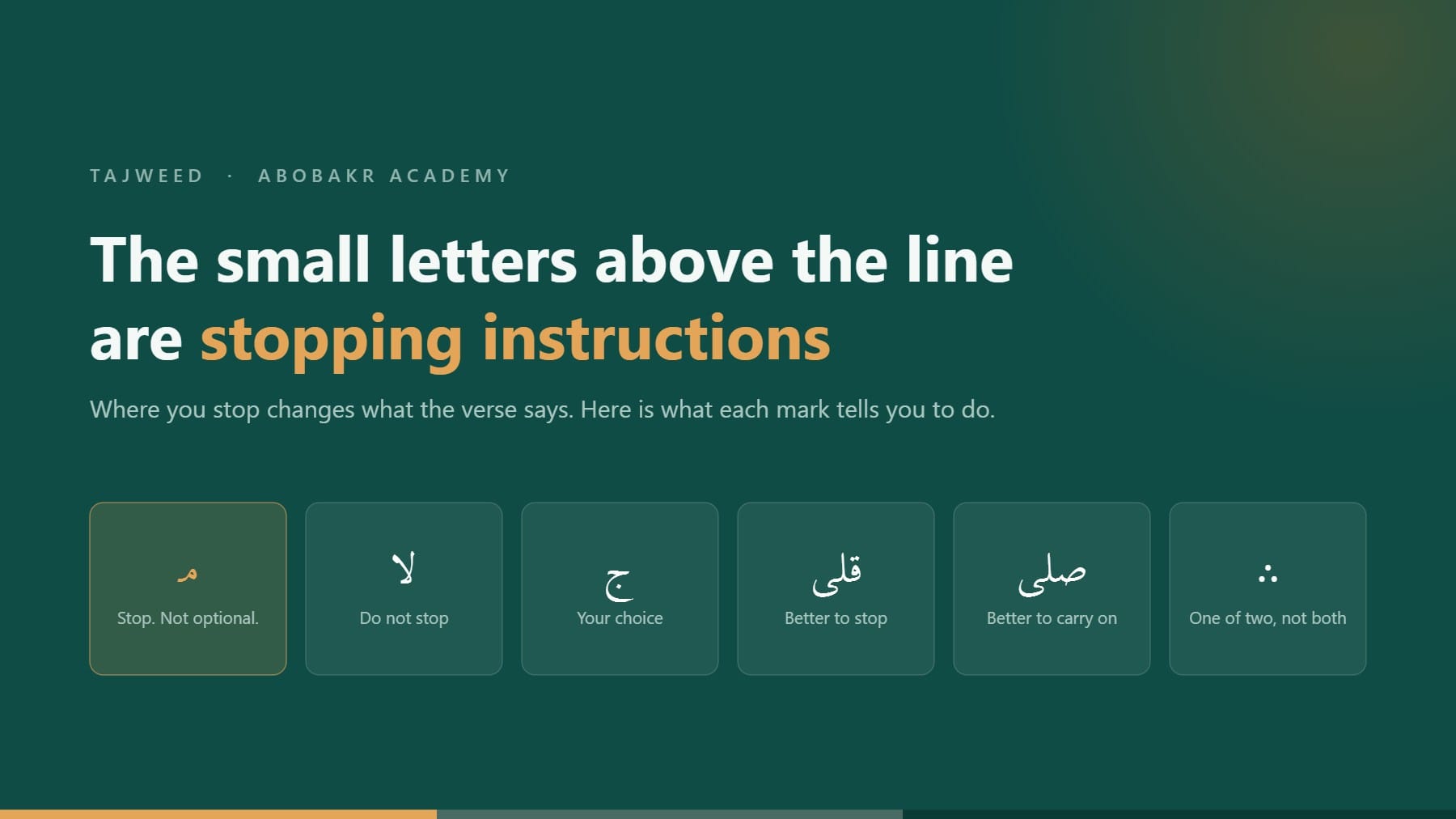
Open a mushaf at almost any page and you will see small letters sitting above the line, in a lighter colour or a smaller hand than the words themselves. A tiny ج here, a لا there, occasionally three dots that seem to have been sprinkled on twice. Most people who did not grow up with a teacher beside them read straight past all of it.
They are not decoration, and they are not part of the verse. They are the Quran stop signs, and they were put there because where you stop changes what the words mean. In the books they are called waqf marks, and the two names describe the same set of symbols.
Where you breathe is part of the meaning
Arabic sentences in the Quran run long. A single thought can stretch over three lines, and a reader who runs out of air halfway through has to stop somewhere. If you stop in the wrong place, you can end a sentence on a word that flips its sense, or join two clauses that were never meant to touch.
The clearest example in the whole mushaf is in Surah Al-An’am, verse 36. Read it once with the stop, and once without:
Run the two together and you have said that the dead respond too.
That is why the marks exist. Not to make recitation prettier, but to stop a reader turning a sentence into something the verse does not say.
The Quran stop signs you will actually meet
There are longer lists in the books, but in an ordinary mushaf you will meet six or seven of them, over and over. Learn these and you have covered nearly every mark you will ever see.
Two of these cause more confusion than all the others combined, because they look similar and mean opposite things. صلى is short for al-wasl awla, continuing is better. قلى is short for al-waqf awla, stopping is better. One letter apart on the page, and a reader skimming will take one for the other for years.
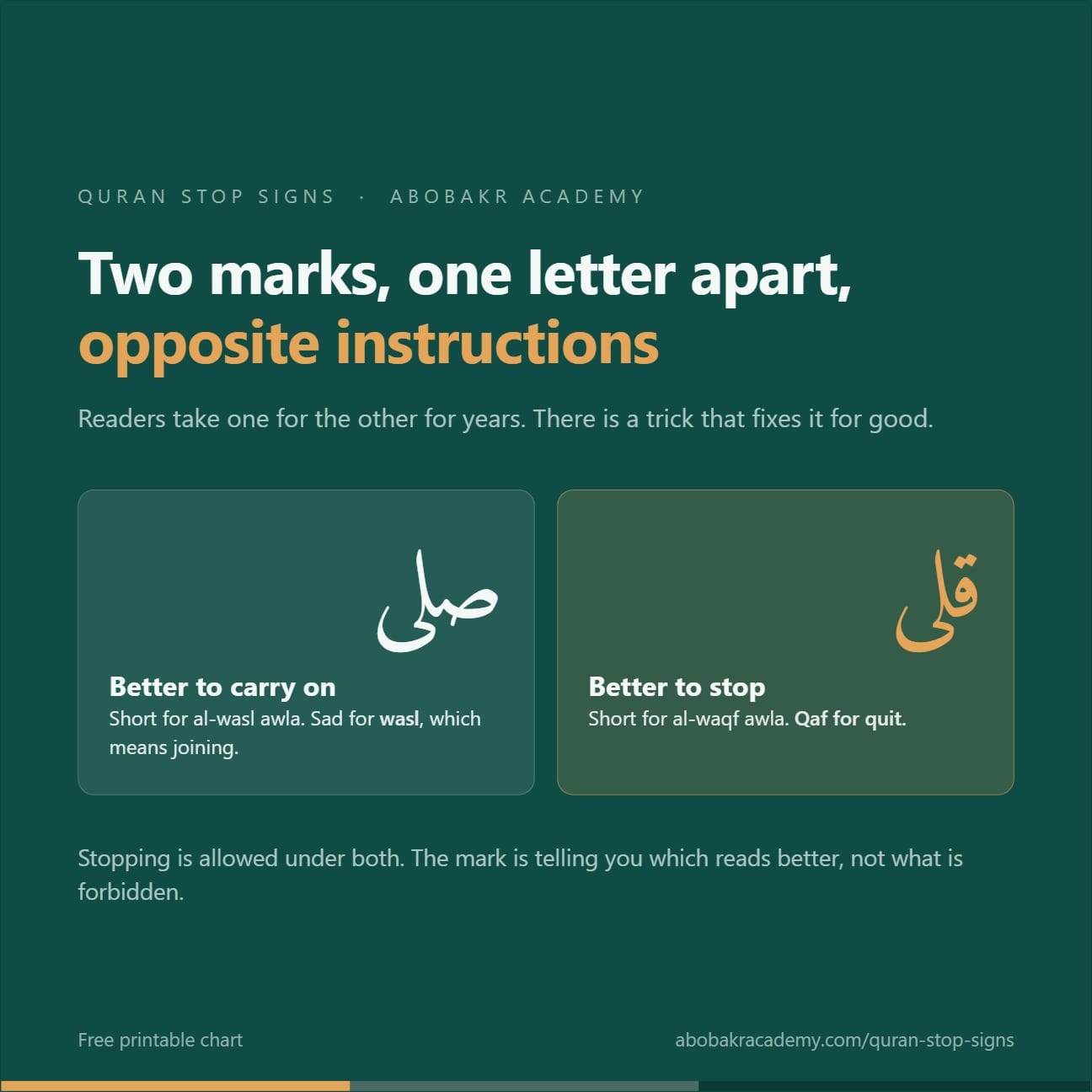
The trick that fixes it: ص is the first letter of wasl written in its old spelling, and wasl means joining. ق is the first letter of waqf, and waqf means stopping. Qaf for quit.
The three dots that come in pairs
If you see three dots in a triangle, look ahead a few words. There will be another set. They always come as a pair, and they are telling you something no other mark tells you: the verse can be read two ways, and you should choose one.
Stop at the second: this Book, there is no doubt in it. Guidance for the God-conscious.
Both are sound. Stopping at both is the one thing you must not do.
You can see the pair in place in Al-Baqarah verse 2. Reading this in a group is where it shows. Two people stop at different dots and both are correct, which surprises people who assume there is a single right way to read every line.
Saktah: stop the sound, keep the breath
This is the one almost nobody is taught unless a teacher is listening. In four places, the reading of Hafs calls for a saktah: a short break in the sound with no breath taken. You cut the voice for about the length of one beat, then carry straight on. Take a breath and you have done something different from what the mark asks.
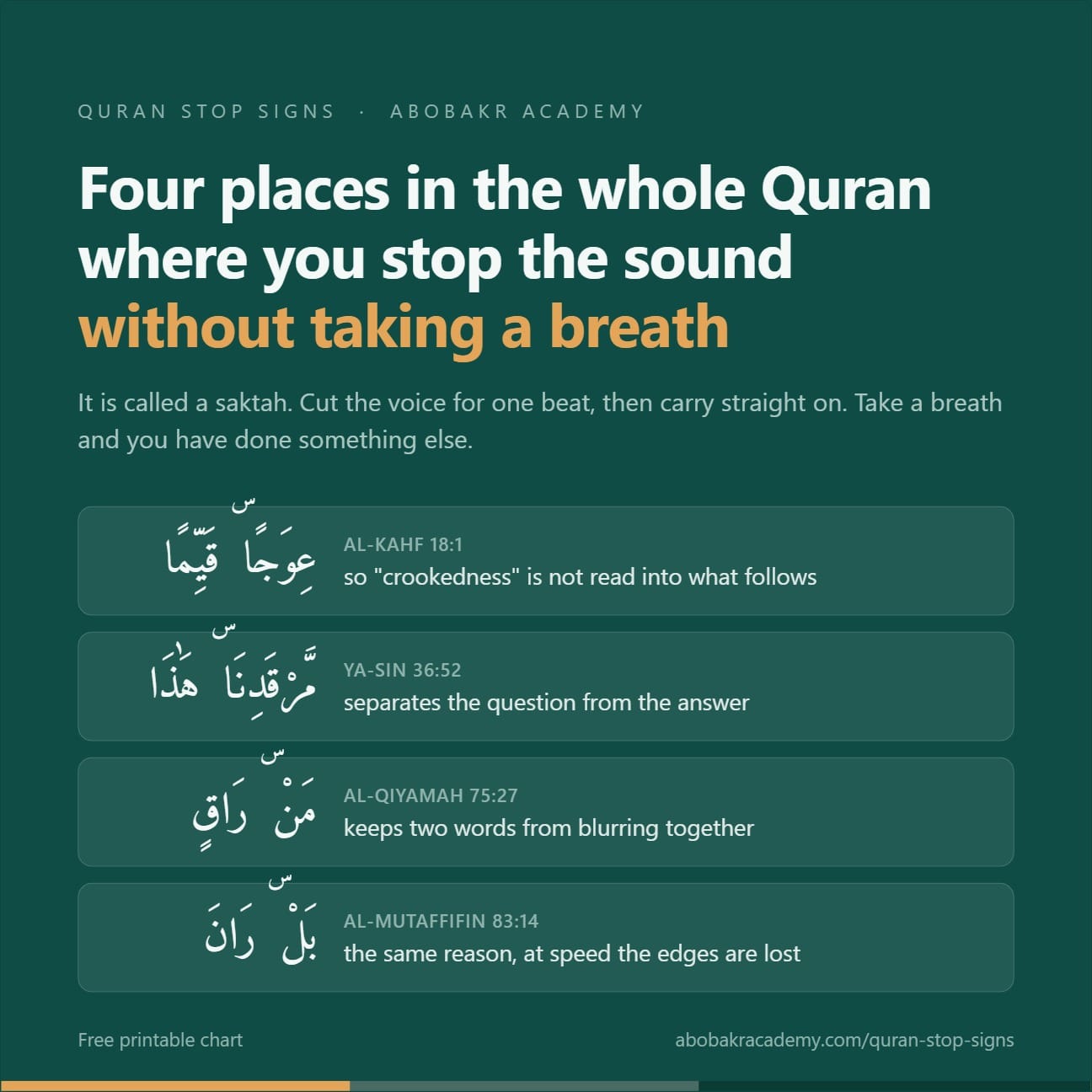
If you have read the Quran for years and never held a saktah, you are in ordinary company. It is exactly the sort of thing that never comes up until somebody hears you read.
Your mushaf may not match this list, and that is fine
Here is the part most articles leave out. These marks are not revelation. The verses are fixed; the stopping marks are the work of scholars who read the text closely and wrote down where the sense breaks.
The core system goes back to Muhammad ibn Tayfur al-Sajawandi, who died in 560 AH and set out six marks in his book on stopping and starting. Later printers added to it, dropped from it and rearranged it. So a Madinah mushaf leans on صلى and قلى where a South Asian printing may use ط and ز, and a Turkish or North African copy may mark fewer stops altogether.
If you and your child are reading from different printings, the marks will not always line up. Nobody is wrong. You are reading two editors, not two Qurans.
This matters practically. Buy the same mushaf your teacher uses, or at least know which family yours belongs to, and a whole category of confusion disappears.
What a parent who does not read Arabic can still check
You do not need to read the script to notice the two failures that matter most, and both of them are audible.
Does your child ever stop in the middle of a line? A reader who only stops at the end of verses is not reading the marks at all. They are reading to the red circle and taking a breath there because that is the obvious place. Ask them to point at a mark on the page and tell you what it says to do. If there is no answer, that is your finding.
Does the breath run the reading? Listen for stops that arrive with a gasp. A stop chosen for meaning sounds settled, and the next phrase starts cleanly. A stop forced by empty lungs sounds like an interruption, and it usually lands in a strange place. This is the same failure that shows up when rules are known but not yet applied while reciting, and it gets worse the faster a child reads.
Neither check needs Arabic. If you want more of this kind of listening test, the printable Tajweed rules chart puts the core rules on a single page, and the nasal sound children raised abroad drop first is the other thing worth listening for once stopping is under control.
What happens to the last word when you stop
Stopping is not simply going quiet. The word you stop on changes shape, and this is the part that separates someone who knows the marks from someone who can actually use them.
This gives you a second test that needs no Arabic. Listen to the last sound your child makes before they pause. If a stop ends in -un, -in or -an, they have stopped without applying any of this, which usually means they stopped because the breath ran out rather than because they decided to. A stop done properly ends flat, on the consonant, or on a stretched -aa.
Starting again is the half nobody teaches
Every article on this subject stops at the marks. The classical books spend as much time on ibtida, starting, because a stop is only half a decision. Where you resume from decides whether the sentence survives.
The scholars graded stops long before Sajawandi printed symbols for them, and the grades are what the symbols are shorthand for. There are four, and knowing them tells you what to do after you have stopped:
Notice that going back is not a mistake or an admission of failure. It is the prescribed thing to do, and it is why an experienced reciter who runs out of breath mid-phrase repeats a word or two rather than picking up where the sound stopped. Teach a child this early and they stop feeling caught out when their lungs give way in a long verse.
One more thing about resuming: the vowel you dropped at the stop comes back when you start again. You stopped on الرَّحِيمْ, but if you resume from that word you say الرَّحِيمِ once more, because the grammar has restarted with it.
A week of practice that changes something
Reading about this does nothing on its own. Five short sessions will do more than an hour of explanation, and none of them need you to read Arabic.
Nights one and two, hunt for marks. Open one page and have your child find and name every mark on it. Not read, just find. Two minutes.
Night three, the compulsory stop. Find a مـ and read the verse both ways, with the stop and without. Ask them which one sounds like it means something different.
Night four, listen to the endings. Have them read four lines slowly and stop at each mark. You are only listening for whether the stops end flat rather than on -un or -in.
Night five, go back. Ask them to read until their breath runs out, wherever that falls, and then resume by going back to the start of the phrase rather than from where they stopped. This is the habit worth building, and it is the one a page of rules cannot install.
Print the chart and keep it with the Mushaf
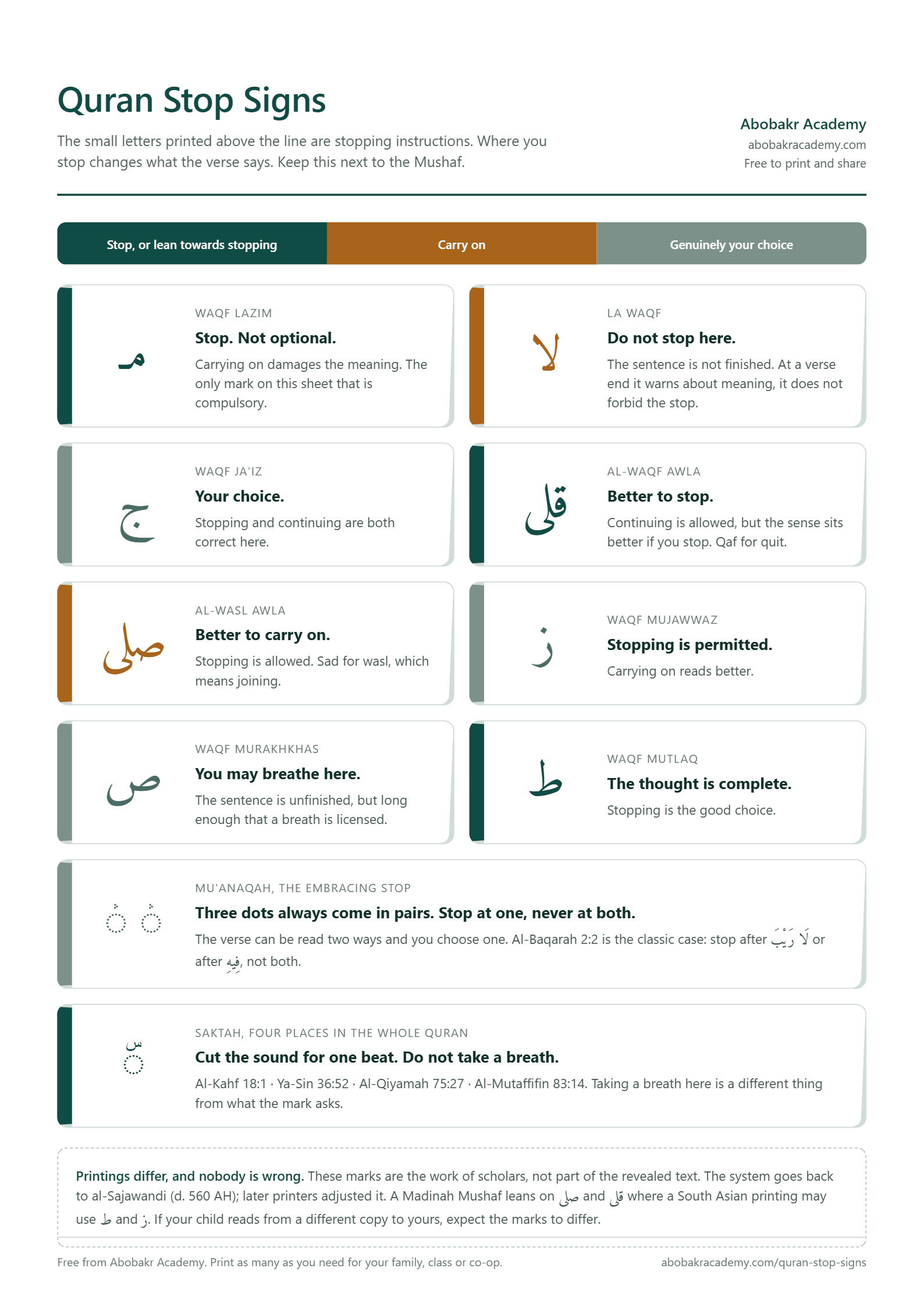
We made a one page version of everything above so it can sit next to the Mushaf rather than on a screen. It is free, there is no signup and no email wall, and you are welcome to print as many as you need for your family, your class or your weekend school. Teachers and co-ops are welcome to host the file themselves rather than link to us.
Quran stop signs chart, colour version (best on screen or a colour printer)
Quran stop signs chart, black and white (cleaner on a home printer, no colour ink)
What this article cannot do for you
Everything above is learnable from a page. What is not is whether you are actually doing it. A parent can hear that a stop landed flat rather than on -un, but cannot hear whether the qalqalah was a bounce or a thud, whether the stretched -aa ran to two counts or three, or whether the phrase your child resumed from was the right one.
None of it can be judged from a page. Somebody has to hear you read and stop you at the word. That is why this material has always been passed on face to face, and it is the honest reason a chart alone will not finish the job. Our one-to-one Tajweed lessons exist for exactly this gap, and adults working through it on their own often find starting again as an adult less embarrassing than they expected.
Questions people ask about the Quran stop signs
Is it wrong to stop where there is no mark?
Not automatically. Marks flag the places worth flagging, not every acceptable stop. A reader with good Arabic can stop anywhere the sense is complete. A reader without it should keep to the marks and to the ends of verses, because those are the stops that have already been checked for you.
Can I always stop at the end of a verse?
Yes. Stopping at the end of an ayah is sound, and there is a strong case that it is preferred, because it is how the Prophet, peace be upon him, is reported to have recited. This holds even where a لا sits at the verse end, which confuses many readers. The لا is warning you about the meaning if you stop, not forbidding the stop itself.
What if I run out of breath in the middle of a long verse?
Stop, go back a word or two, and carry on from there. Breaking off is a fact of reading aloud. Restarting mid-phrase without going back is the part that leaves the sentence broken.
At what age should a child know the waqf signs?
Once they can read a line without sounding it out letter by letter, usually around the second year of Qaida and Quran work. Before that the attention is on the letters themselves and adding marks to the load slows everything down. Introduce مـ and لا first. They are the two with consequences.
My child’s teacher never mentions the marks. Should I ask?
Ask. It is a fair question and the answer tells you something either way. Some teachers hold stopping back deliberately until reading is fluent, which is a defensible choice. Others have simply not got to it. The difference between the two answers is worth hearing.
Do the waqf signs apply in salah?
They apply most in salah, because that is where recitation is longest and breath is under the least conscious control. A reader who has never thought about stopping tends to break wherever the lungs give out, and in a long surah that happens several times.
Start with the two that matter
You will not learn eight marks in one sitting and you do not need to. Tonight, open the mushaf with your child and find one مـ and one لا. Read the verse both ways, with the stop and without it, and let them hear the difference themselves. That single comparison teaches more than the whole list, because it turns the marks from clutter on the page into something with a reason behind it.
If you would like a teacher listening while your child works through it, our tutors run a short trial lesson and will tell you plainly where the reading currently stands.