Kids

10 articles
Guidance for parents rather than lessons for children. Choosing a class, holding a routine together through the school year, and knowing what real progress looks like when you cannot check the work yourself.

How Long Does It Take to Memorize the Quran? Do the Arithmetic First

Range chart of how many years memorizing the whole Quran takes at four levels of weekly commitment, from 1 to 2 years at 30 hours a week down to 12 to 16 years at 2 hours a week.

The trial class finishes, everyone says salaam, and the teacher says something warm and vague about consistency and two years, in shaa Allah. You nod. Then you close the laptop and realise you have no way at all to test that sentence. You do not read Arabic. You cannot tell a strong page from a shaky one. And you are about to commit a child, and a monthly fee, to something you cannot measure. That is the actual question behind “how long does it take to memorize the Quran”. It is not really about the Quran. It is about whether the number you were quoted is honest, and whether your particular house can sustain it. So let us do the arithmetic properly, on paper, the way you would with anything else you were about to commit years to. The short answer, before the caveats A child who starts around seven, holds half a page a day through the school year and slows over the summers, finishes somewhere between thirteen and sixteen years old. An adult with a job who manages three sessions a week and a page each time is looking at four to six years. Someone doing a full page a day with nothing interrupting them finishes in two, and a small number of people do. Those are the ranges. Any teacher who gives you a single number instead of a range is either guessing or selling. They also assume a child who can already read Arabic without help, which is a separate piece of work that comes first. If your child is not there yet, the reading has to be solid before the memorizing starts, and that changes the clock considerably. But the ranges are the least interesting part of this, and they are not what you should be deciding on. What matters is the number underneath them, which almost nobody shows you, and which changes the whole shape of the commitment. Start with the only fixed number in the calculation A standard mushaf runs to 604 pages. That is the one figure in this entire exercise that does not move. Everything else is a variable you and your child control. So the naive sum is easy. Half a page a day, five days a week, is two and a half pages a week. Divide 604 by 2.5 and you get about 242 weeks, which is four and a half years of unbroken work. Hold that number for a second, because the real one is six to nine years for a child on exactly that pace. The gap between four and a half and nine is not sloppiness. It is the entire subject of this article. Look at what the sum quietly assumed. No illness, no exams, no travel, no Ramadan disruption, no summer, no week where the child simply refuses. Every half page going in first time. And, much bigger than all of those, it assumed that once a page is memorized it stays memorized. None of them hold. The last one is the one that doubles the timeline. The number that sets the timeline is review, not new memorization Here is the thing that separates a real hifz plan from a spreadsheet. New memorization is flat. Half a page today, half a page tomorrow, half a page next April. The workload never changes. Review is not flat. It grows with everything already memorized. When your child holds one juz, keeping it warm costs a few minutes. When they hold ten, keeping those ten warm costs most of the session. There is a point, usually somewhere around the twelfth to fifteenth juz, where the review load overtakes the new work and the child is spending forty minutes holding on to what they have and eight minutes adding to it. That crossover is where most children stall. Not because they got lazy and not because the teacher got worse. Because the arithmetic changed underneath them and nobody adjusted the plan. New pages stay the same size the whole way through. Review does not, and it takes its minutes from the only place available. The Prophet, peace be upon him, put it more sharply than any study plan could. Memorized Quran, he said, is more prone “to break away than a camel in its bind”. That is not a warning about effort. It is a description of how memory behaves, and it means that a plan built only around new pages is built wrong. Tonight: ask your child to recite something they finished six months ago. Cold, no warm-up, no prompt from the page. If it comes out hesitant or stops halfway, the plan has too much new work in it and not enough old. That is a scheduling problem, and it is fixable in a week. What this looks like on an actual school week Every published hifz schedule you have found assumes a student whose entire day is available. Three months, six months, one year, two years. Those plans are real. They are also written for someone doing six to eight hours a day in a residential programme with a teacher in the room. Your child gets twenty-five minutes after homework, on the evenings when there is no football and nobody is exhausted. That is a completely different calculation, and running it against a residential schedule is how families conclude they are failing when they are simply doing a different thing. So here is the honest version, in the units you actually have. What your week really looks like New material a week Realistic finish 20 to 25 minutes, 4 evenings About 1 page Juz Amma in roughly a year; the whole Quran is 12 years or more 30 minutes, 5 evenings 2 to 2.5 pages 6 to 9 years, and this is the commonest case 60 to 90 minutes, 6 days 5 to 7 pages 2 to 4 years, nearer two only if nothing interrupts 5 hours or more, 6 days 15 to 20 pages

A Ramadan Quran Reading Plan for the House Where No One Reads Arabic

Overview graphic for a Ramadan Quran reading plan built for households where no adult reads Arabic: one fixed reading slot after Maghrib, a weekly repeat of recent pages, and a listening habit that needs no Arabic reading skill.

If you’ve already worked out that “read a juz a day” doesn’t mean much when the person doing the reading is a nine-year-old who’s still sounding out letters, or an adult who hasn’t opened a mus-haf since Sunday school, you’re not doing Ramadan wrong. You’ve just noticed something most Ramadan planners don’t account for: they’re written for households where at least one adult already reads Arabic fluently. Yours might not be one of them, and that changes what a workable plan actually looks like. Why the Usual Ramadan Plans Don’t Fit This House Search for a Ramadan Quran reading plan and you’ll find the same handful of formats: a juz a day to finish the whole Quran by Eid, a page-a-prayer schedule built around the five daily prayers, or a “pick your pace” chart with three or four speed options. All of them assume the reader can already read. None of them tell you what to do when the reader is learning the letters themselves, or when you, the parent, are the one who’d have to check the reading and can’t. That’s not a small gap. It’s the reason so many well-intentioned Ramadan plans get abandoned by the second week: the child loses momentum because nobody at home can tell if they’re actually reading correctly, and the parent quietly stops asking because they don’t know what a right answer sounds like either. Start With Who’s Actually Reading, Not Who You Wish Was Reading A workable plan starts by being honest about who’s doing what this Ramadan. In most of the families we work with, that’s some mix of three people, and each one needs a different kind of plan. Reader What Ramadan usually does to their reading What actually helps The child mid-way through learning to read Parents push a bigger daily target because it’s Ramadan, and the child falls further behind on accuracy Keep the daily amount the same as any other month; add a short listening habit instead (see below) The parent restarting their own reading Guilt about “not knowing enough to lead by example” stops them starting at all A fixed 10 minutes after Maghrib, reading whatever they can manage, with no target to finish anything The homeschooling parent tracking more than one child One shared chart for children at different stages, so it fits nobody well One row per child on the same weekly sheet, with different daily amounts written in If two or three of these people live in your house, that’s fine. The plan below has a lane for each of them, and none of the lanes requires you to check a recitation by ear in Arabic you don’t read yourself. The Three-Part Shape That Actually Survives Ramadan Tutors who run Ramadan intensives lean on the same three-part structure whether the student is six or sixty: new material, recent material, and older material on rotation. Ramadan tends to blow this up, because everyone wants to add new material and nobody wants to spend Ramadan on revision. That’s backwards for a house with a learning reader. New material is the smallest, most fragile part of the day precisely because it hasn’t been tested yet, and a child who takes on too much new reading during Ramadan loses the confidence to keep going once the month ends and the extra attention does too. For a family without a fluent Arabic reader at home, the practical version of this looks like three short, separate things rather than one long session: A fixed reading slot, five to fifteen minutes, same time every day. Straight after Maghrib works for most families because everyone’s already sitting down. A weekly repeat of whatever was read three or four days ago. Not new pages. The same ones, again, out loud. One short listening habit, covered in full further down, that gives you something to check even though you can’t read the text yourself. New material is deliberately the smallest piece. Most of the day’s few minutes go to reading something again, not reading something new. What an Actual Tuesday Looks Like Plans that stay vague fail. Here’s what this looks like in a real house, not a chart. 7:45pm, straight after Maghrib. Your daughter opens her mus-haf to the page she read yesterday, not a new one. She reads it out loud, slowly, while you sit nearby doing something else, half-listening. 7:52pm. She finishes. You ask her to read it once more, this time recording it on your phone. Ninety seconds, done. 8:00pm. You play Saturday’s recording back to back with tonight’s, not to grade it, just to hear whether it sounds steadier. It usually does, and telling her so takes ten seconds and matters more than you’d think. Once a week, Friday evening. You send both recordings to her Quran teacher with one line: “Is this improving, and is there anything I should be listening for that I’m missing?” That’s the whole homework loop, and it costs the teacher two minutes to answer. That’s the entire plan on a normal night. No juz count, no chart to fill in with a marker, nothing that requires you to know whether a letter was pronounced correctly. It survives busy nights because there’s almost nothing to it, which is the point. Four Things You Can Listen For Without Knowing Arabic This is the part most Ramadan guides skip, because they’re written by people who can already read the text and check it. You can’t do that, but you can do this: listen for pace, not pronunciation. None of these require reading a single Arabic letter. They’re about how the reading sounds, not what it says. Hesitation before a word, not during it. A pause mid-word is normal while sounding out a letter. A pause right before a whole word, every time it appears, usually means the word hasn’t actually been learned yet, just guessed at from memory of the page. A flat pace with no pauses at all. Real reading has natural stopping

The Arabic Letters Your Child Says Wrong 17 Times a Day

The Arabic words qalb meaning heart and kalb meaning dog side by side, one letter apart, above the article title

Al-Fatiha comes round seventeen times a day. Two rak’ahs at Fajr, four at Dhuhr, four at Asr, three at Maghrib, four at Isha, and the same seven verses in every one of them. That repetition is exactly why it’s worth listening to. Whatever your child is doing with those sounds, they’re doing it seventeen times a day and have been since they learned to pray. If a letter is being substituted, this is where the groove is deepest. It’s also the one passage you can check without reading Arabic, because you already know how it goes. You’ve heard it thousands of times. Your ear knows more than you think. What actually goes wrong The usual explanation is that Arabic has sounds English doesn’t have. That’s true, but it hides the useful part. Most of these letters have an English near-neighbour standing right beside them. Your child already owns that neighbour, reaches for it in both places, and produces one letter twice. They’re not failing at some exotic new sound. They’re flattening a pair into one. One letter on this page has no neighbour at all, and that one behaves differently: instead of a substitution you get a gap. One English sound, two Arabic lettersYour child already owns the English sound and reaches for it twice. English “k”as in kiteكkaflight, further forwardقqafdeeper, heavier English “h”as in hatهhaopen, unobstructedحhaasqueezed, rasping English “s”as in sunسseenlight and thinصsadheavy and full English “d”as in doorدdaltongue tipضdadside of tongue, longer Nothingno equivalentعaynmiddle throat, voicedNothing to substitute, so children skip it. Listen for a gap, not a wrong sound.Four English sounds standing in for eight Arabic letters, plus one letter with no English equivalent at all. That distinction is what makes this checkable. You’re not judging whether a sound is correct, which would need Arabic. You’re listening for whether two sounds are different from each other, which needs nothing but ears. How much this matters One pair genuinely swaps one word for another. قلب is qalb, heart. كلب is kalb, dog, and it’s one letter away. It’s the example most teachers reach for and it earns its place. Don’t carry that too far, though. Most substitutions don’t produce a different word. They produce something that isn’t a word at all, which is a different sort of error. Scholars do treat clear errors more seriously than hidden ones, and substituting one letter for another sits in the serious category. I’d rather say that plainly than hedge it. But the classical answer to the worry that follows is already there: the Prophet ﷺ said the one who recites the Qur’an proficiently is with the noble scribes, and the one who recites it and stumbles, finding it hard, has two rewards (Muslim 798, also Bukhari 4937 in slightly different wording). A child working at a sound is in the second group. That’s a good place to be, not a shameful one. Where these sounds are madeArabic uses the whole throat and mouth. English uses only the front half. هhadeepest throatع حayn · haamiddle throatق كqaf · kafback of tongueضdadside of tongueد س صdal · seen · sadtongue tipFrom the deepest part of the throat on the left to the tip of the tongue on the right. Note that qaf and kaf are tongue sounds, not throat sounds. Qaf and kaf Your English “k” is essentially kaf. There’s no English sound at all where qaf lives, so qaf gets swallowed by the neighbour next door. Both come from the back of the tongue against the roof of the mouth, not from the throat. Qaf sits further back and heavier, kaf slightly forward and lighter. Where to hear it: مَالِكِ يَوْمِ الدِّينِ in verse four carries kaf. الصِّرَاطَ الْمُسْتَقِيمَ in verse six carries qaf. The test: these two letters have clearly different names, so just ask. “Say qaf. Now say kaf.” Any child past the first Qaida lessons knows them. If you hear the same English “k” twice, you’ve found something worth passing on. The two h sounds Here the letter names won’t help you, because both ح and ه come out as some version of “ha” and that’s precisely why they collapse. So use words instead. You already know these two. ه comes from the deepest part of the throat and it’s open, breath with nothing in its way. ح comes from the middle of the throat, the same breath squeezed until the air rasps through a tightened passage. They differ in where they’re made and in how hard the air has to work. Where to hear it: الْحَمْدُ, the first word of verse two, opens on ح. اهْدِنَا, the first word of verse six, opens on ه. The test: ask for those two words, one after the other. ه should sound easy, like fogging a mirror. ح should sound tighter and rougher, closer to the start of clearing your throat but without the scrape at the back. That scrape belongs to غ, another letter entirely. If both words start with the same soft English “h”, they’ve been flattened together. Ayn, the one with no neighbour Ayn (ع) is the letter with nothing standing beside it in English. Not a rough approximation, nothing. It’s voiced, made in the middle of the throat with a genuine constriction, and most English speakers need months to get near it. Because there’s nothing to substitute, children don’t substitute. They skip. What you’re listening for is an absence. Where to hear it: عَلَيْهِمْ, in the last verse, begins on ayn. It appears twice in that verse, so you get two goes at it. Verse five gives you two more, inside نَعْبُدُ and نَسْتَعِينُ. The test: listen to the start of عليهم. There should be a real sound there, deliberate and slightly tight in the throat. If the word simply opens on a plain “a”, the way an English speaker would say “alay-him”, the ayn has been dropped. Be patient with this one. It’s the hardest to hear on the list and the slowest to fix.

What Is Ghunnah? The Tajweed Rule Children Raised Abroad Drop First

kids learning arabic quran mushaf

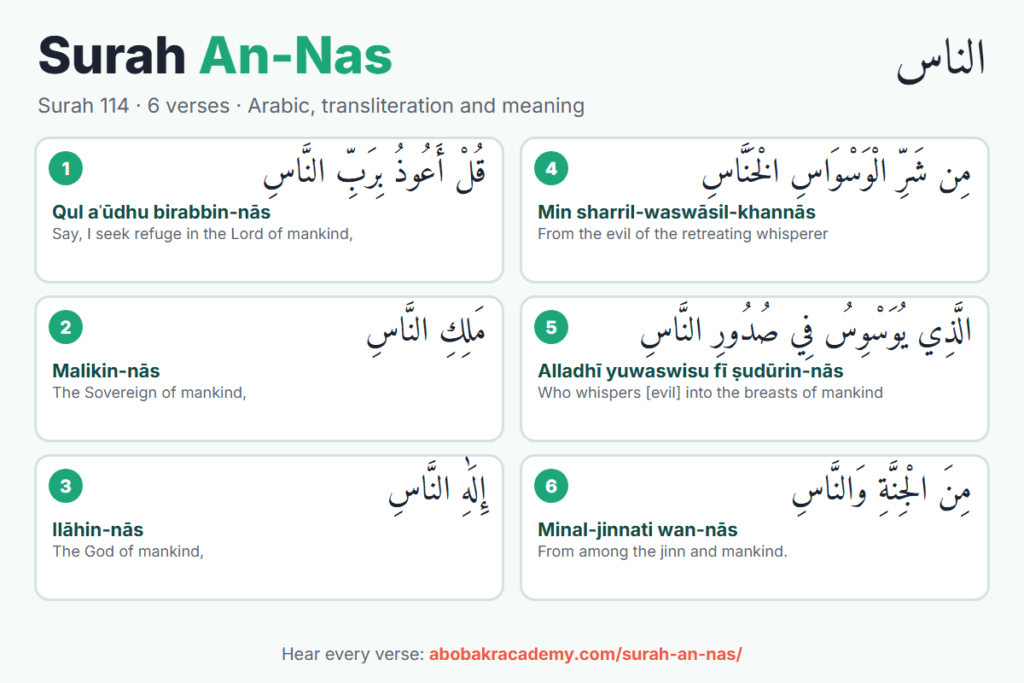
Your child reads the verse and it sounds fine. The letters are right, the pace is steady, nothing makes you stop them. Yet something is missing that a trained ear would catch in the first line. More often than not, what is missing is ghunnah in Tajweed: the nasal sound that should be there and is not. What ghunnah in Tajweed actually is Ghunnah is a nasal sound. It comes through the nose rather than the mouth, and it is held for roughly two counts. A count here means the length of one short vowel, about the time it takes to say “a”. It is required whenever a noon or a meem carries a shaddah: نّ and مّ. That is the entire rule. It is one of the simplest in Tajweed to state and one of the most commonly lost. Four words to test it on You do not need to hunt for examples. These come up constantly: إِنَّ (inna), noon with shaddah ثُمَّ (thumma), meem with shaddah النَّاسِ (an-naas), the word that closes Surah An-Nas مِمَّا (mimma), meem with shaddah Every one of them needs that held nasal sound. If your child rattles through all four without it, the rule is absent rather than inconsistent, which is actually easier to work with. Why children raised outside an Arabic-speaking home skip it English has no equivalent. There is no moment in an English word where you hold a nasal consonant deliberately and count it out. So when a child meets a shaddah on a noon, their mouth does what English trained it to do: it produces the consonant and moves straight on. Here is what makes it stubborn. The word still comes out recognisable. Nobody listening casually thinks anything is wrong, because nothing sounds broken. It sounds slightly hurried at most. So the child is not corrected, and they read it the same way the following week, and the week after that. A year later it is no longer a mistake. It is a habit, and habits take considerably more work to unpick than the rule took to learn in the first place. The two-count test, tonight You do not need to read Arabic to run this. Ask your child to read a verse containing a shaddah on a noon or meem. Surah An-Nas opens with one. Then listen for a single thing: Does any sound carry through the nose, or does it stop dead at the letter? If it stops dead, that is your answer. If there is a nasal sound but it finishes almost instantly, the rule is present and the length is not, which is a smaller fix. One warning before you try it. Do not turn this into an inspection. Ask your child to read something they already know well, listen, and say nothing at all the first time. You are gathering information, not correcting yet. What you will actually hear Parents often ask what the correct version sounds like, since they have no reference point. The closest English comparison is the sound at the end of “hmm” when you say it thoughtfully, held briefly rather than clipped. It resonates behind the nose. If you pinch your nostrils gently while making it, the sound changes noticeably, which is a useful check: pinch your child’s nose while they read one of the four words above, and if nothing changes, no ghunnah is being produced. How ghunnah in Tajweed gets fixed Slowly, and with someone listening. The sequence that works in practice: Exaggerate first. Have your child hold the sound far longer than two counts, four or five, so the body learns what the nasal resonance feels like. Accuracy comes after the sensation is familiar. Then shorten to two. Count it out loud together at first. Most children are surprised by how short two counts actually is once they have overshot it. One rule at a time. Do not correct ghunnah alongside four other things in the same session. A child corrected on everything at once stops volunteering to read. Expect it to slip. It will be correct in practice and vanish in normal reading for a while. That is ordinary progress, not failure. What age this makes sense at Children can produce the sound long before they can name the rule. A five or six year old can copy a held nasal sound accurately by imitation, and that is the right approach at that age: model it, have them echo it, move on. Naming the rule and counting the length suits roughly seven and above, when a child can hold an abstract instruction while reading at the same time. If your child is younger and reading already, do not skip the sound and plan to add it later. Imitation now costs nothing and prevents the habit forming. Where else ghunnah in Tajweed shows up Noon and meem with shaddah are the clearest cases, but the nasal sound also lives inside several other rules. Ikhfa, Iqlab, and Idgham with ghunnah all carry it. In practice this means a child who has lost ghunnah is not missing one rule, they are missing a component of several at once, which is why it is worth catching early rather than treating it as a detail. All of these sit on our free printable Tajweed rules chart, which puts Noon Sakinah, Meem Sakinah, Qalqalah, Ghunnah and the Madd lengths on one page. It is free, there is no signup, and teachers and co-ops are welcome to print it. If ghunnah is already steady, the next thing most children have never been shown is what the stopping marks above the line mean. Those marks decide where a breath is allowed to fall. Mistakes parents make when correcting Three that come up repeatedly, all well intentioned: Correcting mid-verse, every time. Stopping a child on each occurrence turns reading into a test. Let them finish, then go back to one instance. Over-holding it. Enthusiastic correction often produces a four count drone. Too long is

Your Child’s Quran Routine When School Starts Again

Chart showing what a child loses over a summer break: letter recognition holds up, reading fluency slips, and tajweed application and Quran memorisation go first

Most families do not notice the gap until the first lesson back. The child sits down in September, opens the mushaf at the page they finished in June, and cannot read it at the speed they were reading it two months earlier. Nothing has gone wrong. This happens to almost every child, and how the next three weeks are handled decides whether the year starts well or turns into an argument. What follows applies whether your child studies with a tutor or with you at home. Building a Quran routine for kids around a new school timetable is a different problem from keeping one going through the holidays, and our teachers working with younger students see the same pattern every September. What actually slips over a summer Not everything decays at the same rate, which is worth knowing because it tells you what to repair first. Letter recognition is stubborn. A child who genuinely knew the letters in June still knows them in September. What goes is fluency, the speed of moving from seeing a word to saying it. Reading that had become smooth reverts to sounding out, and to a parent listening it sounds like the child has forgotten far more than they have. Memorisation is the opposite. It decays quickly and quietly. Surahs recited daily in June are half gone by August, and the parts that survive are the beginnings. A child will start confidently and stall in the middle, which is the normal shape of decayed hifz rather than a sign of carelessness. Tajweed rules sit in between. The knowledge stays, the application goes first. Expect a child to be able to tell you what ikhfa is while not doing it. Repair fluency and memorisation first. Letter recognition rarely needs rebuilding. Why the September restart usually goes wrong The common mistake is restarting at the level the child finished at. It feels logical. It also means the first three lessons are spent failing, and a child who fails in the first three lessons decides they have got worse and stops wanting to go. Adults recover from a bad restart because they understand what is happening. Children read it as evidence about themselves. That is the whole reason the first fortnight matters more than the rest of the term. The second mistake is scheduling for the parent you intend to be rather than the parent you will be in week six. Four sessions a week booked in early September, in the first flush of a new school year, is a schedule that quietly collapses by half term and takes the habit down with it. Re-baselining without making it feel like a punishment Go back deliberately. Start the child a little below where they finished, on material they will get right, and let the first week be easy. Fluency returns much faster than it was built, usually within two or three weeks, because the underlying recognition never left. For memorisation, revise before adding anything new. A child who spends the first fortnight recovering surahs they already know will hold them far better than one who is pushed straight into new material on top of a shaky base. Nothing new goes in until the old material comes out cleanly. Say out loud what you are doing and why. A child told we are going back a bit because everyone does after a break hears something completely different from a child who is silently moved back a level. Fitting Quran into a school week The scheduling question parents ask is when there is time. The more useful question is when the child still has attention left, because those are not the same window. The after-school hour is worse than it looks The slot straight after school looks ideal on paper and is often the worst hour of the day. The child has been concentrating since morning, has not eaten properly, and still has homework ahead. Lessons in that window tend to be technically attended and largely wasted. Early mornings work better than most parents expect Before school is unpopular with everyone and works surprisingly well, particularly for memorisation, which benefits from a mind that has not yet been filled with anything else. Fifteen minutes of revision before breakfast holds more than forty minutes at nine at night. Weekends carry more than you think A family that cannot protect two weekday slots can still run a real programme on a weekend session plus short daily revision at home. The daily part is what matters. The lesson checks the work, but it does not replace it. When homework and Quran collide They will collide, usually around the time exams or projects appear, and the family that has decided in advance what happens copes far better than the family improvising at seven in the evening. The workable rule is to protect the daily revision and let the lesson move. Ten minutes of revision survives almost any week. A full lesson does not, and trying to force it through a genuinely overloaded evening teaches a child that Quran is the thing that gets fought over. Practically, that means knowing your rescheduling terms before you need them. Ours ask for two hours notice, and a weekly subscription includes one cancellation a month, so a clash can be moved rather than lost. Families who use that deliberately in a heavy week keep the habit intact. Families who cancel without moving the lesson usually lose the slot and then the routine. What a realistic first term looks like Roughly the first three weeks go on recovery, and it is a mistake to read progress before that. From there a child working steadily through a school term will normally rebuild to their June level and move meaningfully past it by the winter break. That is a slower headline than most parents expect and a faster one than most fear. The variable that moves it is not talent and rarely the number of lessons. It is whether the short

Noorani Qaida Classes for Kids

Noorani Qaida classes for kids_

A Noorani Qaida lesson is short, spoken and repetitive. Your child opens the book at the line they reached last time, reads it aloud, and the tutor corrects whatever came out wrong. Then they read it again. The letters become automatic through that repetition rather than through explanation. Abobakr Academy teaches the Qaida to children in live one-to-one classes over video call. Your child keeps the same tutor each week, at a time that fits around school, and the first class costs nothing. If that is where you are, our Qaida course is the usual next step. If you want the background on the book itself, our complete guide to Noorani Qaida explains what the lessons contain and how long the whole book usually takes. What Happens in a Noorani Qaida Class for Kids Lessons follow the same shape every week, which is most of why young children cope with them. The tutor greets your child, asks them to read back the previous line, and only then moves forward. Nothing new is introduced until the last thing is secure. Most of the class time goes on one specific difficulty. Children usually read isolated letters well within a few weeks, then stumble the moment two letters are joined and the shape changes. That join is where the repetition is spent. Recap of the previous lesson, read aloud by the child New letters or joins, modelled first by the tutor Correction of individual sounds, one at a time A short passage to practise before the next class Choosing the Right Class Length for Your Child’s Age Attention span decides this more than ability does. Ages four to six. Thirty minutes is usually the ceiling, and even that works best when the tutor breaks it up. Two shorter classes a week suit this age better than one long one. Ages seven to nine. Thirty minutes is comfortable and progress becomes visible faster, because children this age can practise on their own between lessons. Ages ten and above. Longer classes are workable, and children at this age often move through the Qaida quickly once the alphabet is secure. Where a child should enter this sequence is a question of readiness as much as age. Who Will Teach Your Child Our Quran teachers are Al-Azhar trained, and several hold Ijazah, meaning their recitation has been certified through an unbroken chain of teachers. That matters for the Qaida specifically, because a child copies the sound their teacher makes. A mispronounced letter learned at five is difficult to correct at fifteen. You can read the teachers’ names, subjects and qualifications on our About Us page. Families who would prefer a female teacher for their daughter should mention it when booking. Booking Classes Around School Hours We teach families in the United States, the United Kingdom, Canada and Australia. Our tutors keep late hours to cover North American evenings, so an after-school or weekend slot in your own time zone is almost always available. A five o’clock lesson in London falls at seven in the evening in Cairo. North American slots run later still. Tell us the window that works around school and homework, and we will fit the tutor to it rather than the other way round. Your Child’s First Class Is Free The trial is a real lesson, not a sales call. The tutor finds out what your child already recognises, starts them at the right page, and afterwards tells you honestly whether they are ready for the Qaida or would do better waiting a few months. Book through the form on this site or message us on WhatsApp. It helps to say your child’s age, your time zone, and whether they have seen Arabic letters before. How You Will Know Your Child Is Progressing The Qaida makes progress unusually easy to see, because it is ordered. Ask your child to read a page from three lessons ago. If it comes out fluently without prompting, the earlier material has settled and the pace is right. If it does not, the tutor slows down. That check works beyond the Qaida too, and there are other signs a parent can read without knowing Arabic. Tutors flag the letters a child keeps missing so the same sounds come round again in later lessons instead of being left behind. One-to-One Classes Compared With Group Classes Group classes are cheaper and work well for older children who already read. The Qaida is a poor fit for them. A child reading aloud in a group gets a fraction of the correction they need, and the mistakes that matter most are individual: one child cannot distinguish two similar letters, another rushes the vowels. One-to-one means every one of those gets addressed the week it appears. What Comes After the Qaida Finishing the Qaida means your child can decode Arabic script. The next step is applying the rules of recitation properly, which is covered in our Tajweed classes, and then reading from the Mushaf itself in our weekly lessons for children. Questions Parents Ask Before Booking What age can my child start Noorani Qaida classes? Around five is the usual starting point, because the child needs to sit still and repeat a sound back accurately. Some four-year-olds manage it in short bursts. If your child is not ready, the tutor will tell you honestly after the trial rather than take a booking that will not work. Does my child need to know Arabic first? No. The Qaida assumes no Arabic at all. It teaches the letters and their sounds from the first page, which is why it works for children in English-speaking homes who have never seen the script before. Can I sit in on the lessons? Yes, and with younger children we encourage it for the first few weeks. Most parents find their child settles after three or four lessons and prefers to manage the call alone after that. What happens if we miss a class? Tell the tutor in advance and

Online Arabic Lessons for Kids: Getting Them Speaking, Not Just Reading

Online Arabic Lessons for Kids

Teaching a child Arabic online works differently from teaching an adult, and the most common mistake is booking a child into a scaled-down version of an adult class. A seven year old’s attention span and motivation call for a different approach, not the same material delivered more slowly. There is a second difference that most course pages skip. A large share of the children in these lessons are not absolute beginners. They have heard Arabic at home their whole lives. What they cannot do is produce it, and that changes where the lesson should start. If you are looking at Arabic for the household generally rather than for one child, the adult programme covers that ground. When Your Child Understands Arabic but Answers in English Ask a Muslim parent in Manchester or Michigan how much Arabic their eight year old has, and the answer is often contradictory: he understands everything, he just will not speak it. That is not a contradiction. Understanding a language and producing it are two different skills, and they come apart quickly when a child spends six hours a day in an English-speaking school. The first is receptive, the second productive. A child can recognise hundreds of Arabic words instantly when a grandmother uses them and still be unable to build a sentence, because recognising a word costs far less effort than retrieving one. This decides how the lesson should be run. A child with a receptive base does not need the same starting point as a true beginner. Drilling the alphabet from zero throws away what they already have and bores them, which is usually the week a parent hears that Arabic class is boring. What they need is production: being asked questions they have to answer aloud, being handed a sentence frame and made to fill it, being allowed to be wrong quickly and often. The English-answer reflex does not break through explanation. It breaks through volume of speaking. In a lesson taught one to one, or in a small group of two or three, a child cannot sit behind a classmate, which is the main reason this format suits heritage learners better than a class of thirty. The free trial session is short, roughly fifteen to twenty minutes, and most of it is the tutor working out what the child already recognises before deciding where to begin. Recognising a word and building a sentence are two different skills, and they come apart fast. Why Kids Need a Different Structure, Not Just a Slower One Children generally learn best through repetition wrapped in something enjoyable: songs, short games, visual flashcards, and frequent small wins rather than long explanations. A thirty-minute session packed with short activities holds a child’s attention far better than the same thirty minutes spent on a single grammar point. Teachers working with young learners typically switch activities every five to seven minutes, something that would feel disjointed in an adult lesson but works well with a child. What Your Child Actually Learns, in Order Parents usually want the sequence, not just an assurance that one exists. For children the order below holds at any age, though the speed varies enormously. Letter shapes before letter names. Knowing the twenty-eight letters is the easy half. The harder half is that each one changes shape depending on where it sits in a word, and a child who has only met letters in isolation stalls badly here. It is worth staying on this until it is automatic. A wall chart helps here more than a book does; ours is free to download and print, and it shows every letter in all four positions. Short vowels, then reading aloud. Harakat turn letters into syllables, and this is the point at which naming letters becomes reading. It tends to arrive faster for a child who has heard the language spoken at home. Handwriting. Frequently skipped in online courses because it is awkward to supervise through a screen, and it should not be. Forming the letters by hand fixes their shapes in a way reading alone does not, and children who write Arabic read it with more confidence. Everyday speech. Greetings, family, food, school, the things a child can use with a relative that same week. For heritage learners this is where recognition starts converting into speech. Connected text. Short passages instead of isolated words. This is a bigger jump than it sounds and is where a lot of children need to slow down. Grammar, late and lightly. Children absorb pattern well before rule. Formal grammar introduced too early produces a child who can name a case ending and cannot hold a conversation. The sequence holds at any age. Only the speed changes. Different Ages Need Different Pacing Children under seven generally need heavy visual and audio repetition with minimal reading before letter recognition is solid, and we take students from age four. Children between eight and twelve can usually handle longer sessions and reading practice sooner, especially with some exposure to Arabic sounds at home. Teenagers often do better in a lighter version of an adult-paced class than in a young-child format, since the game-based approach starts to feel patronising once a student is old enough for direct instruction. A different shape of lesson, not the same lesson delivered more slowly. When Home Arabic and Classroom Arabic Disagree A child who speaks Egyptian or Levantine Arabic at home will eventually tell the tutor that a word is wrong. They are not being difficult. Written Arabic and spoken dialect genuinely differ in vocabulary and in the shape of ordinary sentences, and a child who has only ever heard one has no reason to expect the other. How that moment is handled matters more than which variety is being taught. What works is naming the difference out loud rather than correcting the child: this is how it is written, that is how your family says it, both are Arabic. Children accept that easily. What they will not accept

Book a free class