Harakat are the small marks above and below Arabic letters that give each letter its short vowel: a fathah says a, a kasrah says i, a dammah says u. Tanween doubles those marks at the end of a word to add an n: an, in, un.
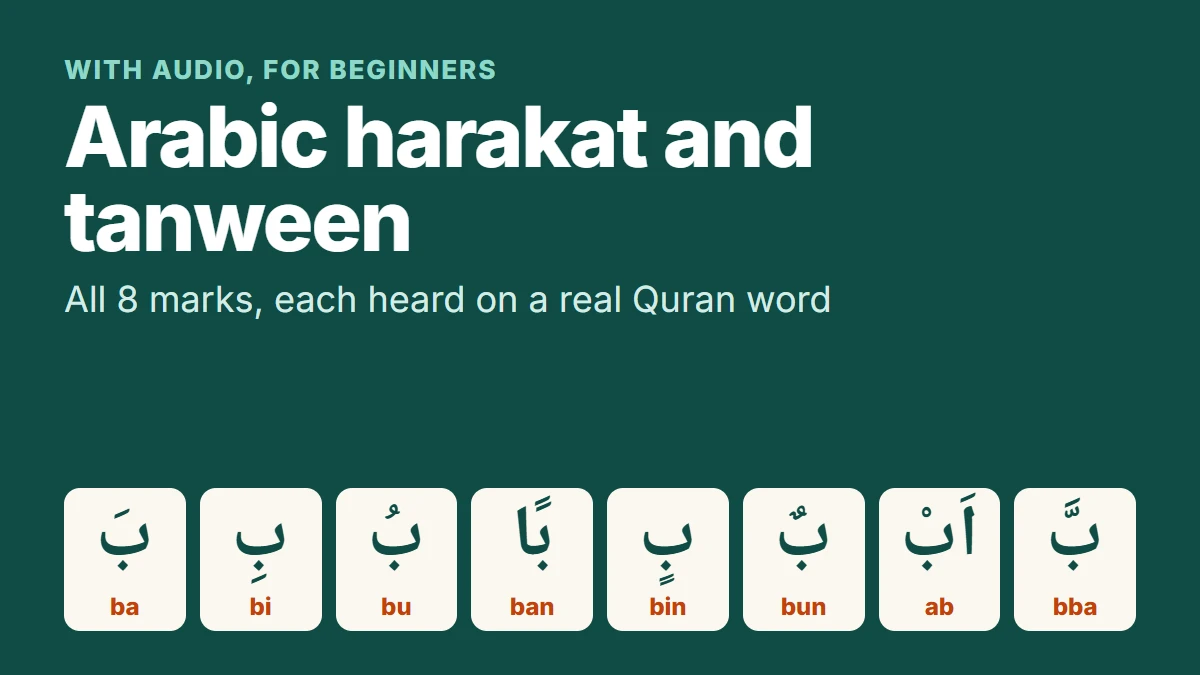
With the sukoon (no vowel) and the shaddah (a doubled letter), that makes the eight marks a beginner learns. Below, each one is shown on the same letter and played on a real Quran word, so you can hear it even if nobody at home reads Arabic.
The chart · Hear each mark · What to listen for · Two lookalikes · Printable sheet · Questions
The eight marks on one letter
Every card shows the letter ba (ب) so the only thing that changes is the mark. Look at where it sits: above the letter, below it, or doubled.
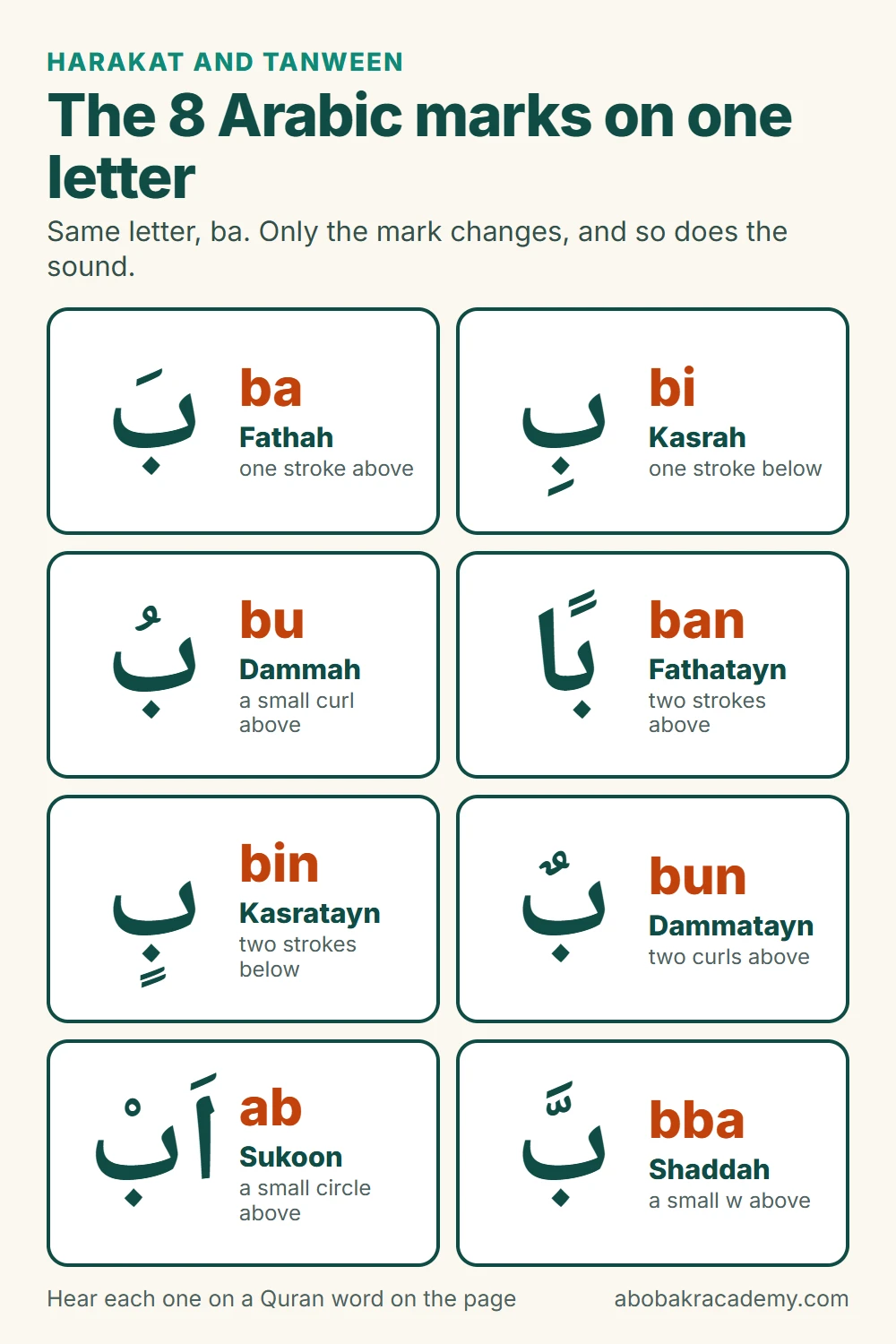
| Mark | On ba | Where it sits | Sound |
|---|---|---|---|
| Fathah | بَ | one stroke above | ba |
| Kasrah | بِ | one stroke below | bi |
| Dammah | بُ | a small curl above | bu |
| Fathatayn | بًا | two strokes above | ban |
| Kasratayn | بٍ | two strokes below | bin |
| Dammatayn | بٌ | two curls above | bun |
| Sukoon | اَبْ | a small circle above | ab |
| Shaddah | بَّ | a small w above | bba |
Hear each mark on a real Quran word
Each verse below is from Sheikh Mahmoud Khalil al-Husary’s teaching recitation (al-Mu’allim), read slowly so learners can repeat. The word that carries the mark is in orange. Press play and listen for the sound under “Listen for”.
The three short vowels (harakat)
Fathah (Al-Fil 105:1)
أَلَمْ تَرَ كَيْفَ فَعَلَ رَبُّكَ بِأَصْحَـٰبِ ٱلْفِيلِ
Have you not considered, [O Muḥammad], how your Lord dealt with the companions of the elephant?
Listen for: Fa’ala, “did”: three letters, each with a fathah, so three short a sounds in a row.
Kasrah (Al-Fatihah 1:1)
بِسْمِ ٱللَّهِ ٱلرَّحْمَـٰنِ ٱلرَّحِيمِ
In the name of Allāh, the Entirely Merciful, the Especially Merciful.
Listen for: The first word, bismi. The kasrah under the b gives a short i: bi, never ba.
Dammah (Al-Buruj 85:1)
وَٱلسَّمَآءِ ذَاتِ ٱلْبُرُوجِ
By the sky containing great stars
Listen for: The last word, al-burooj. The dammah on the b is a short u, said with rounded lips.
The three tanween marks
Tanween is only written on the last letter of a word. The n it adds is a sound, not a letter: you will not see a noon (ن) written. In each verse below the next word starts with a throat letter, so the n is said clearly; before most other letters it blends into the next word, which your child meets later in Tajweed.
Fathatayn (Al-Ikhlas 112:4)
وَلَمْ يَكُن لَّهُۥ كُفُوًا أَحَدٌۢ
Nor is there to Him any equivalent.
Listen for: Kufuwan ahad. The two strokes over the waw give wan: a short a, then a clean n before the next word.
Kasratayn (Al-Falaq 113:3)
وَمِن شَرِّ غَاسِقٍ إِذَا وَقَبَ
And from the evil of darkness when it settles
Listen for: Ghaasiqin idhaa. The two strokes under the qaf give qin: a short i, then the n, said clearly.
Dammatayn (Al-Qadr 97:5)
سَلَـٰمٌ هِىَ حَتَّىٰ مَطْلَعِ ٱلْفَجْرِ
Peace it is until the emergence of dawn.
Listen for: The first word, salaamun. The doubled dammah on the meem gives mun: a short u, then the n.
Sukoon and shaddah
Sukoon (Al-Masad 111:5)
فِى جِيدِهَا حَبْلٌ مِّن مَّسَدٍۭ
Around her neck is a rope of [twisted] fiber.
Listen for: Hablun, “a rope”. The b has a sukoon, so it closes the syllable with no vowel: hab, then lun.
Shaddah (Al-Falaq 113:1)
قُلْ أَعُوذُ بِرَبِّ ٱلْفَلَقِ
Say, "I seek refuge in the Lord of daybreak…"
Listen for: Bi-rabbi. The shaddah on the last b doubles it: the lips press and hold for a beat, rab-bi, not ra-bi.
What a parent can listen for (no Arabic needed)
In the Noorani Qaida, the short vowels and tanween come straight after the joined letters (Lessons 4 and 5 on our tracker; printed editions number them a little differently). You do not need to read the script to hear the three slips almost every beginner makes:
| The sound | Said right | What a slip sounds like |
|---|---|---|
| ba, bi, bu (the three harakat) | Three short, crisp sounds. | A long baa instead of ba, or a rising, guessing voice because your child is not sure which mark it is. |
| ban, bin, bun (tanween) | One beat: the vowel closes on a short n. | An extra syllable: ba-nun instead of ban. |
| The shaddah | The voice presses on the letter for a beat, then lets go: rab-bi. | Rushing past it as if the letter were single: ra-bi. In some words that changes the meaning. |
Tick off Lessons 4, 5 and 6 as your child finishes them on the free Noorani Qaida progress tracker. If the letters themselves are still shaky, start with the Arabic alphabet chart, and for the letters children say wrong most often, see the hardest Arabic letters to pronounce.
Two lookalikes parents ask about
A stroke near the shaddah. In many printed copies of the Quran, a kasrah on a doubled letter sits just under the shaddah’s little crown, still above the letter, instead of under the letter. It is still a kasrah, i. A stroke on top of the crown is a fathah, a.
The small upright alif. Next in the Qaida (Lesson 7 on our tracker) your child meets a small standing alif above a letter, and its cousins, a standing kasrah and an upside-down dammah. A normal fathah is short, one count. A standing fathah is a long vowel, held for two counts, like a full alif.
A printable practice sheet
Download the harakat practice sheet (PDF, 93 KB). One page: the eight marks on ba in large print, the sound under each, and three days of boxes to tick. Your child points and says each sound; you listen for the three slips above.
Questions parents and beginners ask about harakat and tanween
What is harakat in Arabic?
Harakat (حَرَكَات) means “movements”. It is the name for the three short vowel marks, fathah, kasrah and dammah, written above or below a letter to show which vowel follows it. Arabic letters are mostly consonants, so without these marks a beginner cannot tell ba from bi or bu.
How many harakat are there?
Three: fathah (a), kasrah (i) and dammah (u). Teachers usually teach eight marks together: those three, the three tanween marks, the sukoon and the shaddah. The standing vowels come after those eight.
What is the difference between tashkeel, harakat and tanween?
Tashkeel (تَشْكِيل) is the word for all the marks together. Harakat are the three short vowels. Tanween (تَنْوِين) is those vowels doubled on the last letter of a word to add an n sound, -an, -in or -un, without writing the letter noon.
Why does fathatayn usually come with an alif?
In standard spelling, a word that ends in fathatayn carries a silent alif after the mark, as in كِتَابًا (kitaban, a book). When you read on, you say -an; when you stop at the end of a verse, it becomes a long -aa. The exception is a word ending in a round taa (ةً): it takes no alif, and on a stop it is said -ah.
How do I write Arabic with harakat?
By hand, write the whole word first, then go back and add the marks above and below each letter. On a computer, most Arabic keyboard layouts put the marks on the Shift layer: type the letter, then the mark, and it attaches to the letter before it.
Children’s books and copies of the Quran print every mark; everyday adult Arabic, such as newspapers and signs, leaves them out because fluent readers already know the words.
What is the letter that looks like ya with no dots?
The dotless ى at the end of a word is called alif maqsurah, the “short alif”. It looks like ya (ي) without its two dots and is read as a long aa after a fathah, as in مُوسَىٰ (Musa). With tanween, as in هُدًى (2:2), it reads hudan when you carry on and hudaa when you stop.
Which letter is خ?
That is kha: a rough kh from the back of the throat, like the ch in the Scottish “loch”. It has one dot above. The same shape with no dot is ha, a strong breathy h from the middle of the throat, and with a dot below it is jeem. With a fathah it reads kha, with a kasrah khi, with a dammah khu.
Want a teacher to hear your child read the marks?
An app plays the same way whether your child says ba, baa or ban. In our live one-to-one Noorani Qaida classes for kids, a qualified teacher (a female teacher if you ask) hears every line and corrects each slip as it happens, in English, for homes where nobody reads Arabic. Plans start at $34 a month and the first lesson is free.
Or see how the free trial works.
Lessons in this subject: Online Quran classes for kids