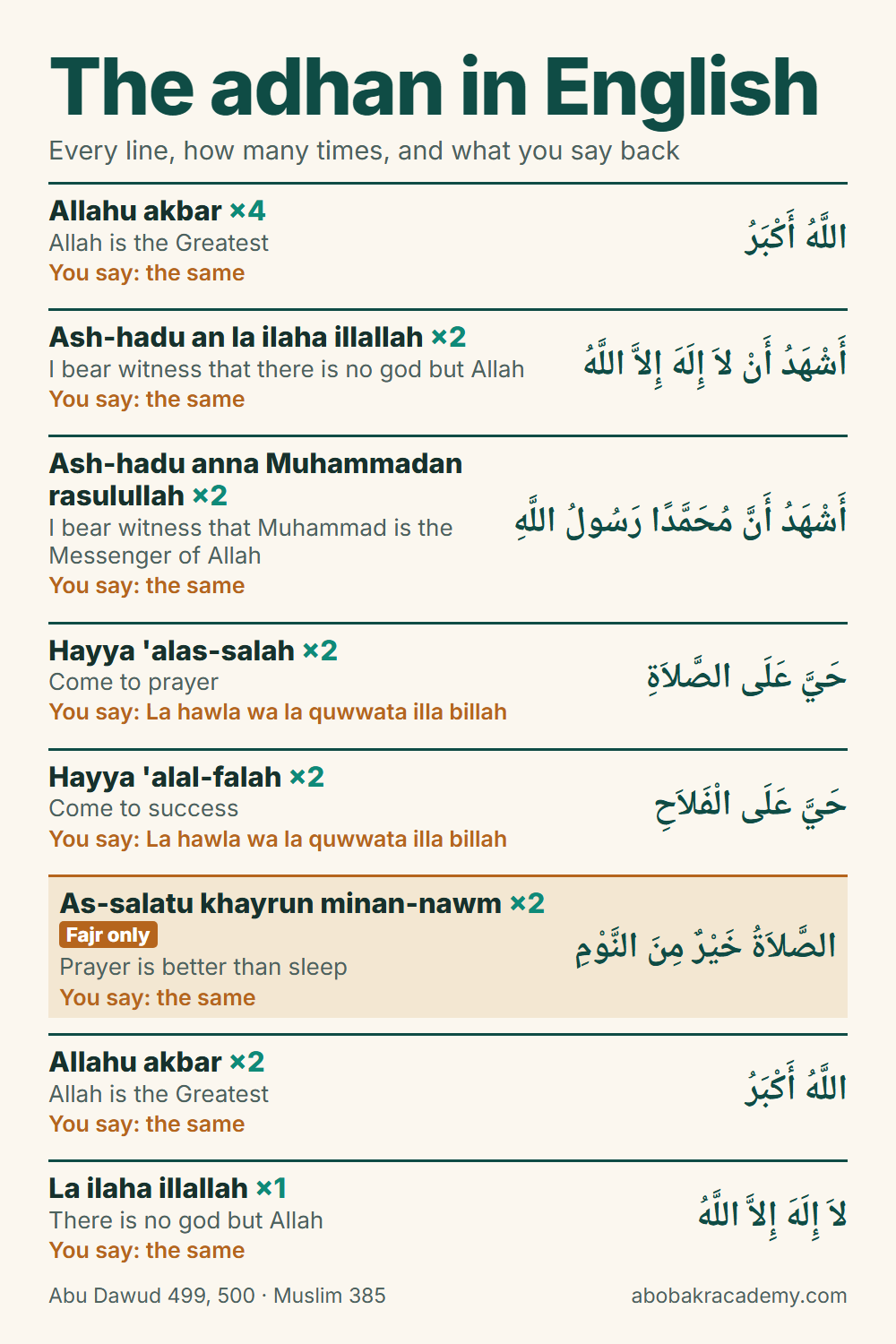
The adhan is the Muslim call to prayer, heard five times a day. In English it says: Allah is the Greatest (four times), I bear witness that there is no god but Allah (twice), I bear witness that Muhammad is the Messenger of Allah (twice), come to prayer (twice), come to success (twice), Allah is the Greatest (twice) and there is no god but Allah (once). Before dawn, the muezzin adds prayer is better than sleep (twice).
That is fifteen lines, or seventeen at Fajr, built from seven short phrases. The table below gives each one in Arabic with how to say it, what it means, and the words you say back, which is the part most guides leave out. Three of the phrases have a play button so a child can hear them one at a time.
The adhan line by line, with the reply
| Said | The muezzin says | You say back |
|---|---|---|
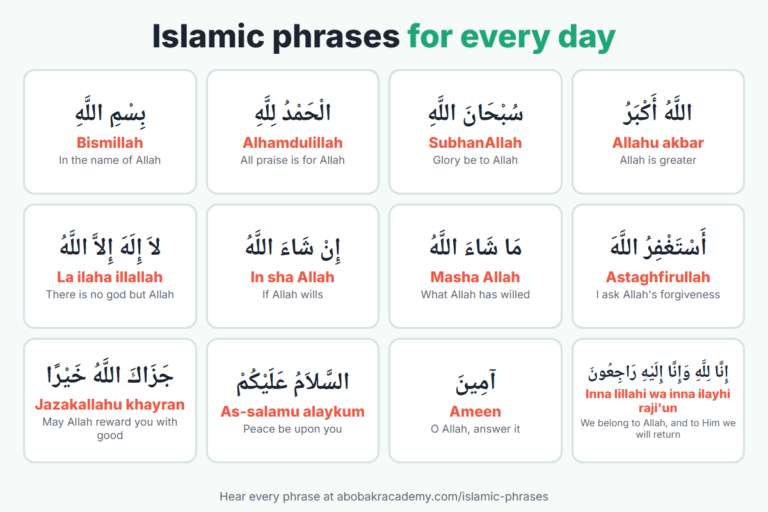
| 4× | اللَّهُ أَكْبَرُ Allahu akbar Allah is the Greatest | The same words |
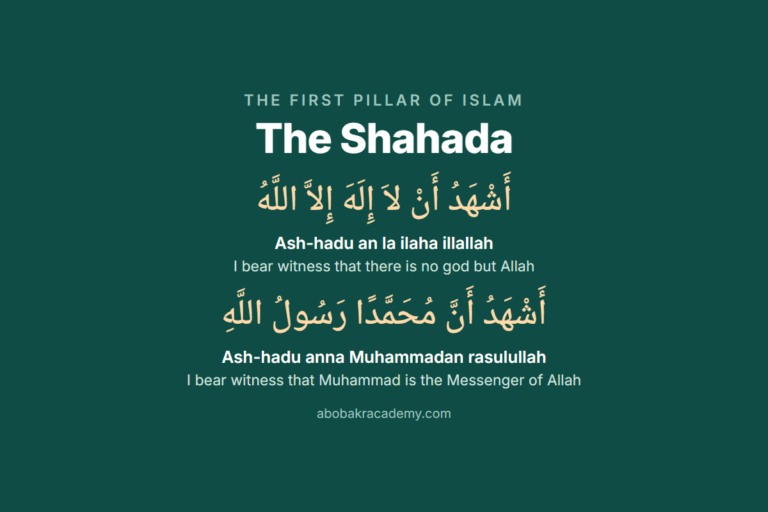
| 2× | أَشْهَدُ أَنْ لاَ إِلَهَ إِلاَّ اللَّهُ Ash-hadu an la ilaha illallah I bear witness that there is no god but Allah | The same words |
| 2× | أَشْهَدُ أَنَّ مُحَمَّدًا رَسُولُ اللَّهِ Ash-hadu anna Muhammadan rasulullah I bear witness that Muhammad is the Messenger of Allah | The same words |
| 2× | حَيَّ عَلَى الصَّلاَةِ Hayya ‘alas-salah Come to prayer | لاَ حَوْلَ وَلاَ قُوَّةَ إِلاَّ بِاللَّهِ La hawla wa la quwwata illa billah There is no power and no strength except with Allah |
| 2× | حَيَّ عَلَى الْفَلاَحِ Hayya ‘alal-falah Come to success | لاَ حَوْلَ وَلاَ قُوَّةَ إِلاَّ بِاللَّهِ La hawla wa la quwwata illa billah There is no power and no strength except with Allah |
| 2× Fajr only | الصَّلاَةُ خَيْرٌ مِنَ النَّوْمِ As-salatu khayrun minan-nawm Prayer is better than sleep | The same words |
| 2× | اللَّهُ أَكْبَرُ Allahu akbar Allah is the Greatest | The same words |
| 1× | لاَ إِلَهَ إِلاَّ اللَّهُ La ilaha illallah There is no god but Allah | The same words |
So for almost every line, you simply repeat what you hear. The two exceptions are the lines that call you to come: at “come to prayer” and “come to success” you answer la hawla wa la quwwata illa billah, “there is no power and no strength except with Allah.” It is an honest answer. You are being called to get up and pray, and you are admitting you can only do it with Allah’s help.
What each line means, in words a child can hold
If you are explaining the adhan to a child who has heard it but never understood it, these are the meanings in plain words. They are not new translations, only the same meaning said the way you would say it at bedtime.
Allahu akbar. Allah is greater. Greater than the game you are playing, the show you are watching, the thing that feels big today. The adhan opens by putting everything else in its place.
Ash-hadu an la ilaha illallah. I say out loud, as someone who knows it, that only Allah is to be worshipped. “Ash-hadu” means “I bear witness”: it is what a witness says in front of everyone.
Ash-hadu anna Muhammadan rasulullah. I also say that Muhammad ﷺ is the one Allah sent to us. These two lines together are the Shahada, the words that make a person Muslim, so a child hears the whole of their faith in every call.
Hayya ‘alas-salah. Come to prayer. This is the line that asks you to do something: stop now and come.
Hayya ‘alal-falah. Come to success. Falah is the kind of winning that lasts, in this life and the next, and the adhan says plainly where it is found.
As-salatu khayrun minan-nawm. Prayer is better than sleep. Only at Fajr, when most people are still in bed, and it is hard to argue with when you are the one getting up.
La ilaha illallah. There is no god but Allah. The adhan ends on the same truth it began with.
What to say when you hear the adhan
The Prophet ﷺ taught that when the muezzin says each line, the listener says it too, with la hawla wa la quwwata illa billah at the two “come” lines, and that whoever answers this way from the heart will enter Paradise (Sahih Muslim 385). Many scholars say you repeat the Fajr line as you hear it, since that hadith does not mention it.
In another hadith he told the listener what comes after: repeat what the muezzin says, then send blessings on him, then ask Allah to give him al-Wasilah, a place in Paradise for one servant of Allah only (Sahih Muslim 384). So the order is: answer each line, say a short salawat such as Allahumma salli ‘ala Muhammad, then say the dua below.
For a child: start with just two things. Stop talking when the adhan starts, and say “la hawla wa la quwwata illa billah” at the two “hayya” lines. Repeating the other lines comes easily once those two are a habit.
The dua after the adhan
Allahumma rabba hadhihid-da’watit-tammah, was-salatil-qa’imah, ati Muhammadanil-wasilata wal-fadilah, wab’ath-hu maqaman mahmudanil-ladhi wa’adtah
“O Allah, Lord of this complete call and of the prayer about to be prayed, give Muhammad al-Wasilah and the honour, and raise him to the praised place You promised him.”
The Prophet ﷺ said that whoever says this when they hear the call will have his intercession on the Day of Resurrection (Sahih al-Bukhari 614).
Copy the dua with its vowel marks:
اللَّهُمَّ رَبَّ هَذِهِ الدَّعْوَةِ التَّامَّةِ وَالصَّلاَةِ الْقَائِمَةِ آتِ مُحَمَّدًا الْوَسِيلَةَ وَالْفَضِيلَةَ وَابْعَثْهُ مَقَامًا مَحْمُودًا الَّذِي وَعَدْتَهُ
Without vowel marks, as you would type it in a message:
اللهم رب هذه الدعوة التامة والصلاة القائمة آت محمدا الوسيلة والفضيلة وابعثه مقاما محمودا الذي وعدته
Al-Wasilah is the highest place in Paradise, and “the praised place” (al-maqam al-mahmud) is the station of intercession the Prophet ﷺ was promised. It is a long dua for a young child, so many families teach it in three parts over a few weeks, one part for each prayer time until it sticks.
The iqamah: the second call, just before the prayer starts
When the people in the masjid stand up to pray, someone says the iqamah. It uses the same words, mostly said once instead of twice, and adds qad qamatis-salah, “the prayer has begun.” It was taught in the same hadith as the adhan (Sunan Abi Dawud 499).
| Said | The words |
|---|---|
| 2× | اللَّهُ أَكْبَرُ Allahu akbar Allah is the Greatest |
| 1× | أَشْهَدُ أَنْ لاَ إِلَهَ إِلاَّ اللَّهُ Ash-hadu an la ilaha illallah I bear witness that there is no god but Allah |
| 1× | أَشْهَدُ أَنَّ مُحَمَّدًا رَسُولُ اللَّهِ Ash-hadu anna Muhammadan rasulullah I bear witness that Muhammad is the Messenger of Allah |
| 1× | حَيَّ عَلَى الصَّلاَةِ Hayya ‘alas-salah Come to prayer |
| 1× | حَيَّ عَلَى الْفَلاَحِ Hayya ‘alal-falah Come to success |
| 2× | قَدْ قَامَتِ الصَّلاَةُ Qad qamatis-salah The prayer has begun |
| 2× | اللَّهُ أَكْبَرُ Allahu akbar Allah is the Greatest |
| 1× | لاَ إِلَهَ إِلاَّ اللَّهُ La ilaha illallah There is no god but Allah |
In masjids that follow the Hanafi school the iqamah repeats each line twice, like the adhan, with qad qamatis-salah added. Both ways are practised.
How the adhan began: a story to tell your child
When the Muslims first lived in Madinah, there was no way to tell everyone it was time to pray. People talked about using a bell, the way others did. One night a Companion called Abdullah ibn Zayd had a dream. A man carrying a bell came to him, and Abdullah asked if he could buy it to call people to prayer. The man said: shall I tell you something better? And he taught him the words of the adhan.
In the morning Abdullah told the Prophet ﷺ, who said it was a true dream and told him to teach the words to Bilal, because Bilal’s voice carried further. When Bilal called the adhan for the first time, Umar ibn al-Khattab came out of his house in a hurry, trailing his cloak, saying he had seen the very same dream (Sunan Abi Dawud 499).
Children tend to remember three things from this: the bell that was never used, two people having the same dream, and Bilal, the first muezzin, chosen for his voice.
Teaching a child the adhan, age by age
| Age | What to aim for |
|---|---|
| 2 to 4 | Stop and listen. Turn the music down when the adhan plays at home or on an app, and say “that’s the adhan, it’s time to pray.” Let them hear Allahu akbar and say it with you. |
| 5 to 6 | Answer the two “hayya” lines with la hawla wa la quwwata illa billah, and repeat the rest. Learn what each line means using the section above. |
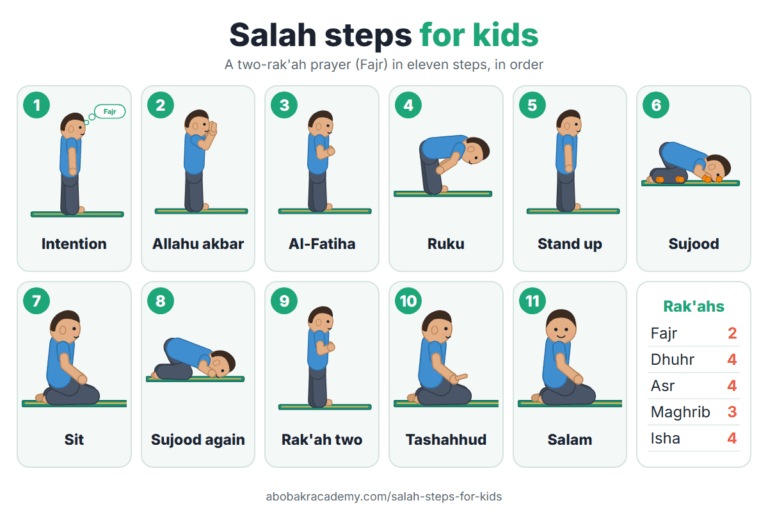
| 7 and up | This is the age to start praying (the salah steps for kids go through it), so link the two: the adhan calls, wudu, then the prayer. Add the dua after the adhan in parts. |
| 10 and up | Let them say the adhan themselves at home before a family prayer. It is good practice for reading the Quran, because the sounds are the same. |
If nobody at home reads Arabic, the transliteration above is enough to start, and the play buttons give you the sound. The hardest sounds for English speakers are the deep h in hayya and the ‘ayn in ‘ala, and those are worth getting a teacher to check.
Questions parents ask
Can you say the adhan at home, or alone?
Yes. A family praying together at home can have one person say the adhan, and someone praying alone can say it too. The Prophet ﷺ told a man who looked after sheep in open country to raise his voice when he called the adhan there, because every human, jinn and creature that hears it will be a witness for him on the Day of Resurrection (Sahih al-Bukhari 609).
Why is the adhan said in a newborn baby’s ear?
Many families say the adhan softly into a newborn’s right ear, so that the first words the baby hears are Allahu akbar and the Shahada. It goes back to the report that the Prophet ﷺ called the adhan in the ear of his grandson al-Hasan when he was born (Sunan Abi Dawud 5105, graded hasan by al-Albani; some scholars consider it weak, so families differ on it).
Does the adhan have to be in Arabic?
Yes. The adhan is a fixed form of words taught by the Prophet ﷺ, and Muslims everywhere call it in Arabic, the same as the prayer. Learning the English meaning is how you understand it, not a replacement for it.
How long does the adhan take?
Usually two to three minutes. The muezzin draws out the long vowels and pauses between lines, which gives the listener time to answer each one.
Why do some adhans sound different?
The melody changes from country to country, and the wording differs slightly between schools. Masjids that follow the Maliki school open with Allahu akbar twice rather than four times, and Abu Dawud notes both versions under the same hadith. Shia Muslims add “hayya ‘ala khayril-‘amal” (come to the best of deeds) and other lines. The table on this page is the most widely used Sunni wording.
Nobody at home reads Arabic? Your child can still learn every line of the adhan, and what it means.
Our tutors teach children one to one and online, by ear first, then from the letters up to reading the Quran. The adhan, the prayer and the duas of the day are part of the lessons. See Quran classes for kids, or message us and the first lesson is free.
Lessons in this subject: Online Islamic Studies