“I love you” in Arabic is uhibbuka when you say it to a boy or a man, and uhibbuki when you say it to a girl or a woman. It is one word. The only difference is the last sound: -ka for him, -ki for her.
Uhibbuka: I love you (to a man or a boy)
Uhibbuki: I love you (to a woman or a girl)
If you typed it into Google Translate, you saw ‘uhibuk with no ending. That is the pause form, how the word sounds when a sentence stops on it, and it hides the one sound that tells a boy from a girl. Said to someone, or followed by their name, the ending is there: uhibbuka ya Adam, uhibbuki ya Maryam.
Most pages stop there, or move on to romance. This one is for families. Below you will find what to say to your mother, your father, a son and a daughter, each with a recording, plus the words the Prophet ﷺ used when he told a companion he loved him. You do not need to read Arabic for any of it. Press play, listen twice, and say it back.
I love you in Arabic, by who you are saying it to
Arabic changes the ending to match the person you are talking to, so the first thing to decide is who that is. Add ya (“O”) and the name of the relationship after it, and the sentence becomes personal.
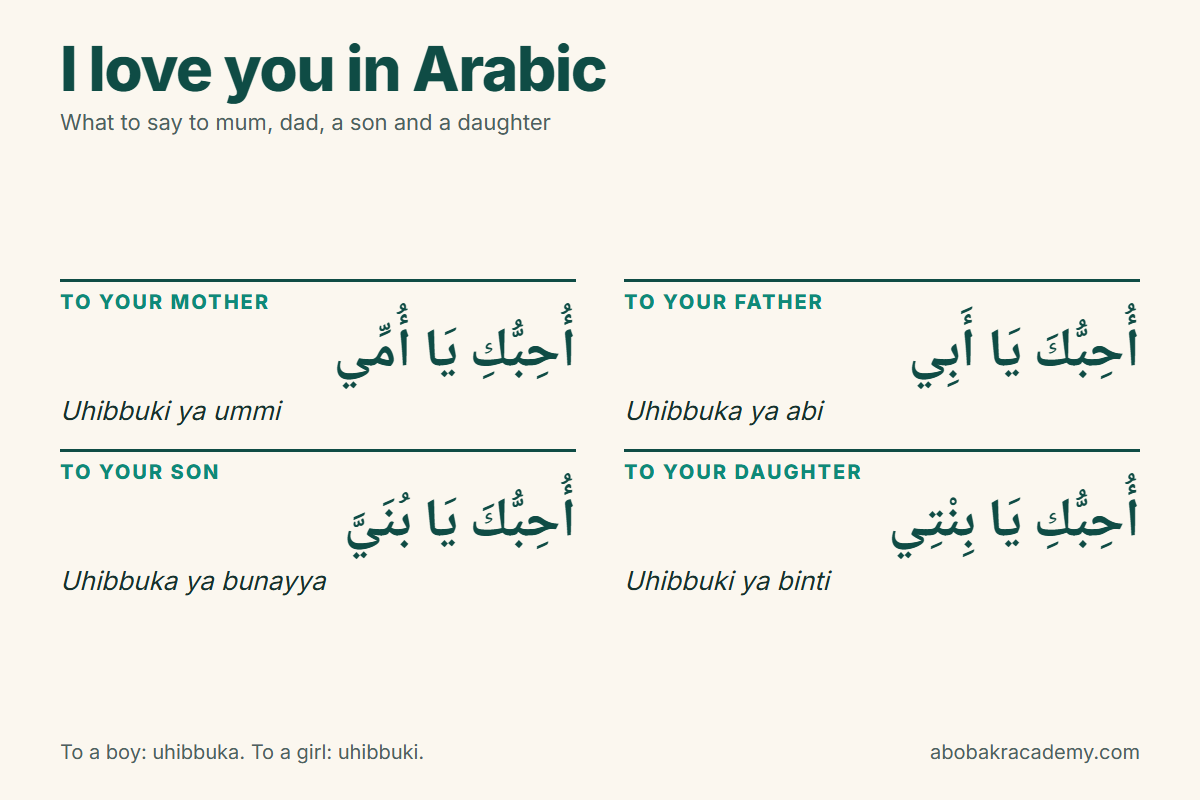
| Saying it to | Arabic | How to say it |
|---|---|---|
| Your mother | أُحِبُّكِ يَا أُمِّي | Uhibbuki ya ummi |
| Your father | أُحِبُّكَ يَا أَبِي | Uhibbuka ya abi |
| Your son | أُحِبُّكَ يَا بُنَيَّ | Uhibbuka ya bunayya |
| Your daughter | أُحِبُّكِ يَا بِنْتِي | Uhibbuki ya binti |
| All your children, or the whole family | أُحِبُّكُمْ | Uhibbukum |
| Mum, at home | أُحِبُّكِ يَا مَامَا | Uhibbuki ya mama |
| Dad, at home | أُحِبُّكَ يَا بَابَا | Uhibbuka ya baba |
| Very much | أُحِبُّكَ كَثِيرًا | Uhibbuka kathiran |
A few notes that save confusion later:
- Ummi is “my mother” and abi is “my father”. Plenty of families simply say mama and baba at home, and that is fine too.
- Ya bunayya is a tender way to say “my dear son”, like “my little boy”. It is the word Luqman uses when he advises his son in the Quran (Surah Luqman, 31:13), which makes it a lovely one to teach.
- For “very much” to a girl, change the ending: uhibbuki kathiran.
- Saying it to the whole family at once? Uhibbukum, “I love you all”: uhibbu is “I love” (the verb on Wiktionary) and -kum is “you all”.
Habibi and habibti
حَبِيبِي
Habibi: My dear, my love (to a boy or a man)
حَبِيبَتِي
Habibti: My dear, my love (to a girl or a woman)
You will hear these everywhere, from grandparents to song lyrics. They come from the same root as uhibbuka and mean “my beloved”, though in daily use they are closer to “sweetheart” or “my dear”. A parent can call a child habibi all day long. Put it together with the main phrase for a bedtime line: uhibbuka ya habibi.
Two more you will hear, to a child, a parent or a husband or wife:
يَا رُوحِي
Ya ruhi: My soul (to anyone you love)
يَا قَلْبِي
Ya qalbi: My heart (often said albi in Egypt and the Levant)
What you will hear from Arabic-speaking relatives
If your family speaks Egyptian, Syrian, Lebanese or Palestinian Arabic, you will hear bahibbak (to a man) and bahibbik (to a woman). It is the spoken form of the same word. Both are right, and your child will understand both. We teach the standard form on this page because it is the one in books, in the Quran’s language and in every Arabic class, and it is understood in every Arab country.
To answer someone who says it to you: wa ana uhibbuka aydan (“and I love you too”), or wa ana uhibbuki aydan to a girl or a woman.
I love you for the sake of Allah
This is the Muslim way to tell a friend, a brother or a sister in faith that you love them, and the Prophet ﷺ told us to say it out loud rather than keep it to ourselves.
Inni uhibbuka fillah: I love you for the sake of Allah
A man told the Prophet ﷺ that he loved someone who had just walked past. “Have you told him?” the Prophet asked. When he said no, he was told to go and tell him, and this is what he said. Sunan Abi Dawud 5125, graded hasan.
The reply the other man gave is the one Muslims still use today:
Ahabbaka-lladhi ahbabtani lah: May the One for whose sake you love me love you
Said to a woman, the first phrase becomes inni uhibbuki fillah, and the reply changes to match: ahabbaki-lladhi ahbabtini lah.
When the Prophet ﷺ said “I love you”
Ya Mu’adh, wallahi inni la-uhibbuk: Mu’adh, by Allah, I love you
He took Mu’adh ibn Jabal by the hand, said it twice, and then taught him a short dua to say after every prayer. Sunan Abi Dawud 1522, graded sahih.
It is a good story to tell a child. The best of people said “I love you” plainly, held a hand while he said it, and then gave something useful along with it.
Making it a habit at home
Children pick up a phrase like this by hearing it at the same moment every day, long before they could read it. A few ways families do it:
- At bedtime. Say uhibbuka or uhibbuki as the light goes off, every night. Within a week most children say it back.
- In the lunchbox. Print the notes below, cut them out and tuck one in. Read it with them the first time so they know what it says.
- To grandparents. A child saying uhibbuki ya teta or ya jaddati on a video call will be remembered for a long time. (Teta is what many families call a grandmother; jaddati is the standard word.)
- Let them choose. Ask “is it -ka or -ki for Daddy?” It turns a phrase into a small grammar lesson without anyone noticing.
Free printable: I love you in Arabic, eight notes to cut out (PDF). Each note has the Arabic, how to say it and what it means, so a parent who does not read Arabic can still hand it over with confidence.
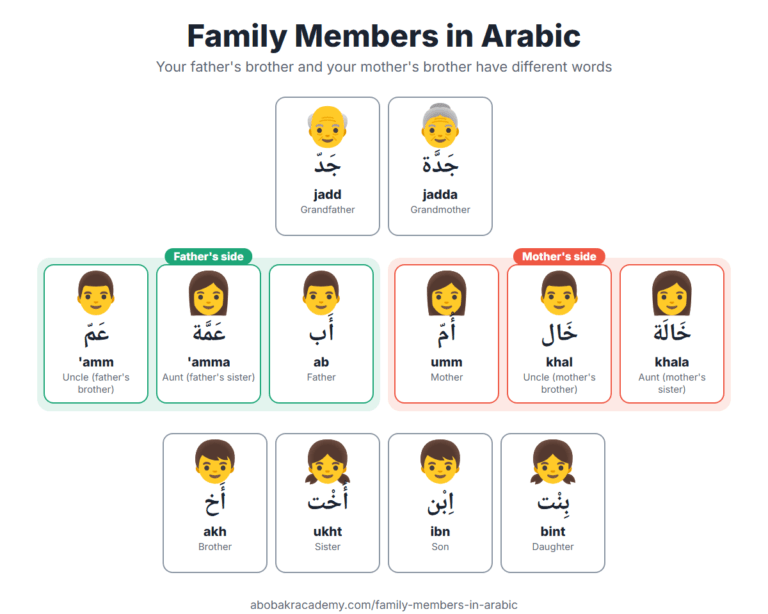
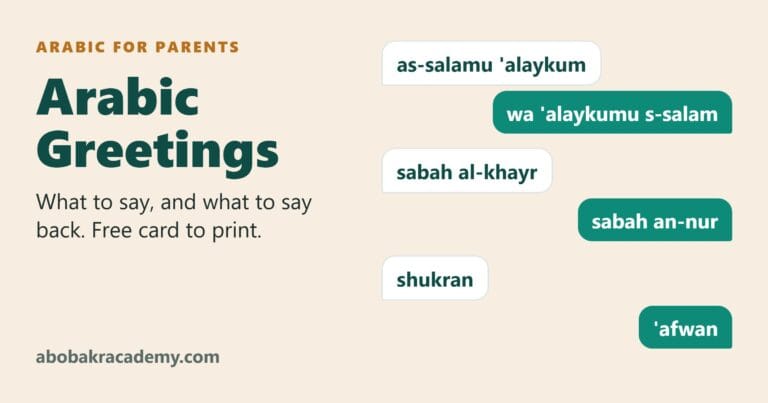
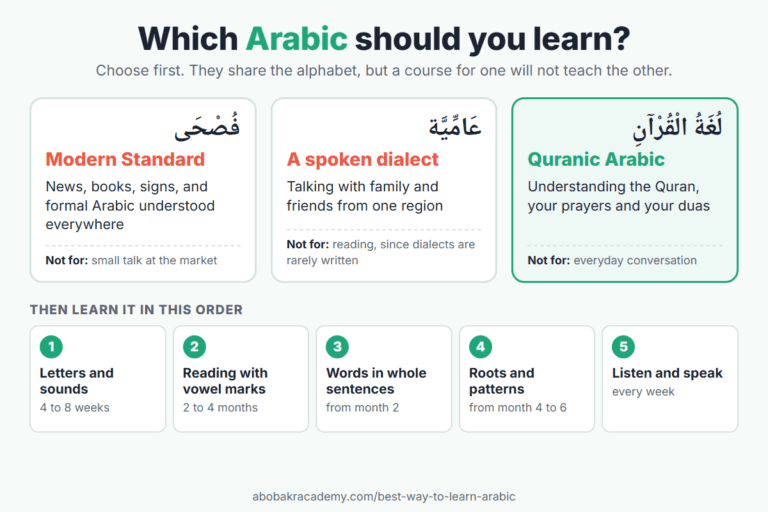
If you are teaching family words at the same time, our pages on family members in Arabic, thank you in Arabic and Arabic greetings follow the same pattern: hear it, say it, use it the same day. For a plan that works when no one at home speaks the language, start with teaching Arabic to kids when you don’t speak it. If you would like to learn it yourself, start with the best way to learn Arabic as an adult.
Questions about saying I love you in Arabic
How do you say I love you in Arabic?
Uhibbuka to a boy or a man, uhibbuki to a girl or a woman. In spoken Egyptian and Levantine Arabic you will also hear bahibbak and bahibbik.
What does ana uhibbuka mean?
Ana means “I”, so ana uhibbuka is “I love you” with extra weight on the I. It is correct, but uhibbuka on its own already includes “I”, and that is how it is usually said.
What is ana bahebak?
Ana bahebak is “I love you” in spoken Egyptian and Levantine Arabic, said to a man (to a woman it is ana bahebik). It is the everyday version of ana uhibbuka.
How do you say I love you babe in Arabic?
Uhibbuka ya habibi to a man, uhibbuki ya habibti to a woman. Habibi and habibti do the work of “babe” or “darling”, and between a husband and wife ya ruhi (“my soul”) is just as common.
How do you say I love you a lot in Arabic?
Uhibbuka kathiran to a boy or a man, uhibbuki kathiran to a girl or a woman. Kathiran means “a lot”.
How do you reply to I love you in Arabic?
Wa ana uhibbuka aydan, “and I love you too”, or wa ana uhibbuki aydan to a girl or a woman.
How do I say I love you, Mum in Arabic?
Uhibbuki ya ummi, “I love you, my mother”. At home many children say uhibbuki ya mama.
How do you reply to I love you for the sake of Allah?
Ahabbaka-lladhi ahbabtani lah, “May the One for whose sake you love me love you.” This reply comes from the hadith in Sunan Abi Dawud 5125.
What is the difference between habibi and uhibbuka?
Uhibbuka is a sentence, “I love you”. Habibi is a word, “my dear” or “my love”, used as a name for someone you love.
Want your child to say more than a phrase?
Our tutors teach Arabic to children one to one and online, starting from the sounds and simple sentences like these, and they plan for a home where nobody else speaks Arabic. See online Arabic classes for kids, or message us and the first lesson is free.