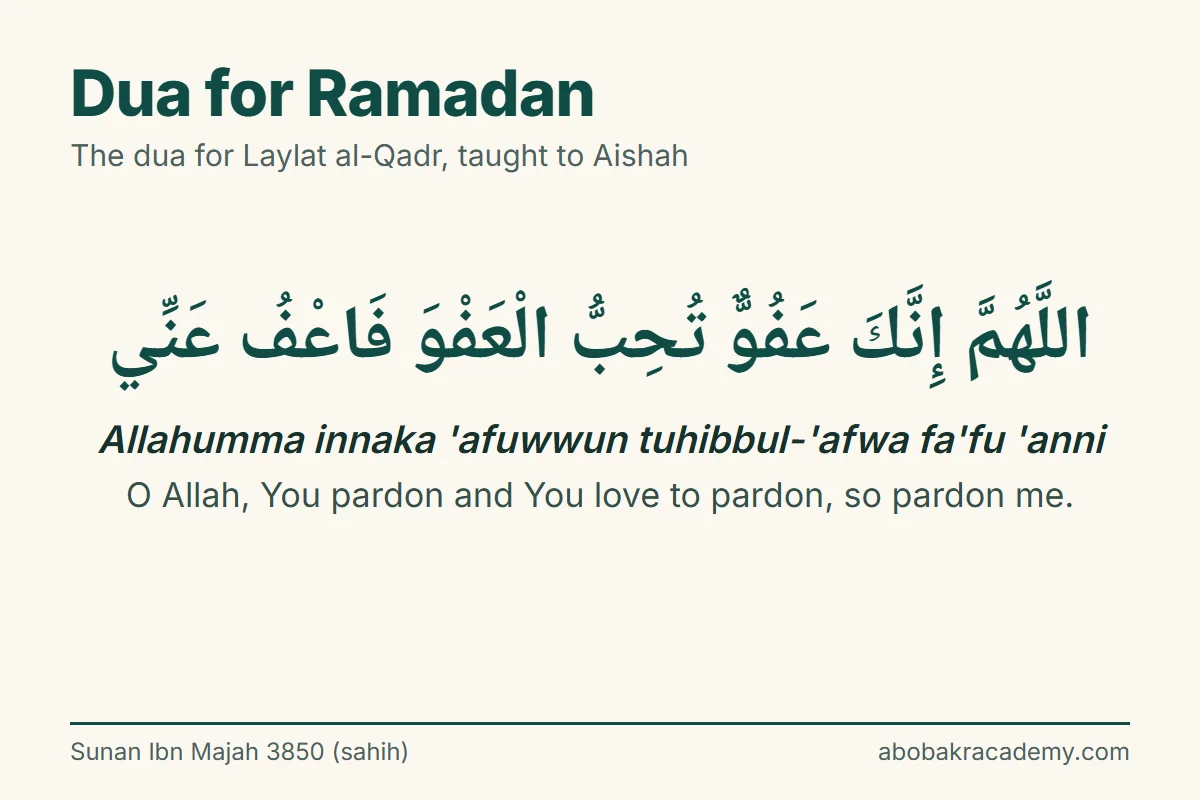
The dua for Ramadan the Prophet ﷺ taught for its greatest night, Laylat al-Qadr, is Allahumma innaka ‘afuwwun tuhibbul-‘afwa fa’fu ‘anni, “O Allah, You pardon and You love to pardon, so pardon me.” The rest of the month has its own moments, from the new moon to the iftar table, and each has words of its own.
This page puts them in the order your family meets them. Each dua comes with its Arabic, a way to say it, its meaning, and the grade sunnah.com prints for its hadith, so you know which ones are firm. Some popular wordings have no source we could find, and we say which. Where a dua has a play button, you can hear it said aloud, for homes where nobody reads Arabic, and there is an iftar card for your child to print.
Which dua for which moment
| Moment | What to say | Basis |
|---|---|---|
| When Rajab begins | Allahumma barik lana fi Rajabin wa Sha’bana, wa ballighna Ramadana | Weak: Mishkat 1369 |
| The new moon | Allahumma ahlilhu ‘alayna bil-yumni wal-iman, was-salamati wal-islam. Rabbi wa rabbuk-Allah | Weak: Tirmidhi 3451 |
| Suhoor | Bismillah, and eat: there is blessing in suhoor | Firm: Bukhari 1923 |
| Before dawn | Decide to fast. No set words | Firm: Abi Dawud 2454 |
| Iftar | Dhahabadh-dhama’u, wabtallatil-‘uruqu, wa thabatal-ajru in sha’ Allah | Hasan: Abi Dawud 2357 |
| Someone feeds you | Aftara ‘indakumus-sa’imun, wa akala ta’amakumul-abrar, wa sallat ‘alaykumul-mala’ikah | Sahih: Ibn Majah 1747 |
| Someone provokes you | Inni sa’im, inni sa’im | Sahih: Bukhari 1894 |
| The odd nights of the last ten | Allahumma innaka ‘afuwwun tuhibbul-‘afwa fa’fu ‘anni | Sahih: Ibn Majah 3850 |
| Any night | Allahumma inni as’alukal-huda wat-tuqa wal-‘afafa wal-ghina | Sahih: Muslim 2721 |
| Any time, often | Rabbana atina fid-dunya hasanatan wa fil-akhirati hasanatan wa qina ‘adhaban-nar | Quran: 2:201 |
| Asking forgiveness | Rabbighfir li wa tub ‘alayya, innaka antat-tawwabur-rahim | Sahih: Abi Dawud 1516 |
If you only teach two, teach the iftar words and the Laylat al-Qadr dua. Both have firm grades, and both are short enough for a child to learn by hearing them every evening.
Before Ramadan: the dua to reach it
Anas reported that when the month of Rajab came, the Prophet ﷺ said the words below. Rajab is two months before Ramadan, so families who use this dua start early.
When Rajab begins
Allahumma barik lana fi Rajabin wa Sha’bana, wa ballighna Ramadana
O Allah, bless us in Rajab and Sha’ban, and let us reach Ramadan.
Mishkat al-Masabih 1369 (al-Bayhaqi, ad-Da’awat al-Kabir). Da’if (al-Albani). Narrated by Anas ibn Malik.
You will often see a different wording, Allahumma sallimni ila Ramadan, “O Allah, deliver me safely to Ramadan.” It is the line the AI answers quote. We searched sunnah.com for it in Arabic and in English and it is not there. Asking Allah to let you reach Ramadan is a good dua in any words; just know that neither version is a firm hadith.
When you see the new moon
The Prophet ﷺ said this whenever he saw a crescent, so it belongs to the start of every month, Ramadan included. Going outside after Maghrib on the 29th of Sha’ban to look for the moon is a lovely thing to do with children, even when the sky is cloudy and the announcement comes by phone.
On seeing the new moon
Allahumma ahlilhu ‘alayna bil-yumni wal-iman, was-salamati wal-islam. Rabbi wa rabbuk-Allah
O Allah, bring this new moon over us with blessing and faith, with safety and Islam. My Lord and your Lord is Allah.
Jami’ at-Tirmidhi 3451. Da’if (Darussalam). Narrated by Talhah ibn ‘Ubaidullah.
The intention for the fast
Many lists give a sentence to say at suhoor, wa bi-sawmi ghadin nawaytu min shahri Ramadan, “I intend to fast tomorrow in the month of Ramadan.” We could not find that sentence in any hadith on sunnah.com.
What the hadith do say is simpler. Hafsah reported that the Prophet ﷺ said whoever does not resolve to fast before dawn has no fast (Sunan Abi Dawud 2454), and the first hadith in Sahih al-Bukhari says deeds are judged by their intentions (Bukhari 1).
Neither gives words to recite. Waking for suhoor and deciding to fast that day is the intention. If your family says the sentence anyway, treat it as a habit, not as a dua from the Prophet ﷺ.
Suhoor
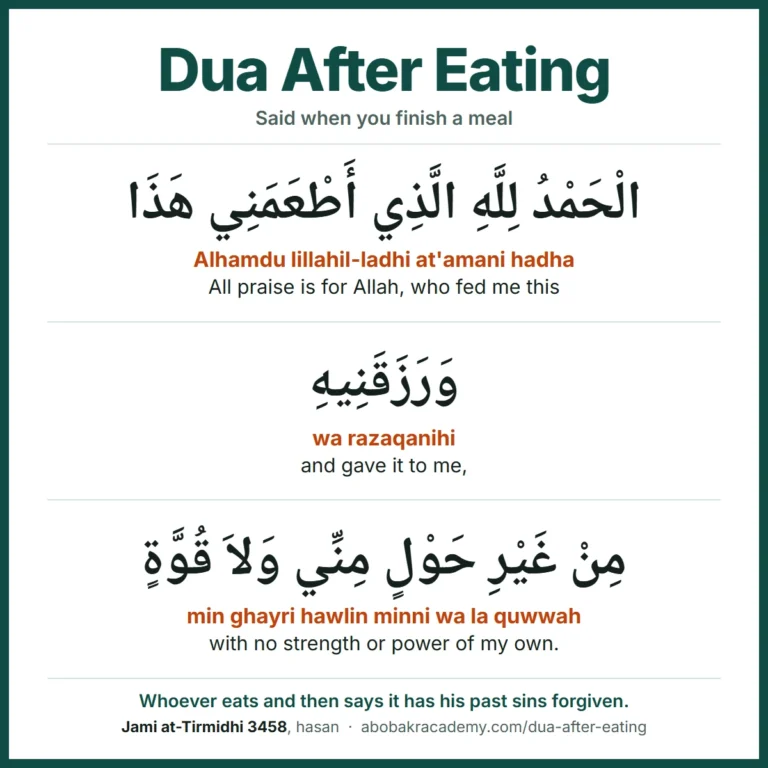
The firm instruction about suhoor is to eat it: “Take suhoor, for there is blessing in it” (Sahih al-Bukhari 1923). There is no dua tied to suhoor itself. Say Bismillah before you eat, as at any meal, and the dua after eating when you finish.
The “suhoor dua” some lists print, Allahumma barik lana fihi wa at’imna khayran minhu, comes from a hadith about any food Allah gives you (Jami’ at-Tirmidhi 3455), and sunnah.com shows Darussalam’s grade for it as weak. It is a fine thing to say over food, at any meal of the year.
At iftar: three duas, and how firm each is
The minutes around sunset matter. The Prophet ﷺ named the fasting person at iftar first among three people whose dua is not turned back (Jami’ at-Tirmidhi 3598, graded hasan by Darussalam). So before the plates go round, pause, and ask Allah for what your family needs, in English if that is your language.
The words with the firmest grade are these. Ibn Umar reported that the Prophet ﷺ said them when he broke his fast, and they describe the moment after the first drink of water.
At iftar, the firmest grade
Dhahabadh-dhama’u, wabtallatil-‘uruqu, wa thabatal-ajru in sha’ Allah
The thirst is gone, the veins are moist, and the reward is certain, if Allah wills.
Sunan Abi Dawud 2357. Hasan (al-Albani). Narrated by ‘Abdullah ibn ‘Umar.
The dua most lists give for iftar is the next one. Its grade is weak: the narrator, Mu’adh ibn Zuhrah, says it reached him, without naming who told him.
At iftar, the best known
Allahumma laka sumtu, wa ‘ala rizqika aftartu
O Allah, for You I fasted, and with Your provision I broke my fast.
Sunan Abi Dawud 2358. Da’if (al-Albani). Narrated by Mu’adh ibn Zuhrah (it reached him; he did not hear it from the Prophet).
The added words. Many lists, and the AI answers that copy them, print a longer version: Allahumma inni laka sumtu, wa bika amantu, wa ‘alayka tawakkaltu, wa ‘ala rizqika aftartu. The hadith in Sunan Abi Dawud 2358 has no inni at the start and ends at aftartu. The middle part, “I believe in You and I put my trust in You”, is not in it.
The third is not the Prophet’s wording but a Companion’s. Abdullah ibn Amr narrated that a fasting person’s dua at iftar is not turned back, and Ibn Abi Mulaikah heard him say these words when he broke his own fast. Sunnah.com shows the hadith as hasan.
At iftar, Abdullah ibn Amr’s words
Allahumma inni as’aluka bi-rahmatikal-lati wasi’at kulla shay’in an taghfira li
O Allah, I ask You by Your mercy, which covers all things, to forgive me.
Sunan Ibn Majah 1753. Hasan (Darussalam). Narrated by ‘Abdullah ibn ‘Amr’s own words at iftar, as Ibn Abi Mulaikah heard them.
When someone feeds you iftar
Ramadan is the month of eating at other people’s tables. When the Prophet ﷺ broke his fast with Sa’d ibn Mu’adh, he said this to his host. Children love having a line to say to the family that invited them.
To your host
Aftara ‘indakumus-sa’imun, wa akala ta’amakumul-abrar, wa sallat ‘alaykumul-mala’ikah
May fasting people break their fast with you, may the righteous eat your food, and may the angels pray for you.
Sunan Ibn Majah 1747. Sahih (Darussalam). Narrated by ‘Abdullah ibn az-Zubair.
If someone provokes you while you fast
This is not a dua, but it is the one sentence a fasting child needs most. The Prophet ﷺ said fasting is a shield, and that if someone fights with you or insults you, you say twice: “I am fasting” (Sahih al-Bukhari 1894).
Said twice
Inni sa’im, inni sa’im
I am fasting. (Said twice, to someone who fights with you or insults you.)
Sahih al-Bukhari 1894. Sahih al-Bukhari. Narrated by Abu Hurairah.
It works at school as well as at home. A child who is teased for not eating has words to say, and the words end the argument instead of starting one.
If the anger is already rising, the Prophet ﷺ named the words that calm it: A’udhu billahi minash-shaytanir-rajim, “I seek refuge with Allah from Satan, the outcast” (Sahih al-Bukhari 3282).
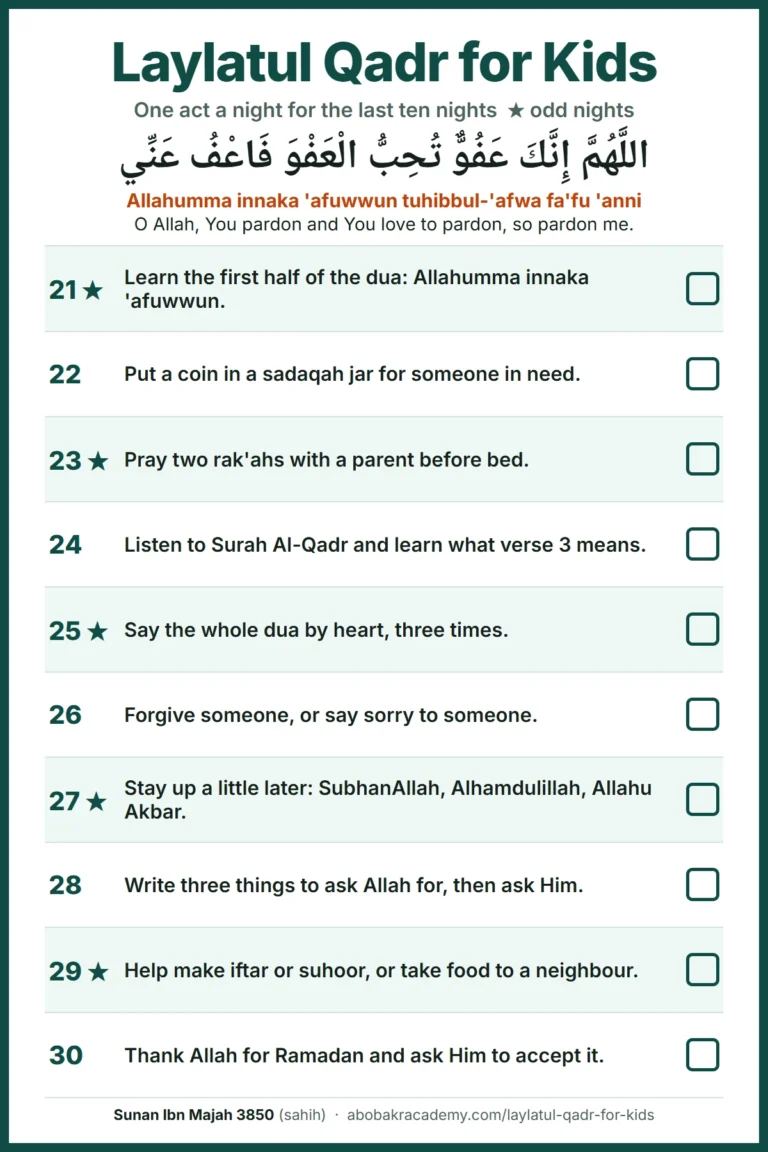
Laylat al-Qadr: the dua the Prophet ﷺ taught Aishah
Aishah asked the Prophet ﷺ what she should say if she knew which night was Laylat al-Qadr. He told her this dua. The Prophet ﷺ also told us to look for that night in the odd nights of the last ten (Sahih al-Bukhari 2017): the 21st, 23rd, 25th, 27th and 29th.
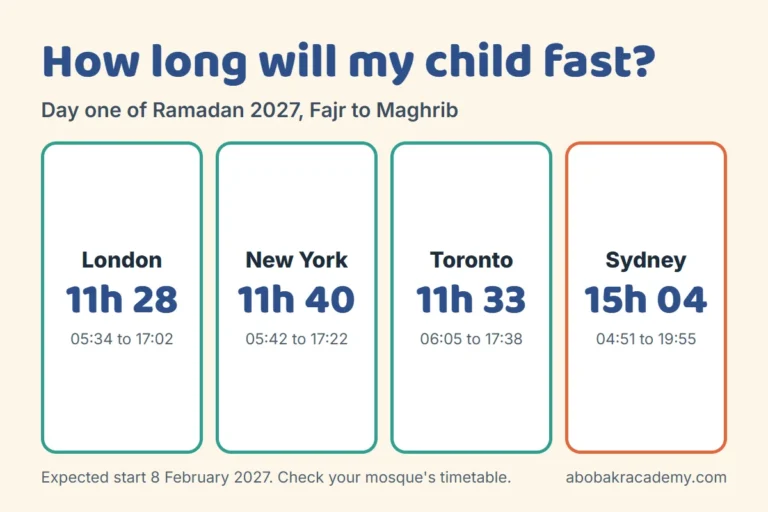
Ramadan 2027 is expected to begin on about Monday 8 February, depending on the moon where you live, which puts those nights on the evenings of about 27 February and 1, 3, 5 and 7 March.
Laylat al-Qadr
Allahumma innaka ‘afuwwun tuhibbul-‘afwa fa’fu ‘anni
O Allah, You pardon and You love to pardon, so pardon me.
Sunan Ibn Majah 3850; also Jami’ at-Tirmidhi 3513. Sahih (Darussalam), both. Narrated by ‘Aishah.
Some lists add one word, karim (generous), after ‘afuwwun. That is how the version in Jami’ at-Tirmidhi 3513 reads on sunnah.com:
اللَّهُمَّ إِنَّكَ عَفُوٌّ كَرِيمٌ تُحِبُّ الْعَفْوَ فَاعْفُ عَنِّي
Ibn Majah’s version, above, has no karim, and both are graded sahih there. Either is fine to say. The shorter one is easier for a child, and it is the one on our card. To teach it to a child over the last ten nights, one act a night, see Laylatul Qadr for kids.
When a Ramadan dua is answered
Asking which dua is “most powerful” puts the weight on the words. The hadith put it on the time and the person. Four times stand out in Ramadan:
- At iftar. The Prophet ﷺ counted the fasting person, as the fast is broken, among three people whose dua Allah does not refuse (Tirmidhi 3598).
- The last third of every night. Allah descends to the nearest heaven and asks who is calling on Him so He may answer (Sahih al-Bukhari 1145). In Ramadan you are already awake for suhoor in that last third.
- The 21st, 23rd, 25th, 27th and 29th nights, looking for Laylat al-Qadr (Bukhari 2017).
- In sujood. A servant is nearest to his Lord while prostrating, so ask then (Sahih Muslim 482). Taraweeh gives you many prostrations a night.
How to ask matters as much as when. The Prophet ﷺ heard a man ask in his prayer without first praising Allah or sending blessings on him, and said he had rushed: begin with praise, then blessings on the Prophet, then ask (Jami’ at-Tirmidhi 3477, hasan).
And keep asking: a dua is answered as long as you do not grow impatient and say “I asked, and nothing came” (Sahih al-Bukhari 6340). Some pages add a hadith telling you to ask certain of an answer; sunnah.com grades that one weak (Tirmidhi 3479).
A dua for guidance, any night
Abdullah ibn Mas’ud reported that the Prophet ﷺ used to say this. It asks for four things in one short line, which makes it a good next dua for a child who has learned Bismillah.
For guidance
Allahumma inni as’alukal-huda wat-tuqa wal-‘afafa wal-ghina
O Allah, I ask You for guidance, piety, chastity and freedom from want.
Sahih Muslim 2721a. Sahih Muslim (the collection is sahih). Narrated by ‘Abdullah ibn Mas’ud.
A shorter one, from the same book: the Prophet ﷺ told Ali to say Allahummah-dini wa saddidni, “O Allah, guide me and keep me on the straight path” (Sahih Muslim 2725).
Good in both worlds, and a dua for forgiveness
Anas said the Prophet ﷺ made this dua from the Quran more often than any other. It asks for everything in one breath, which is why so many families end every dua with it.
The one he said most often
Rabbana atina fid-dunya hasanatan wa fil-akhirati hasanatan wa qina ‘adhaban-nar
Our Lord, give us good in this world and good in the Hereafter, and protect us from the punishment of the Fire.
Quran 2:201. The Quran; Anas said it was the dua the Prophet said most often (Sahih al-Bukhari 6389).
Ramadan is the month of forgiveness, and this is the short form. Abdullah ibn Umar counted the Prophet ﷺ saying it a hundred times in one sitting.
Forgive me, accept my repentance
Rabbighfir li wa tub ‘alayya, innaka antat-tawwabur-rahim
My Lord, forgive me and accept my repentance. You are the One who accepts repentance, the Merciful.
Sunan Abi Dawud 1516. Sahih (al-Albani). Narrated by ‘Abdullah ibn ‘Umar, who counted the Prophet saying it a hundred times in one sitting.
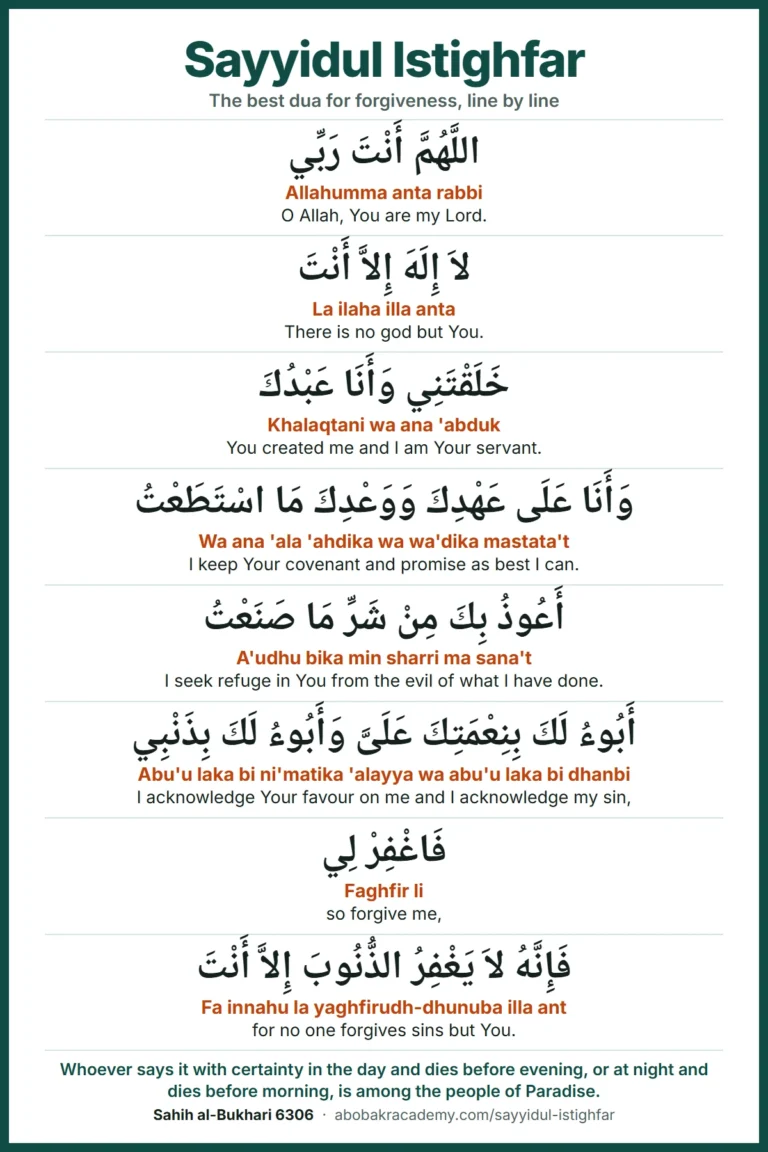
The longest and most complete of the forgiveness duas is the master of seeking forgiveness, with its own page: Sayyidul Istighfar, line by line with audio.
Other duas for the last ten nights
The longer lists add duas for good health, for family members who have died, for the whole ummah, for Paradise and against the Fire, and the Quran’s dua for forgiveness in Surah Al Imran 3:16. These are good duas for any night of the year.
The hadith do not tie them to Ramadan, so pick the ones your family needs. The health dua, for example, is one Abu Bakrah’s son heard his father say every morning (Sunan Abi Dawud 5090, its chain graded hasan by al-Albani).
Wordings lists give without a source
We looked each of these up on sunnah.com on 23 November 2026. Here is what we found.
| What lists say | What we found |
|---|---|
| Intention wording ‘wa bi-sawmi ghadin nawaytu’ | No hadith on sunnah.com (0 results). Instead: Abu Dawud 2454 and Bukhari 1: the intention is made before dawn, in the heart. |
| ‘Sallimni ila Ramadan’ to reach Ramadan | Not on sunnah.com. Instead: Mishkat 1369, graded weak. |
| Iftar dua with ‘wa bika amantu wa alayka tawakkaltu’ added | Abu Dawud 2358 ends at aftartu. Instead: Abu Dawud 2358 as printed (weak), or 2357 (hasan). |
| A ‘suhoor dua’ (Allahumma barik lana fihi wa at’imna khayran minhu) | Tirmidhi 3455, said whenever Allah gives you food; graded da’if (Darussalam); nothing ties it to suhoor. Instead: Bukhari 1923: take suhoor, there is blessing in it. |
| A ‘taraweeh dua’ (Subhana dhil-mulki wal-malakut…) | Sunnah.com has nothing tying it to taraweeh. |
| A dua for each ten-day third (Ya Hayyu ya Qayyum for the first ten) | Tirmidhi 3524 (hasan) is a dua for any distress; no hadith on sunnah.com assigns it to the first ten days. |
| Dua on the last night of Ramadan (la taj’alhu akhiral-‘ahd) | Not found on sunnah.com (0 results). |
| A different dua for each day of Ramadan (Day 1: ‘make my fasting the fasting of those who fast’) | Not on sunnah.com (0 results for that wording); no hadith there gives a dua for each day. Instead: one sourced dua from this page a night. |
| Dua when paying zakat (Allahummaj-‘alha maghnaman) | Ibn Majah 1797, marked maudu’ (fabricated) on sunnah.com. |
None of this means you cannot say those words. You can ask Allah for anything in any words. It means you should not teach them to your child as “what the Prophet ﷺ said”, and that the sourced duas above deserve the first place.
Teaching these duas to a child
Children learn a dua by hearing it at the same moment every day, long before they can read it. Ramadan gives you that moment thirty times. Play the iftar words while the dates go round, say them together, and let your child tick a box on the card each evening.
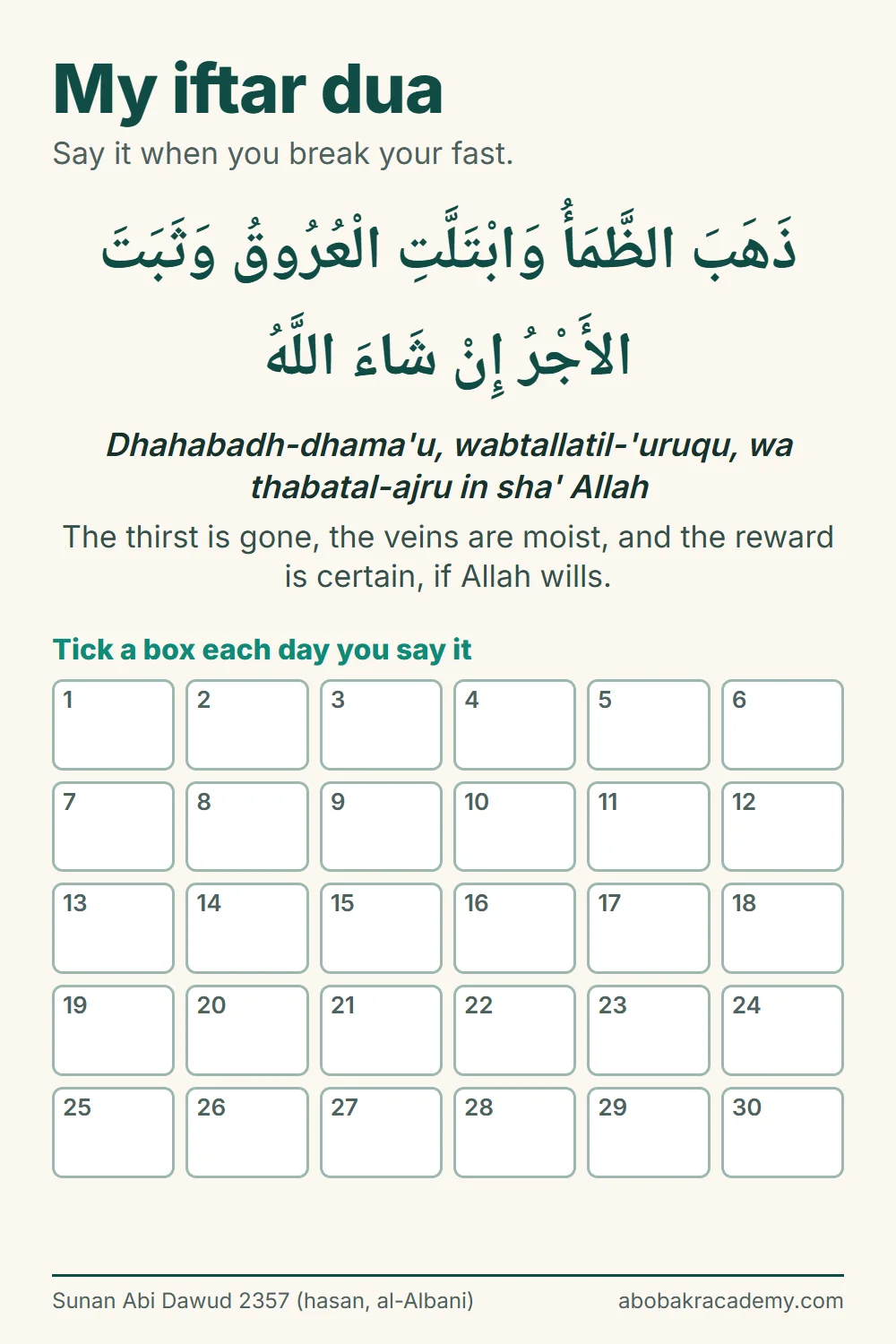
Download the iftar card as a one-page PDF. Print it at home and stick it near the table.
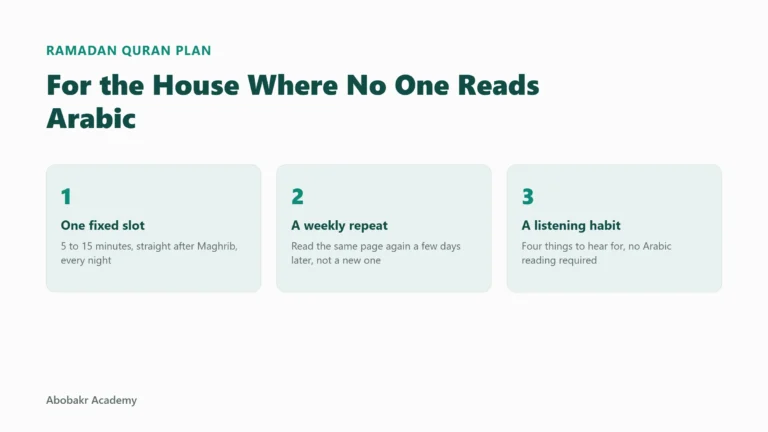
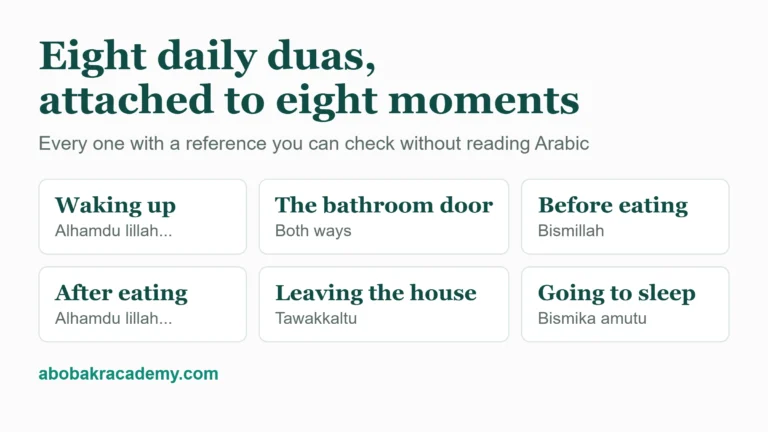
For a younger child who is trying a practice fast, teach inni sa’im first; it gives them something to say when a friend offers a snack. Our guide to Ramadan fasting for kids covers the ages and the half-day fasts, and the daily duas for kids, with their printable cards, carry on after Eid. If you want the whole Quran read in the month, there is a Ramadan Quran reading plan too.
Questions about Ramadan duas
What is the best dua in Ramadan?
The dua the Prophet ﷺ taught Aishah for Laylat al-Qadr: Allahumma innaka ‘afuwwun tuhibbul-‘afwa fa’fu ‘anni, “O Allah, You pardon and You love to pardon, so pardon me.” It is graded sahih (Sunan Ibn Majah 3850). Say it most on the 21st, 23rd, 25th, 27th and 29th nights.
What is the dua for fasting in Ramadan?
There is no set wording for starting the fast: the intention is deciding to fast before dawn (Sunan Abi Dawud 2454). For breaking it, the best-graded words are Dhahabadh-dhama’u, wabtallatil-‘uruqu, wa thabatal-ajru in sha’ Allah, “The thirst is gone, the veins are moist, and the reward is certain, if Allah wills” (Sunan Abi Dawud 2357, hasan).
What is the most powerful dua?
The hadith point to the time more than the words: the dua made as the fast is broken is answered (Jami’ at-Tirmidhi 3598), and Allah answers in the last third of the night (Sahih al-Bukhari 1145). Ask then, for what you need, in your own words.
What should I say during Ramadan?
The new moon dua when the month is sighted, the iftar words at sunset, the host’s dua when someone feeds you, “I am fasting” if someone provokes you, and the Laylat al-Qadr dua in the last ten nights. Any time, the Quran’s Rabbana atina fid-dunya hasanatan (2:201). The table at the top of this page puts them in order.
What is the dua for reaching Ramadan?
The one sunnah.com carries is Allahumma barik lana fi Rajabin wa Sha’bana, wa ballighna Ramadana, “O Allah, bless us in Rajab and Sha’ban, and let us reach Ramadan” (Mishkat al-Masabih 1369), and it is graded weak. The popular Allahumma sallimni ila Ramadan is not on sunnah.com at all. Asking Allah in your own words to reach the month is fine.
Is there a dua for each day of Ramadan?
No hadith on sunnah.com gives a separate dua for each day. The day-by-day lists shared every Ramadan carry no hadith reference, and the Day 1 wording returns no result there. A good plan is one sourced dua from this page each night, said until it is known by heart.
Is “Allahumma inni laka sumtu wa bika amantu” authentic?
The hadith it comes from, Sunan Abi Dawud 2358, reads Allahumma laka sumtu wa ‘ala rizqika aftartu, and al-Albani graded it weak. The words “wa bika amantu wa ‘alayka tawakkaltu” are not in that hadith.
Can I make dua in English in Ramadan?
Yes. The duas on this page are the words the hadith give, but the iftar hadith (Jami’ at-Tirmidhi 3598) promises an answer to the fasting person’s dua without naming any words. Ask in your own language at iftar and at suhoor.
Nobody at home reads Arabic? Your child can still learn every word of these.
Our tutors teach children and adults one to one and online, from the sounds of the letters up to reading the Quran and the duas. See Quran classes for kids, Islamic Studies classes or Quran classes for adults, or message us whenever you are ready. The first lesson is free.