


Not every Quran memorization program is built the same way, and the differences matter more than most comparison lists admit. Some measure success by pages memorized per month; others measure it by how much a student can still recite six months later. Those are very different goals, and they lead to very different teaching methods.
When judging a program, three things are worth checking before anything else: whether the teacher tests old material as often as new material, whether the pace is set by the student’s actual retention rather than a fixed calendar, and whether Tajweed correction happens live during recitation rather than as a separate add-on lesson.
Abobakr Academy’s memorization program is built around those three points, with Hafiz tutors who teach one-to-one and adjust the plan as a student’s retention becomes clear.
What a memorization program actually contains
Ask three academies what their program is and you will get three brochures. The structure underneath is older than any of them, and it has three moving parts that run every single day.
Sabaq is the new material. For a child starting out this is often three or four lines, not a page. Sabaqi is the recent material, roughly whatever was memorized in the last few weeks, recited back to check it has not slipped. Manzil is the old material, the portion already considered finished, cycled through on a fixed rotation so it does not quietly disappear.
The part that surprises most parents is the proportion. New material is the smallest piece of the day. A student memorizing four lines will usually recite several pages of older work in the same session, because memorization that is not revised is not memorization, it is a temporary state that feels identical from the outside.
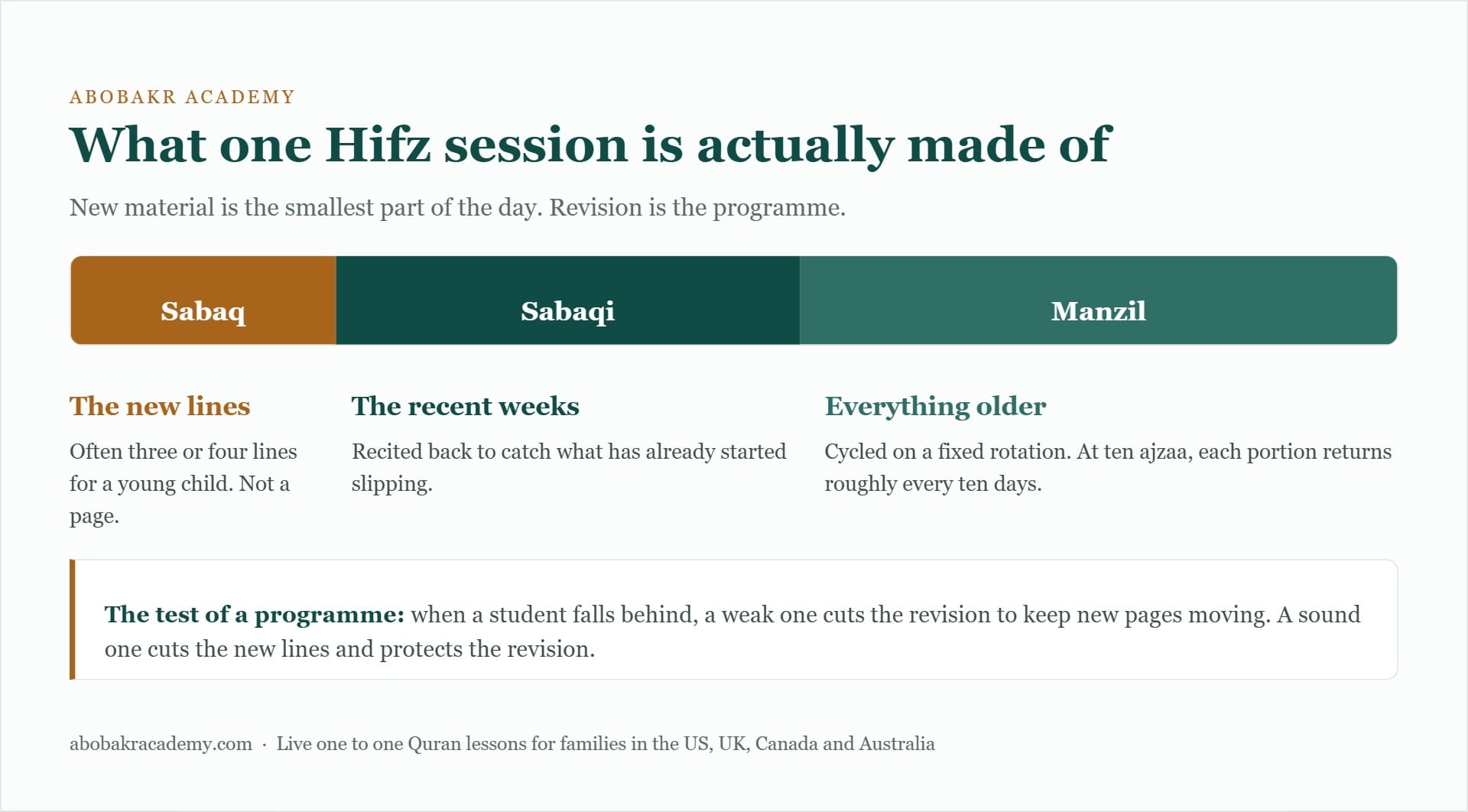
The test of any program is what happens to the revision when a student falls behind. A weak program cuts revision to keep the new pages moving, because new pages are what a parent notices. A sound one cuts the new material and protects the revision. If you ask nothing else on a trial lesson, ask that.
A realistic weekly plan, with the numbers
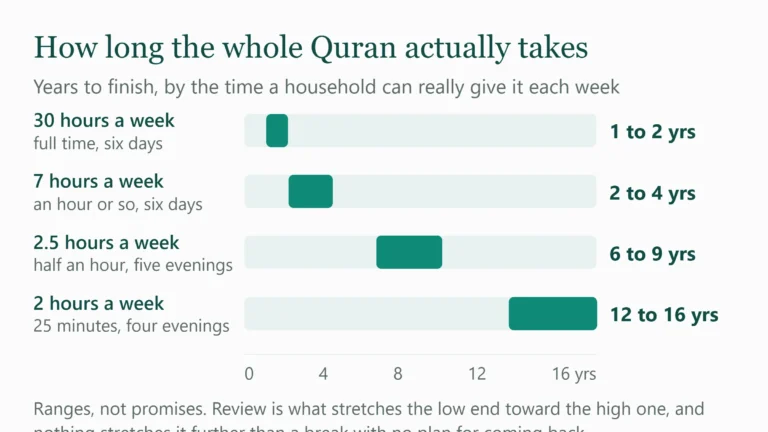
The standard Madani mushaf is 604 pages across thirty ajzaa, so a juz is a little over twenty pages. Every timeline below is just that number divided by an honest pace, and honest means allowing for the weeks when nobody memorizes anything at all.
| Pace | Typical student | Sessions a week | 604 pages takes |
|---|---|---|---|
| 3 to 4 lines a day | Child of six or seven, first year | 4 to 5 | 8 to 10 years |
| Half a page a day | Settled child, eight and up | 5 | 4 to 5 years |
| One page a day | Committed teenager or adult | 5 to 6 | 2 to 3 years |
| Two pages a day | Full-time student, no school alongside | 6 | 14 to 18 months |
The ranges are wide because the arithmetic assumes you miss days, and everybody misses days. Ramadan, illness, exams, travel and the two weeks after a house move all cost pages. A plan built on 365 perfect days a year is not a plan, it is a sales figure.
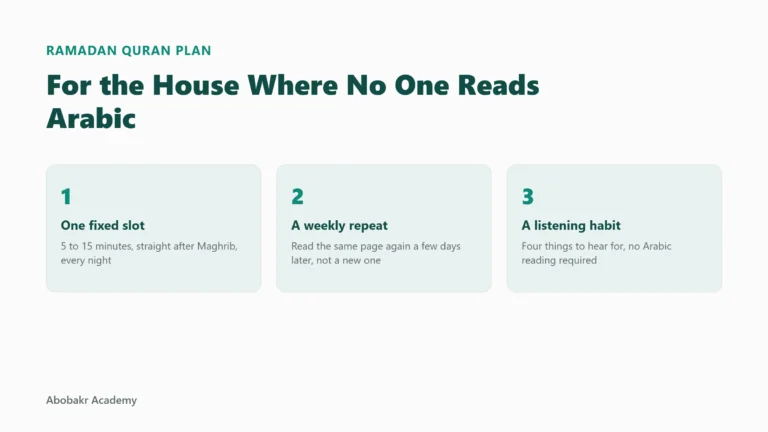
Ramadan specifically is worth planning for rather than just surviving. Our Ramadan Quran reading plan for families who do not read Arabic at home keeps new material to a minimum during the month and leans on the same sabaqi-style weekly repeat described below.
Revision has arithmetic too, and it is the part nobody shows you. Once a student holds ten ajzaa, revising one juz a day means every portion comes back around every ten days. At twenty ajzaa that gap doubles, which is exactly when students who were doing well start losing early surahs. The revision load grows as the memorization grows, and a program that does not plan for that will stall somewhere around juz fifteen.
How long Hifz actually takes
Most academies will not answer this, and the reason is understandable: the honest answer is a range, and a range sells badly against a promise. But the range is knowable.
A child who starts at seven, keeps a half page a day through the school year, and slows over summers, finishes somewhere between thirteen and sixteen. An adult with a job who manages three sessions a week and a page each time is looking at four to six years. Someone doing a page a day with no interruptions can finish in two, and a small number of people do exactly that.
What moves the number is not talent. It is whether the student recites to a teacher daily or twice a week, and whether old material is tested as often as new material is added. Two students at the same pace, one revising properly and one not, will be years apart by juz ten, and the one who skipped revision will be re-memorizing work they already paid for.
Memorizing when nobody at home reads Arabic
This is the situation most of the families we teach are in, and it changes what a parent can usefully do. You cannot check accuracy if you cannot read the script. You can check almost everything else, and the checks are all by ear.
Listen for hesitation at the same place twice. A child who stumbles at the same word on Monday and again on Thursday has not memorized that line, they have memorized the run-up to it. Tell the teacher exactly where it happens.
Ask for a portion from the middle, not the beginning. Say “start from the third line” or name a surah from last month. Memorization that only works from the opening word is chained, not stored, and chained memorization collapses in prayer.
Notice the speed. Fluent recitation of memorized material is even and unhurried. Racing is usually a student outrunning their own uncertainty, and it hides mistakes from an ear that cannot read along.
Count the revision, not the new pages. Ask your child what they revised today, not what they learned. If the answer is regularly “nothing”, the program has quietly become a page counter.
Adults memorizing the Quran
Adults are told they have missed the window. It is not true, and the way it fails for adults is different from the way it fails for children, which is worth knowing before you start.
Adults memorize more slowly per session and retain better per unit of revision. A child will take a page in a morning and lose it in a fortnight without upkeep. An adult often needs three or four sittings for the same page and then holds it more stubbornly, particularly where they understand the meaning, because understanding gives the memory somewhere to attach.
The real obstacle for adults is rarely capacity. It is the consistency of a short daily slot against a week that keeps moving. Fifteen focused minutes every day beats two hours on a Sunday, and every experienced teacher will tell you the same thing. Adults who begin with Juz Amma, take four to six months over it, and revise it to the point of boredom before moving on, tend to still be memorizing three years later. Adults who begin at page one of al-Baqarah usually are not.
What goes wrong, and what it sounds like
Four failures account for most of the students who arrive here having stopped somewhere else.
The pace was set by a calendar. A fixed page-per-week schedule ignores that retention varies week to week. It produces a student who is technically on target and cannot recite juz three.
Tajweed was treated as a separate subject. Mistakes memorized are mistakes preserved. A missed ghunnah or a shortened madd, repeated for six months, becomes the version the student believes is correct, and unlearning it takes longer than learning it did.
Revision was optional. The single most common cause of a stalled Hifz. It shows up as a student who is fluent in what they did this month and vague about anything older.
Nobody tested from the middle. Recitation is checked from the start of the page every time, so nobody notices the memorization is sequential rather than solid until the student stands in prayer and cannot resume after an interruption.
How the memorization program runs here
Lessons are one to one and live. Nothing is recorded, nothing is a video course, and a teacher listens while the student recites, which is the only way a mistake gets corrected in the moment rather than a fortnight later.
Sessions run thirty to a hundred and twenty minutes, and most families choose thirty or sixty. Rates start at 9.50 USD an hour and fall towards 7.00 as monthly hours rise, with monthly plans between 34 and 84 USD and a ten percent discount for siblings. Lessons can be rescheduled with two hours notice, which matters more than it sounds when the plan depends on daily contact. Our teachers are qualified, many of them trained at Al-Azhar, and the Quran teachers hold an Ijazah with a connected chain of transmission.
Students start from the age of four and there is no upper limit. The first lesson is free and runs fifteen to thirty minutes, which is long enough for a teacher to hear where a student actually is and set a pace that reflects it rather than a template.
Questions parents and students ask
How many pages a week should my child be memorizing?
For a settled child of eight or older, two to three pages a week is a sustainable rate that leaves room for revision. More than that is usually borrowed from the revision time and shows up as losses a few months later.
Can my child memorize without knowing Arabic?
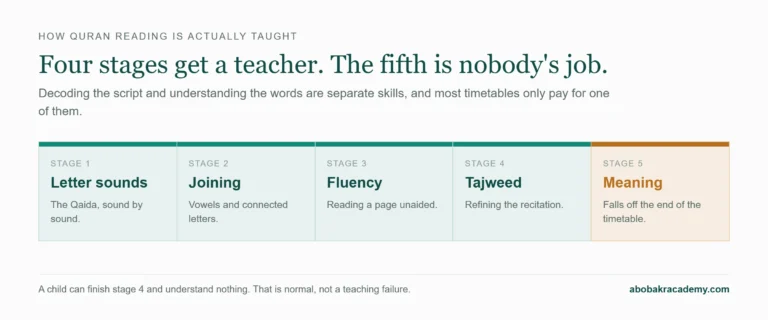
Yes, and most of our students do. Memorization runs on sound rather than comprehension, which is why children who speak no Arabic can hold ajzaa fluently. Understanding is a separate track worth adding, but it is not a prerequisite.
How do I know the memorization is solid if I cannot read Arabic?
Use the four ear checks above. Ask for a portion from the middle, listen for repeated hesitation at the same word, watch the pace, and ask what was revised rather than what was learned.
Is it too late to start as an adult?
No. Expect fewer lines per session than a child and better retention per session. Start with Juz Amma, take months over it rather than weeks, and protect a short daily slot rather than a long weekly one.
What happens if we fall behind?
The new material pauses and the revision continues. That is the correct response, and it is worth asking any academy you are considering how they handle it, because the answer tells you what the program is really optimising for.
Do you offer Ijazah?
Yes. Our Quran teachers hold an Ijazah in Hafs an Asim with a connected chain, and students who complete memorization to the required standard can work towards one.