

Adults comparing online Quran programmes usually weigh the wrong things. Price and website polish are easy to compare, so they get compared. Whether you will still be studying in six months depends on other factors entirely, and most of them are visible before you pay if you know what to ask.
Three things that predict whether you keep going
Adult learners rarely quit because the material was too hard. They quit because the arrangement stopped fitting their week, or because they could not tell whether they were improving.
Whether the teacher can actually hear and correct you
A recorded course cannot tell you that your ha and your haa are landing in the same place. Neither can a class of twenty where you recite once a fortnight. If a programme cannot say how many minutes per session you personally spend reciting aloud while someone listens, that is the answer.
Whether the schedule survives a bad week
Everyone can attend in week one. The question is what happens in week nine when work runs late. Ask what the rescheduling rule is and whether it is written down anywhere. A programme without a stated policy tends to improvise, and improvisation usually favours the academy.
Whether anyone is tracking where you are
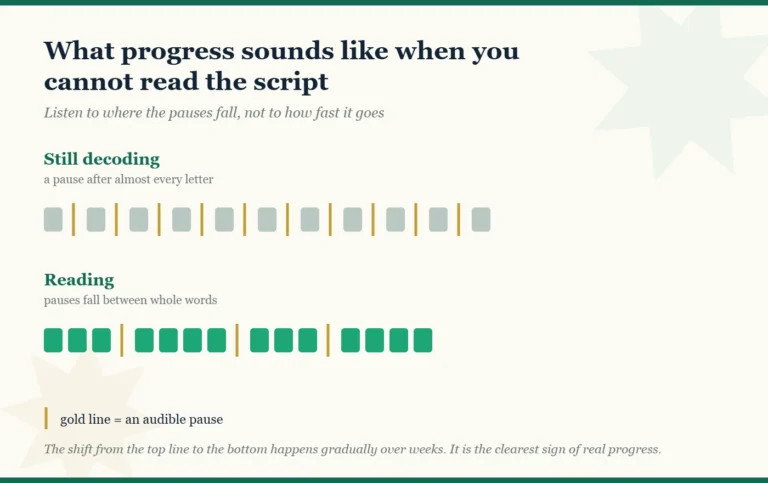
Progress that nobody records is progress you cannot feel. Ask what your teacher writes down after a lesson, and whether you will be told which specific faults you are working on this month rather than a general sense that things are going well.
What a teaching qualification does and does not tell you
Ijazah certification means a teacher recited the Quran to a qualified teacher who certified their accuracy, in a chain of transmission going back to the Prophet, peace be upon him. It is a real credential and worth asking about. Al-Azhar training indicates formal study in the classical sciences rather than self-teaching.
Neither credential says anything about teaching adults specifically. Adults learn differently from children: they want reasons, they get self-conscious about mistakes, and they have limited patience for material that feels childish. A teacher who is excellent with eight-year-olds may be a poor fit for a forty-year-old professional starting from the alphabet. Ask directly how many adult beginners the teacher currently works with.
Also worth knowing: whether the credential belongs to the academy or to the person who will actually teach you. Those are not always the same claim.
Questions worth asking before you pay
Every question below has a correct answer that any established academy should be able to give in writing. Ours are included so you can compare like for like.
What happens if I need to cancel a lesson?
You want a notice period and a monthly allowance, stated in numbers. At Abobakr Academy the notice period is two hours. A weekly subscription includes one cancellation a month; two lessons a week in the same subject includes two. Beyond that allowance, a cancelled lesson counts as taken.
What happens if my teacher disappears?
Teachers move, fall ill and change availability. The question is whether you are handed a replacement or left to chase someone. Our policy is that a replacement tutor is provided when an assigned tutor becomes unavailable for reasons outside their control.
How long is the trial, and is it free?
A trial that is too short only demonstrates that the software works. Ours runs about thirty minutes, which is enough for a teacher to hear you recite and tell you where you actually are. Where a programme charges for the trial, that is stated before you book, and any additional trial is paid in advance.
What am I buying, exactly?
Monthly subscriptions should specify a number of lessons, not a vague amount of access. Ask how many lessons the month includes and what happens to unused ones. Ask when payment is due: ours is due in advance, and a place on a teacher schedule is not held until it is paid.
What is refundable?
Refund policies separate serious academies from the rest quickly. Ours refunds unused lessons. Lessons you have attended are not refundable, which is standard, but it should be stated rather than discovered.
How will we communicate?
Scheduling by memory produces disputes. Confirmations should exist in writing somewhere you can retrieve them. Ours run through the academy WhatsApp number or email, with written confirmation of arrangements.
Our full academy policy sets these out in one place. If a programme you are considering cannot point you to something equivalent, that absence is itself information.
One-to-one and group classes are different products
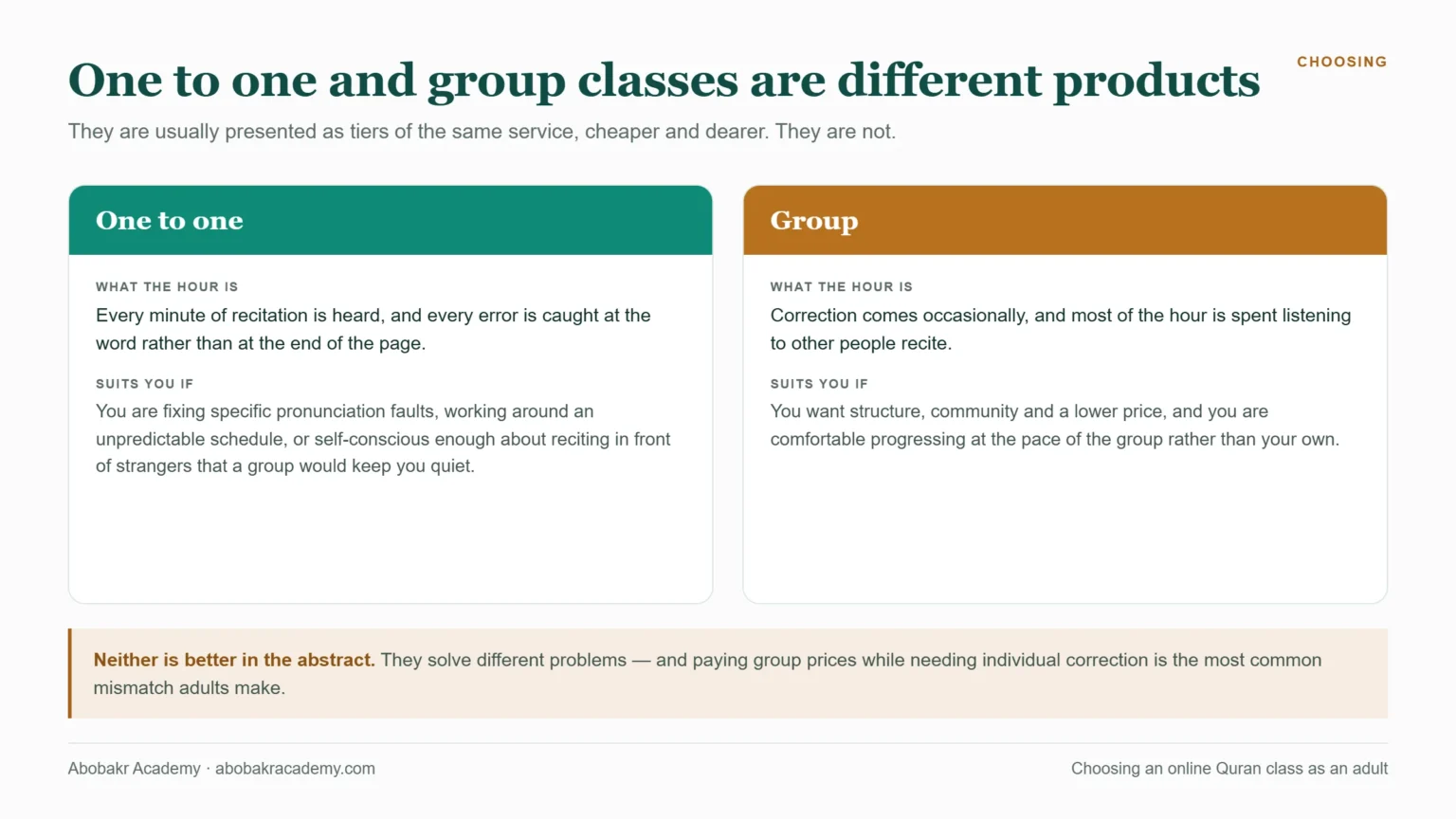
They are often presented as tiers of the same service, cheaper and dearer. They are not. In a group class you receive correction occasionally and spend most of the hour listening. One to one, every minute of recitation is heard and every error is caught at the word rather than at the end of the page.
Group study suits people who want structure, community and a lower price, and who are comfortable progressing at the pace of the group. One to one suits people fixing specific pronunciation faults, working around an unpredictable schedule, or self-conscious enough about reciting in front of strangers that a group would keep them quiet. Neither is better in the abstract. They solve different problems, and paying group prices while needing individual correction is the most common mismatch adults make.
Signals worth taking seriously
- No written policy on cancellations, refunds or payment. Everything is handled case by case, which means handled inconsistently.
- Pressure to buy several months in advance before you have met the teacher.
- The teacher you are shown in marketing is not the teacher you are assigned.
- No trial at all, or a trial that is a sales call rather than a lesson.
- A teacher who lets you finish the whole page before mentioning the mistake you made in the second line. By then you have practised the error eight times.
- Reluctance to say who will teach you or what their background is.
Fitting study into an adult week
The commonest failure is scheduling ambitiously. Someone commits to four lessons a week, manages it for a fortnight, misses three in the third week and stops. Two lessons a week that survive a busy month beat four that collapse.
Consider also when you schedule. A lesson at the end of a working day competes with tiredness. Many adult students do better early, before the day has had a chance to fill up, and lessons are arranged directly between student and teacher rather than dropped into a fixed timetable.
Frequently asked questions
How do I compare two academies that both look professional?
Ask both the same five questions: notice period for cancellations, monthly lesson count, refund rule, replacement teacher policy, and who specifically will teach you. The one that answers in numbers rather than reassurance is the more organised operation.
Is it too late to start reciting properly as an adult?
Adults typically progress faster than children through the early stages, because they can be told a rule once and understand it. The disadvantage is self-consciousness, not capacity. Working one to one removes most of that.
Should I pay more for a teacher with Ijazah if I am a complete beginner?
Not necessarily at the very beginning, where the task is letter recognition and articulation. It matters a great deal once you are reciting connected text and building habits that are difficult to undo later. Many students start with the aim of moving to an Ijazah-holding teacher rather than paying for one on day one.
How many lessons a week do adults usually take?
Two is the most common arrangement among our adult students and tends to hold up across a year. One a week works if you practise between lessons. More than three is generally chosen by people with a memorisation deadline.
What should I expect to be told after a trial?
Something specific. A useful trial ends with two or three named faults and a suggested starting point, not a general statement that you did well. If the feedback could have been given to anyone, it was.
If you want to see how the questions above are answered in practice, book a trial and use them. Our Quran programme for adult learners runs one to one with Al-Azhar trained, Ijazah certified teachers.