
Online Islamic classes with certified tutors, many trained at Al-Azhar, delivered live, one-to-one, directly to your home. Whether you’re in London, Toronto, Sydney, or Dallas, Abobakr Academy brings Quran recitation, Arabic, Tajweed, and Islamic Studies to Muslim children aged 4–16 who grew up speaking English, not Arabic. Every session is personalised, every tutor is qualified with Ijazah, and the first class is completely free, no credit card, no commitment required.
Most Islamic education assumes your child already knows some Arabic. Ours assumes they don’t, and builds from there, in plain English, at exactly their pace.
From the Arabic alphabet to Fiqh of worship, every concept is explained clearly in English first. Arabic is introduced gradually, not assumed from day one.
No sharing attention with 15 classmates. Your child has their tutor’s close attention throughout the session, the surest way to correct Tajweed and Quran recitation properly.
Many of our tutors trained at Al-Azhar, founded 970 CE, and our Quran teachers hold an Ijazah, an authenticated chain of Quranic transmission traced back to the Prophet ﷺ through an unbroken line of scholars.
Saturday mornings. After-school weekdays. Sunday evenings. EST, GMT, CET, AEST, we work around your school run and work schedule, not against it.
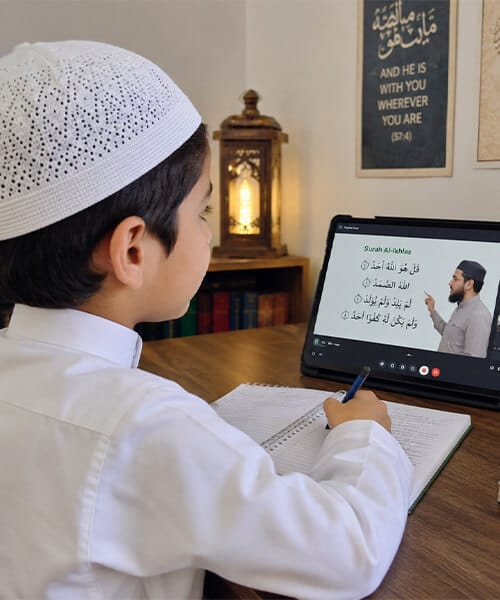
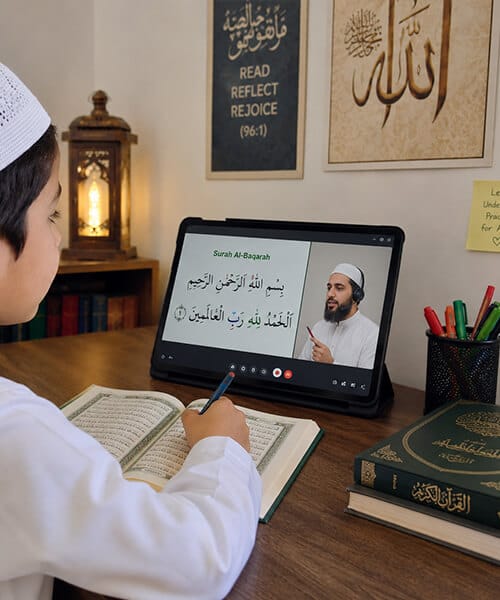
Every online Islamic class at Abobakr Academy is live, one-to-one, and taught by a tutor who specialises in that subject, never a generalist trying to cover everything at once.

Noorani Qaida through Hifz, with correct Tajweed built in from the very first lesson, not added as an afterthought later.
Quran Academy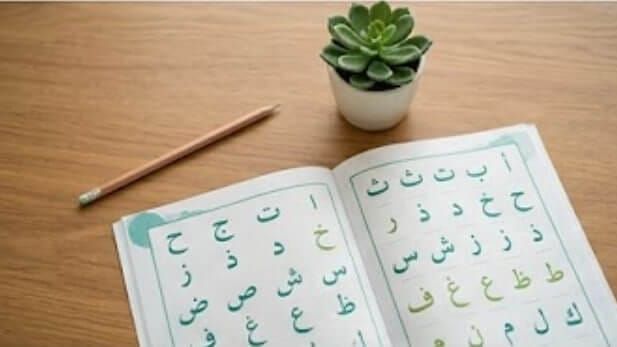
Alphabet, reading fluency, Quranic grammar, explained entirely in English, for children who’ve never seen an Arabic letter in their life.
See the Arabic programme
Every rule, from Noon Sakinah to Madd, taught live, with real-time correction after every recitation. Suitable from age 6 with no Arabic background.
See the Tajweed programme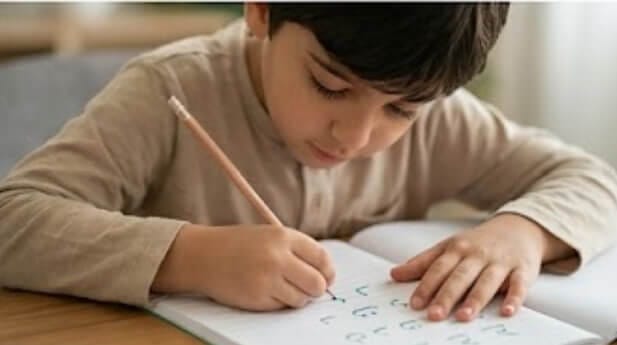
Five Pillars, Seerah, daily duas, Islamic manners and Aqeedah, structured for Western Muslim children who need their faith explained, not just recited.
Enquire NowSend us a WhatsApp message, tell us your child’s age and what you’re hoping to focus on. We’ll recommend the right starting point and book a free trial in under 24 hours.
Help me choose the right classWe don’t have one-size-fits-all online Islamic classes. Every age group has its own approach, pace, and learning style, because a 5-year-old and a 14-year-old are not the same learner.
Arabic alphabet through colour and sound. Short dua memorisation. Prophets’ stories as entry points. Sessions are 20–25 minutes, game-based, with lots of repetition and celebration.
Noorani Qaida completion, first Surahs with Tajweed, introductory Islamic Studies, and beginning Arabic vocabulary. Sessions are 30 minutes, structured but still warm and playful.
Formal Tajweed rules, Hifz pathways, deeper Arabic grammar, and Islamic Studies with real discussion about faith, identity, and practice as a Muslim in the West.
Advanced Tajweed, Ijazah preparation, Quranic Arabic, and Fiqh of daily worship. Some students this age are already aiming to become Hafiz, we support that goal fully.
No complicated enrolment. No waiting lists. A quick WhatsApp message is all it takes to begin.
Tell us your child’s age, level, and which subject interests you. We reply within minutes, not days.
30 minutes with a certified tutor who listens, identifies the starting point, and gives you both a feel for how we teach.
Your tutor builds a roadmap specific to your child’s current level, goals, and the time you realistically have per week.
Weekly sessions at your chosen time. Progress reports sent to parents. Milestones celebrated, every one of them.
We tried two other online Islamic classes before Abobakr Academy. The difference is immediately clear, the tutor actually listens to every word my son recites and corrects it on the spot. In three months, his Tajweed improved more than it had in two years of group mosque classes. I wish we’d found them sooner.
“My daughter refused to go to the local Islamic school after a difficult experience. Online Islamic classes at Abobakr gave her a tutor who is patient, kind, and made her feel capable. She now recites every Friday evening for the family.”
Fatima’s Mother Toronto, Canada“As parents who don’t speak Arabic ourselves, we had no way to check whether what our son was learning was correct. Knowing every tutor has Ijazah, an authenticated chain of transmission, genuinely puts our minds at rest.”
Yusuf’s Parents Melbourne, AustraliaWhen most people search for online Islamic classes, they’re imagining something like a YouTube video, a pre-recorded lecture series, or a large group Zoom session run like a school assembly. What we offer at Abobakr Academy is fundamentally different from all of those, and the distinction has real consequences for how quickly children actually learn.
Our online Islamic classes are live, private, one-to-one sessions between your child and a single certified tutor. The tutor is not sharing their attention with other students, not reading from a script, and not following a rigid syllabus that ignores what the child already knows. Every session is an active, responsive conversation, the tutor listens, corrects, explains differently if something isn’t landing, and adjusts pace based on how that specific child is doing that day.
The most important word in Islamic education is correction. A child can recite Quran incorrectly for years without knowing it, because no one is close enough to hear every word and correct it in real time. That is what one-to-one online Islamic classes actually solve.
This matters most in Quran recitation and Tajweed, where a single mispronounced letter, say, confusing ح and ه, or failing to apply Idgham, can change the meaning of an ayah entirely. Group classes, apps, and videos cannot catch these errors. A private tutor in a live online session can, and does, every time.
For more on the academic research behind one-to-one versus group Islamic instruction, the Quran.com learning resources provide useful context on structured Quran education for non-native speakers.
There are roughly 6 million Muslims in the United States, 3.9 million in the UK, 1.8 million in Canada, and over 800,000 in Australia. The vast majority of Muslim children in these countries are growing up in homes where English, not Arabic, is the dominant language. They attend English-speaking schools, think in English, and process new information most effectively when it is introduced to them in English first.
Yet the majority of Islamic educational resources, even many online ones, are built for Arabic-speaking audiences or for children who already have some Arabic background from home. This creates a gap that too many Western Muslim families are trying to fill with whatever is locally available: an overcrowded mosque class, a semi-qualified volunteer, or an app that can teach letter recognition but not the nuance of correct Quranic pronunciation.
Online Islamic classes designed specifically for English-speaking Western children, like ours, solve this structural problem. According to research published by the Islamic Studies academic community, children who learn Quran and Islamic Studies with pedagogical methods adapted to their first-language environment retain knowledge significantly more effectively than those taught through direct Arabic immersion without support.
The practical reality is this: your child has zero Arabic at home, is exposed to a non-Muslim environment for most of their waking hours, and has limited time between school, homework, and other activities. Online Islamic classes need to respect all of these constraints, and ours are built around them from the ground up.
A typical 30 or 45-minute session at Abobakr Academy follows a rhythm that children become comfortable with quickly, because routine reduces anxiety and lets them focus on learning rather than figuring out what’s happening next.
For Quran and Tajweed sessions specifically, the tutor uses a shared screen to display the Quran text, draws attention to specific letters and vowels, uses audio recordings of expert Qaris as reference models, and, most importantly, listens to every syllable the child produces and corrects it immediately.
For Islamic Studies sessions, conversations are more discussion-based. A 12-year-old in London asking “why do we pray five times a day?” deserves a thoughtful, honest answer that acknowledges the world they actually live in, not a rote recitation of doctrine. Our tutors are specifically trained to navigate these conversations with depth and authenticity.
One of our students in Toronto, a 7-year-old boy who had never seen an Arabic letter, attended 3 online Islamic classes per week for 8 weeks. By the end of that period, he had completed Noorani Qaida lessons 1–12, could recognise all Arabic letters in isolation, had memorised Surah Al-Fatiha with correct pronunciation, and had learned 5 daily duas with their meanings in English. His mother described the moment he recited Al-Fatiha to his grandfather over video call as “one of the best moments of my life as a parent.”
That is what consistent, well-taught online Islamic classes can produce in just two months, for a child starting from absolute zero.
Parents often contact us with a mix of goals: they want their child to read Quran, speak some Arabic, understand Islamic values, and pray correctly, all at once. That’s completely understandable. Here’s a practical way to think about where to begin:
Many families enroll in Quran and Arabic simultaneously, two sessions per week of each. Tutors coordinate to avoid overlap and reinforce each other’s material where possible. Our free assessment session exists specifically to make this decision with expert guidance rather than guesswork. Contact us and we’ll help you decide.
One question we receive constantly is: “we live in California / Queensland / Scotland, do you have slots for us?” The answer is yes, always.
We maintain tutor availability that covers: Eastern Time (New York, Toronto, Boston), Central Time (Chicago, Dallas), Mountain Time (Denver, Calgary), Pacific Time (Los Angeles, Vancouver, Seattle), Greenwich Mean Time (London, Dublin), Central European Time (Berlin, Paris, Amsterdam, Stockholm), and Australian Eastern Standard Time (Sydney, Melbourne, Brisbane).
Slots run from early morning through to late evening, seven days a week. The most popular slots among our Western families are Saturday morning (10 AM local time, any zone) and Tuesday/Thursday after school (4–6 PM local time). We allow rescheduling with two hours notice at no extra charge, because we understand that a child’s school play or a family commitment shouldn’t mean losing a paid session.
We recommend 30-minute sessions for children aged 4–8 (attention span is the limiting factor, not content) and 45-minute sessions for ages 9 and up. For meaningful progress, a minimum of 3 sessions per week is recommended, this allows new material to be introduced, practiced, and revised across the week rather than crammed into one long session. Children attending 5 sessions per week, particularly those on Hifz pathways, progress approximately twice as quickly as those attending twice per week. We are always honest about this with parents so expectations are calibrated correctly.
One thing that distinguishes our online Islamic classes from less structured alternatives is that progress is visible and measurable, not just a vague sense that something is improving.
Every student has a progression tracker that records: Noorani Qaida lessons completed, Surahs memorised with confidence rating, Tajweed rules mastered, Arabic vocabulary acquired, and Islamic Studies topics covered. We share this with parents after each week in a short written update, not a lengthy report, just a clear statement of what was covered, what’s being consolidated, and what’s coming next.
We also encourage parents to create small “performance moments” at home, asking a child to recite a new Surah to a sibling, or explain what Zakat means to a grandparent. These moments do two things: they consolidate learning through active recall, and they create the kind of memory that a child carries for decades. A parent in Sydney told us recently that her son, now 11, spontaneously corrected his own pronunciation mid-recitation during Ramadan, “he self-corrected, like a little Qari,” she said. That’s what well-taught online Islamic classes actually produce over time.
For further reading on evidence-based approaches to children’s Islamic education, the Quran.com platform provides a wealth of structured learning resources that complement live instruction effectively.
The free trial takes 30 minutes. The impact, watching your child recite, understand, and love their faith, lasts a lifetime.
Reserve our free class, message us now