
If your son switches to English the moment he walks in the door, or your daughter understands her grandmother but can’t quite answer her back, you already know why you’re here. Abobakr Academy helps children learn Arabic online through live, one-to-one classes with native-speaking tutors trained specifically to teach kids who grew up abroad — not textbooks written for adults, and not a one-size-fits-all classroom of thirty students. Just your child, a patient teacher, and a plan built around how they actually talk, read, and think.
Whether your family is in London, Toronto, Sydney, or a small town where the nearest Arabic-speaking community is an hour’s drive away, the format stays simple: a laptop or tablet, a fixed weekly time, and a real conversation with a tutor who already knows what it’s like to teach a child who understands some Arabic at home but has never really studied it.
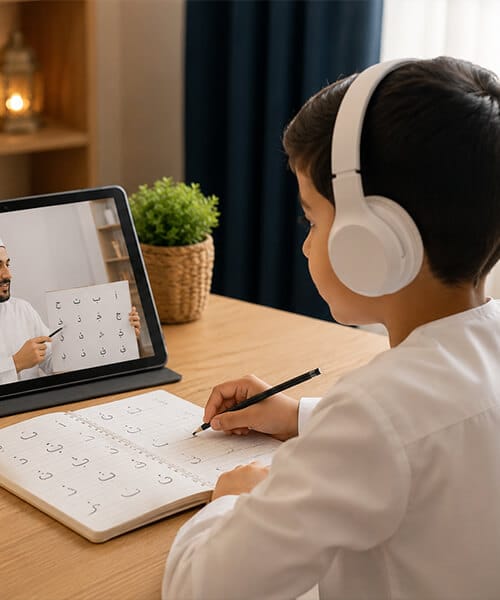
It usually doesn’t happen all at once. It happens in small moments — a word your child reaches for in English because the Arabic one didn’t come fast enough, a phone call with a grandparent that gets shorter every year, a child who can order food in Arabic but couldn’t write you a two-line message. Researchers who study heritage languages describe this pattern in almost every immigrant community: without deliberate, structured practice, a child’s home language plateaus around age five or six while their school language keeps growing. By the teenage years, the gap feels enormous, even though it built up quietly, one skipped conversation at a time.
This is exactly the gap online Arabic classes are built to close. Regular, guided practice with a real tutor — not just passive exposure at home — is what actually moves a child from “understands a little” to “can hold a real conversation, read a paragraph, and write a message to family back home.” The Center for Applied Linguistics has documented this across many language communities: children maintain a heritage language best when parents pair consistent exposure with structured instruction, not one or the other alone.
For Muslim families specifically, there’s a second layer to this. Arabic isn’t only a heritage language — it’s the language your child will meet again every time they read Qur’an, follow a khutbah, or sit in an Islamic studies class. A child who can learn Arabic online comfortably has an easier, faster path into those subjects later, because the letters, sounds, and sentence patterns are already familiar.
A few signs parents mention when they first reach out to us: a child who understands a family video call but rarely speaks up during it, a child who can read some letters but sounds them out one at a time with real effort, or a child who simply says “I don’t know how” the moment they’re asked to write anything in Arabic. None of these mean a child has “lost” the language — they usually mean the language was picked up by ear and never given the structured practice that turns listening into reading, writing, and confident speaking.
The good news is that this is very fixable, and earlier is easier. A child who starts structured Arabic classes online at seven has years to build fluency before the teenage years, when new-language learning naturally slows down and self- consciousness about mistakes tends to rise. That’s not a reason to worry if your child is already older — plenty of families start at nine, eleven, or later with real success — but it’s part of why so many parents choose not to wait.
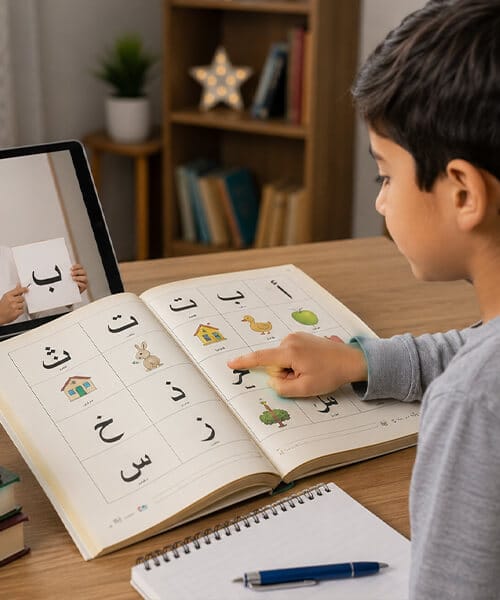
No pressure — just a short chat to see where your child is starting from.
Parents usually ask two things first: will my child actually enjoy this, and will I have to fight them to log on every week? Here’s the honest version of how it runs once a family joins.
A short, relaxed call where we hear your child speak or read a little, so the first real class isn’t a guessing game.
We pair your child with a teacher experienced in Arabic for non-native speakers and kids raised abroad — not a general Arabic teacher used to native classrooms.
Classes run on a schedule that fits your time zone, with real conversation, not just worksheets read aloud on a screen.
Short parent updates so you can see, in plain terms, what your child can now read, write, and say that they couldn’t last month.
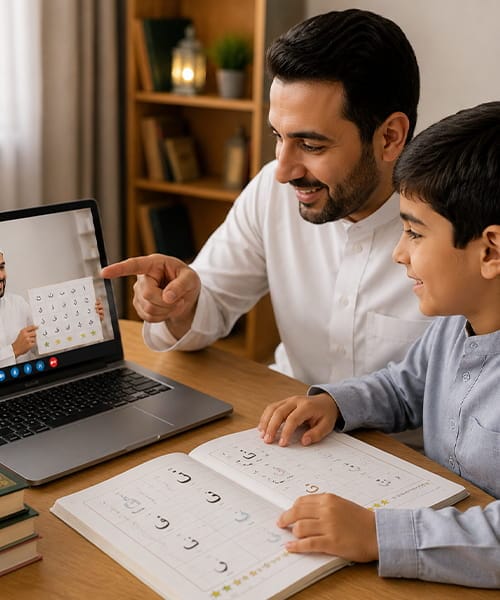
Every class is one teacher and one student, live over video — never a recorded lesson. That matters more than it sounds: a child who mispronounces a letter or freezes on a word gets corrected gently, in the moment, instead of repeating the same mistake for months. It’s also why families searching for Arabic classes online for younger children often prefer this model over group apps — a five- or seven-year-old rarely learns a new alphabet from a screen alone.
A typical 30- to 45-minute session opens with a warm-up in spoken Arabic — simple questions about the child’s day, week, or weekend — before moving into the day’s focus, whether that’s a new set of letters, a short reading passage, or a writing exercise. Tutors keep a visible thread of what was covered the week before, so classes build on each other instead of restarting from zero every time. Parents receive a short note after each class describing what was practiced and what to expect next, so you’re never left wondering what actually happened in the lesson.
Missed a class because of school, travel, or a sick day? Sessions can be rescheduled with reasonable notice, which matters for families juggling multiple children’s activities across different school calendars.
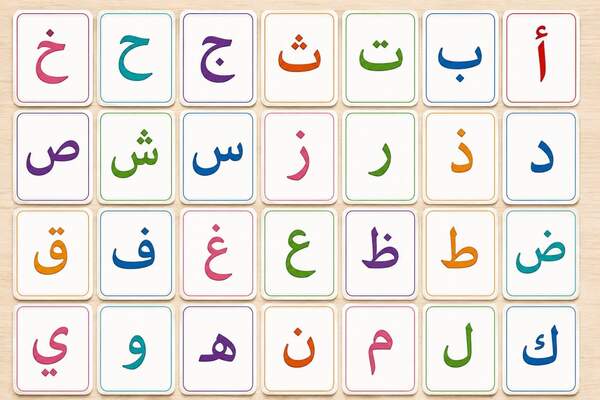
“Curriculum” can sound abstract, so here’s what it looks like in practice for a child working through online Arabic learning at Abobakr Academy. Every stage builds on the last, and a tutor will slow down or speed up based on how your child is actually doing — not a fixed calendar. Because this is a program built to learn Arabic for kids specifically, nothing here is repurposed from an adult beginner’s course; every activity, story, and example is chosen with a young learner’s attention span and interests in mind.
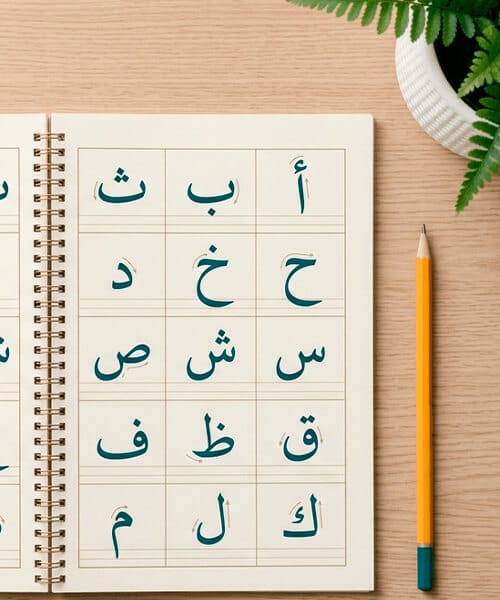
Letter shapes, connecting forms, and sounds — taught the way a native reader was taught, adapted for a child hearing Arabic as a second language.
Moving from sounding out single letters to reading full words, then short sentences, without long pauses or guessing.
Forming letters correctly from day one, so your child can write a real message, not just copy shapes.
Real spoken practice — greetings, questions, family talk — so Arabic becomes something they use, not just study.
Sentence structure introduced through examples and speech first, rules explained second, the way children actually absorb language.
Once reading is solid, we connect it to Qur’anic vocabulary and basic Islamic terms, so the next step into Qur’an classes or tajweed feels familiar, not foreign.
None of these stages are rushed on a fixed timeline. Some children move through the alphabet in a few weeks; others need a full term before reading feels natural, and that’s completely normal. The goal of online Arabic learning at this stage isn’t to finish a workbook — it’s to build a foundation solid enough that your child keeps using Arabic on their own, whether that’s texting a cousin, reading a bedtime story, or, eventually, opening a copy of the Qur’an and recognizing the words on the page.
There’s no shortage of apps and YouTube channels promising quick results. What usually gets a child from “a few memorized words” to genuinely comfortable in Arabic is consistent, personal instruction from someone trained to teach it — and a relationship the child actually looks forward to. We built Abobakr Academy around that idea rather than around flashy features: fewer gimmicks, more of what actually moves a child’s reading, writing, and confidence forward week after week.
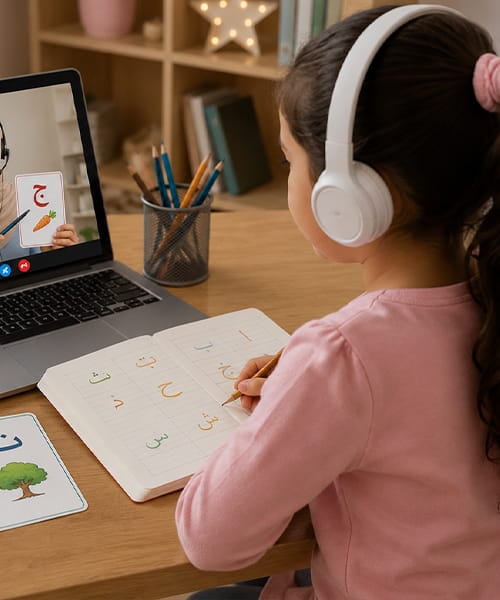
It’s a fair question, and one every parent should ask before signing up for any online program: who is on the other side of the screen? Every tutor at Abobakr Academy is a native Arabic speaker with specific training in teaching Arabic to children who are not being raised in an Arabic-speaking environment. That’s a different skill from teaching a native-speaking classroom in Cairo or Riyadh — it means slowing down at the right moments, explaining a grammar rule in a way a bilingual child understands, and keeping a young learner engaged through a screen rather than in a physical classroom.
Tutors are vetted for both language proficiency and experience working with children, and every class is supervised within a structured curriculum, so your child’s progress isn’t dependent on one teacher’s personal style. If a tutor isn’t the right match for your child’s personality or pace, we’ll pair you with someone else — the goal is a teacher your child genuinely wants to see each week, not just one who’s qualified on paper.
Many of our tutors have taught siblings within the same family, moving from a seven-year-old just learning the alphabet to an older brother or sister already reading short stories, which lets us tailor pacing across a whole household rather than treating each child as a completely separate case.
This is usually the real question underneath “is online learning effective” — and it’s a reasonable one, especially if your child already spends enough time on screens. Here’s what tends to make the difference between a class a child dreads and one they look forward to.
Classes are kept to a length that matches a child’s attention span, not an adult lesson plan squeezed onto a screen.
There’s nowhere to hide and nothing to lose focus on — a tutor’s full attention is on your child the entire time.
Children open up faster with a familiar face they see every week, rather than a rotating cast of instructors.
Classes lean on talking, reading aloud, and light games — not repetitive worksheet drills that feel like extra homework.
Each class ends with something your child can point to — a new word, a sentence read correctly, a letter written cleanly.
You get simple updates so you can encourage progress at home without turning it into a nightly battle over homework.
“My son used to answer his grandmother in English even when she spoke Arabic to him. Six months into his classes, he called her last Eid and read her a message he’d written himself. That alone was worth it.”
— Parent, London, UK“We tried a language app for a year with barely any progress. Two months of live classes and my daughter was already writing short sentences on her own.”
— Parent, Toronto, Canada“What surprised me most was how much my son looked forward to his class. He genuinely likes his teacher, which made all the difference compared to how he felt about Arabic before.”
— Parent, Melbourne, AustraliaRead more real stories from families like yours on our testimonials page, including families who started with almost no spoken Arabic at home.
Online Arabic classes work best when they’re not the only Arabic your child hears all week. You don’t need to be fluent yourself, and you don’t need to turn family life into a language lesson — small, low-pressure habits usually make the biggest difference.
Even a couple of simple, colorful Arabic children’s books on a shelf send the message that Arabic is something you read, not just something you speak.
A short voice note or text to a grandparent in Arabic — even a few words — turns classroom practice into something that feels real and useful.
A short cartoon or kids’ show in Arabic once a week keeps their ear tuned to the language between classes, without feeling like homework.
Noticing when your child reads a new word or uses a phrase unprompted matters more to a child’s motivation than correcting every mistake.
Consistency beats intensity. A child who never misses their weekly class will outpace one who does three classes one week and none the next three.
“What did you learn today?” invites conversation. “Say it in Arabic” on demand often makes a child freeze — save that for the tutor.
None of this needs to feel like a project. The families who see the steadiest results usually aren’t the ones doing the most extra work — they’re the ones who show up consistently for the weekly class and let a few small habits fill in the gaps around it.
Most children do well starting between ages five and seven, once they’re comfortable sitting through a short, focused lesson. That said, we’ve taught complete beginners as late as the early teen years — starting later just means the pace and materials look a little different.
Arabic has its own alphabet and sounds, which makes the first few weeks feel unfamiliar — but children who start young generally pick up the letters and basic reading faster than adults do, especially with one-to-one guidance instead of a large classroom. Children who already hear Arabic at home, even casually, tend to have an even easier time, since the sounds are already familiar and the classes mainly need to build reading and writing on top of what their ear already knows.
Our Online Arabic Academy page covers our full course catalog and levels in detail. This page is written specifically for parents raising children abroad who are deciding whether online Arabic classes are the right first step — think of it as the guide before the enrollment.
We focus on Modern Standard Arabic as the foundation, since it’s what your child will need for reading, writing, and later Qur’anic study. Tutors also weave in everyday conversational phrases so Arabic feels usable, not just academic.
Most families start with two classes a week, which is enough to build real momentum without becoming a burden on a busy school schedule. Some families choose one class weekly to start gently, then add a second once their child is comfortable.
Yes — many families begin here specifically to prepare their child for Qur’an classes, tajweed, and Islamic studies. Reading Arabic comfortably first makes that next step far less overwhelming.
Not sure where to start? These pages can help you find the right fit for your child or family.
Every family we work with started the same way — a quick conversation, one trial class, and a teacher who actually listens to how your child talks and learns. If you’ve been meaning to help your child learn Arabic online for a while now, this is the easiest place to start.
There’s no long-term contract required to try it, and the first conversation costs nothing but ten minutes on WhatsApp. Tell us your child’s age, roughly how much Arabic they already understand, and what your family is hoping for — whether that’s simply keeping the language alive, or building toward Qur’an and Islamic studies down the road — and we’ll suggest a starting point that actually fits.
Free trial class • No obligation • Reply within the day
Further reading on raising bilingual children: the Center for Applied Linguistics’ guide for parents, and the ACTFL Proficiency Guidelines for how language proficiency, including Arabic, is measured at each stage of learning.